How a $5,000 bet turned Kalshi and Netflix into courtroom rivals
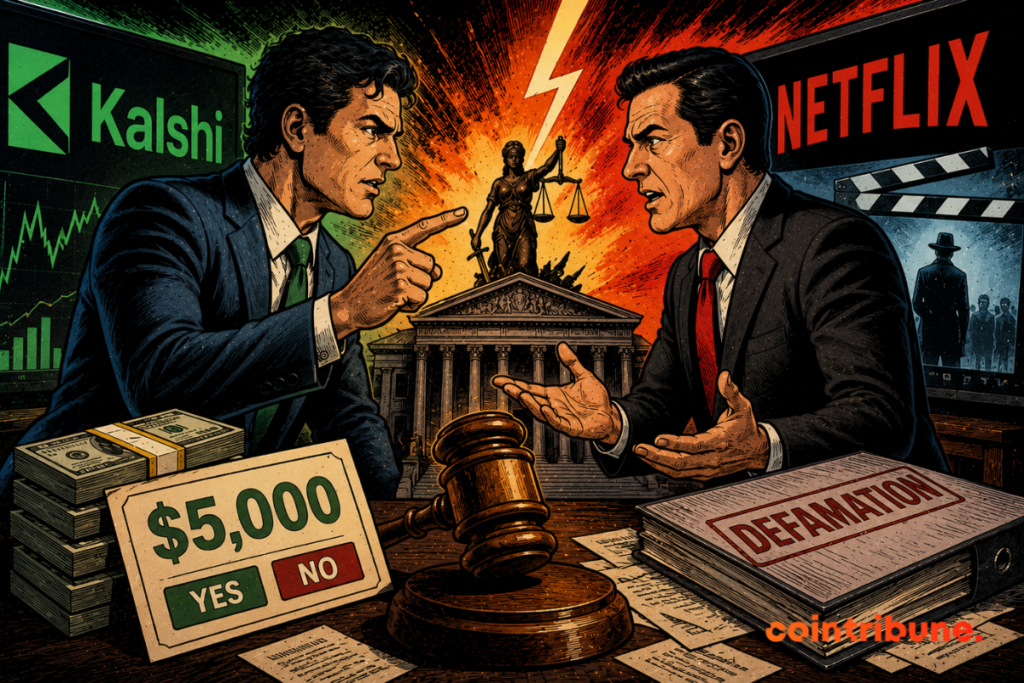
The higher a company climbs, the more dizzying the falls become. Kalshi and Netflix are learning this the hard way, caught in an unexpected legal storm. The streaming giant wanted to tell the story of the rise of prediction markets; it sparked a legal war with one of the industry leaders. A documentary trailer, a betting receipt, and a misinterpreted date: that’s how a simple trailer can turn a partnership into a battlefield.
In Brief
- Kalshi sent a cease and desist letter to Netflix on July 24, 2026, for defamation.
- The trailer shows a $5,000 bet dated May 2025, filmed in July 2026.
- Nevada requires geofencing by August 12 under penalty of $120,000 per day.
- The documentary will air on July 26, the trailer remains online despite threats.
The trailer that landed Kalshi in the crosshairs — and could cost them big
The cease and desist struck like a thunderclap on July 24, 2026. Kalshi, a prediction markets operator, accuses Netflix of defamation in the trailer of the documentary “Instadocs: The Prediction Games.”
The disputed scene takes place in Las Vegas, during the World Cup final weekend. A guest holds up a phone showing a $5,000 bet on Spain. Problem: the receipt is dated May 16, 2025, over a year before the events filmed.
Kalshi claims that the document was fabricated: the word “crop” indicates a simple screenshot, and the term “bet slip” never appears on their platform.
The preview they published shows a completely fabricated Kalshi ticket. Brandon Beckhardt, Kalshi’s marketing director.
The company demands immediate removal of the trailer and a public retraction. However, Netflix holds its line, and the trailer remains online on the eve of the premiere. The legal question is simple: did Netflix knowingly mislead the public about Kalshi’s practices?
Whose story holds up? Netflix and Kalshi battle over what’s real
Netflix presents a defense that sounds like a guillotine: “no images were fabricated“, assures a spokesperson. The scene was filmed at the Winible World Cup Watch Weekend on July 17, 2026. The star trader allegedly showed a screenshot of his bet, placed in May 2025, well before any restrictions in Nevada.
The highlighted bettor, author of the bet on Spain, showed us a screenshot of his bet placed in May 2025, before any Nevada court decisions.
Netflix.
The streaming giant’s defense relies on timing, a clever strategy that could weaken Kalshi’s lawsuit. Yet, this argument raises an ethical doubt: showing an old bet in a scene filmed in Las Vegas in July 2026—isn’t that manipulating the context?
Lawyer Daniel Wallach pointed out a troubling inconsistency: Kalshi claims to have blocked Nevada since May 2026, but transaction evidence was submitted to the court during the same period. This contradiction could seriously undermine the defamation claim.
The battle now lies on the slippery ground of interpretation, where truth slips away like a mirage.
Billions at stake, states pushing back: crypto betting is fighting for survival
Prediction markets grew rapidly in 2025 and 2026. Netflix claims that over $5.6 billion flowed through Kalshi and Polymarket for the 2026 World Cup final alone. These platforms, which allow betting on the outcomes of real events, have become major players in the crypto industry.
However, more than 40 U.S. states accuse them of operating unlicensed casinos, a classification the operators vigorously dispute. Nevada, Michigan, and Washington have already taken restrictive measures.
Kalshi has until August 12, 2026, to deploy a geofencing system, under penalty of a daily fine of $120,000. The casino industry, threatened by this unprecedented competition, is launching a fierce offensive on all fronts.
The federal question remains open: does the CFTC have authority over state gambling laws?
Netflix’s documentary comes at a pivotal moment, as courts must decide fundamental questions about the very nature of these platforms. A misleading trailer could influence public opinion and weigh on upcoming judicial decisions.
X becomes the new courtroom as the Kalshi-Netflix feud goes viral
Brandon Beckhardt, Kalshi’s marketing director, has turned X into a true battleground. “Netflix had a chance to make a really interesting documentary about prediction markets. Instead, they made a sensationalist film built on fiction“, he wrote. He claims the receipt was photoshopped or AI-generated, a serious accusation fueling the controversy.
Internet users followed suit, and their reactions are heating the debate. One user tweeted: “This is a terrible representation of the average winner. We sit in front of our computers all day, we don’t socialize“. Another added: “Weird. These guys are sports bettors, not the principle of prediction markets“. Marshall Cohen, a CNN journalist, also pointed out the geographical inconsistency on X, adding a brick to the media edifice.
Netflix announced the documentary would air on July 26, without confirming any changes to the trailer. Will the documentary survive the media and legal storm?
Key Figures in the Kalshi-Netflix Case
• Cease and desist sent on July 24, 2026;
• Daily fine in Nevada: $120,000;
• Geofencing deadline: August 12, 2026;
• Volume traded on World Cup: $5.6 billion;
• Over 40 states contest prediction markets.
Netflix and Kalshi face off in the spotlight, but this quarrel recalls a deeper debate. In the crypto sphere, people often compare the social utility of Netflix and Bitcoin, one entertaining billions, the other proposing a decentralized currency. At equal energy consumption, which truly serves the public interest? As in the Kalshi case, it’s all a matter of perspective.
Maximize your Cointribune experience with our "Read to Earn" program! For every article you read, earn points and access exclusive rewards. Sign up now and start earning benefits.

La révolution blockchain et crypto est en marche ! Et le jour où les impacts se feront ressentir sur l’économie la plus vulnérable de ce Monde, contre toute espérance, je dirai que j’y étais pour quelque chose
The views, thoughts, and opinions expressed in this article belong solely to the author, and should not be taken as investment advice. Do your own research before taking any investment decisions.