Institutional Trading Changes The future Of Altcoins
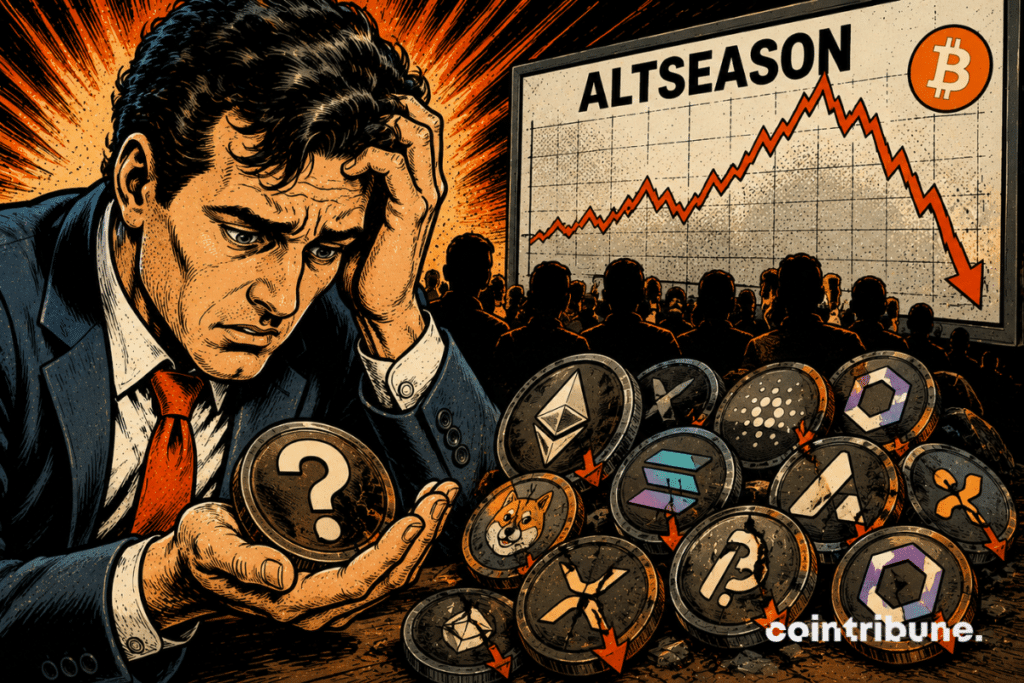
For years, a rule seemed immutable: when bitcoin soared, altcoins followed in its wake. This mechanism, which shaped several bullish cycles, now shows signs of exhaustion. Capital no longer spreads across the entire market but converges towards a handful of favored assets. Thus, the latest Wintermute report reveals this break. The massive influx of institutional investors is reshaping liquidity flows and questions the idea of a generalized altseason.
In brief
- Institutional investors represented 72% of the OTC spot flow at Wintermute in H1 2026, imposing their rhythm on the market.
- Liquidity concentrates on a very limited number of tokens (+24% new tokens traded by institutions versus +76% by retail investors).
- Funds’ activity fades within just 24 hours after a rise, reducing the duration of rallies on altcoins.
- The historical redistribution of Bitcoin profits to small caps has fundamentally disappeared.
The hegemony of institutional OTC flows and the contraction of opportunity windows
Operational data published by Wintermute for the first half of the year show an unprecedented market takeover by large accounts. During this period, institutional counterparties generated 72% of the total OTC spot flow across all cryptos handled by the platform, marking the highest level ever recorded.
This trajectory reflects a continuous acceleration of institutionalization, with the ratio previously at 61% in the second half of 2025 and 59% in the first half of the same year. Beyond this massive volume, the allocation strategy of these actors stands out by extreme selectivity perfectly summarized by the key report figures :
- Record institutional activity : institutional investors represented 72% of the total OTC spot flow at Wintermute in H1 2026, compared to 61% in H2 2025 and 59% in H1 2025 ;
- Increased token selectivity : between H1 2024 and H1 2026, the number of unique tokens traded by institutions increased by only 24%, versus a 76% rise among retail clients ;
- A shortened lifespan of price increases : after a sudden rise in price and volume on a token, institutional activity fades after about 1 day, whereas retail investor activity remains sustained for about 3 days.
This tightening of the range of assets is accompanied by a radical change in the timing of price movements. The observed gap between professionals’ quick profit-taking within 24 hours and the persistence of retail enthusiasm over three days highlights strict execution discipline by funds. They take profits without lingering, thus shortening the life span of speculative waves on altcoins. It therefore becomes clear that upcoming increases in the alternative token segment will be both rarer, narrower, and significantly more ephemeral than during historical cycles.
The break in rotation mechanisms and the new liquidity paradigm
Beyond metrics from OTC trading desks, market indicators confirmed by several analysis firms attest to the end of the classical financial trickle-down model. On June 20, Ki Young Ju, CEO of CryptoQuant, pointed out that the historical rotation of profits derived from bitcoin toward smaller-cap cryptos has fundamentally disappeared. CryptoQuant data indeed indicate that trading volume on altcoin pairs denominated in bitcoin is at historically low levels, close to their lowest performances observed since 2021.
At the same time, the ten largest altcoins excluding stablecoins now concentrate about 80.5% of the total capitalization of this segment. This excessive concentration was also identified by Kaiko as early as July 2025, the data provider noting that these same ten assets captured 63% of the total altcoin trading volume on centralized crypto platforms, compared to about 50% a few months earlier.
This relative scarcity of available capital for secondary projects is also explained by the uncontrolled proliferation of new tokens. On March 15, Andrei Grachev, managing partner of DWF Labs, reminded that too many tokens compete for a limited pool of capital, while institutional decision-makers maintain their near-exclusive focus on bitcoin, Ether and real-world tokenized assets. This fierce competition destroys rally dynamics in favor of targeted sectoral rotations. Hence, economic fundamentals and the real utility of protocols regain a central place in token valuation.
The strategic realignment of investors facing a mature crypto market
This profound shift toward a structured crypto market requires a complete re-evaluation of analysis models and risk management for all stakeholders. The absence of broad redistribution implies that projects lacking institutional anchoring or real operational adoption risk facing prolonged stagnation or even a creeping illiquidity crisis. For retail investors, simply passively holding low-cap tokens while awaiting a widespread speculative frenzy now constitutes a particularly perilous approach.
Future perspectives thus revolve around an irreversible polarization of the ecosystem. On one side, a narrow core of altcoins considered established values and supported by regular professional flows. On the other, a multitude of marginalized projects where volatility no longer reflects fresh capital inflows but the internal redistribution of residual speculation.
Moreover, selectivity imposed by institutional actors marks the definitive entry of the crypto market into a mature phase. The era when mere bullish sentiment sufficed to indiscriminately raise all valuations gives way to an environment governed by metrics, real volume, and the economic relevance of infrastructures. To navigate this new era without falling prey to illiquidity traps, investors will need to demonstrate increased discipline by prioritizing the fundamental quality of assets and rigorously adapting their exposure schedule to now much shorter cycles.
Maximize your Cointribune experience with our "Read to Earn" program! For every article you read, earn points and access exclusive rewards. Sign up now and start earning benefits.

Diplômé de Sciences Po Toulouse et titulaire d'une certification consultant blockchain délivrée par Alyra, j'ai rejoint l'aventure Cointribune en 2019. Convaincu du potentiel de la blockchain pour transformer de nombreux secteurs de l'économie, j'ai pris l'engagement de sensibiliser et d'informer le grand public sur cet écosystème en constante évolution. Mon objectif est de permettre à chacun de mieux comprendre la blockchain et de saisir les opportunités qu'elle offre. Je m'efforce chaque jour de fournir une analyse objective de l'actualité, de décrypter les tendances du marché, de relayer les dernières innovations technologiques et de mettre en perspective les enjeux économiques et sociétaux de cette révolution en marche.
The views, thoughts, and opinions expressed in this article belong solely to the author, and should not be taken as investment advice. Do your own research before taking any investment decisions.