Jensen Huang: Quantum Will Break Today’s Encryption
During his notable appearance on The Joe Rogan Experience on December 3, 2025, Jensen Huang delivered a striking assessment. The head of Nvidia (NVDA), now the world’s most valuable company at $4 trillion, considers artificial intelligence to be a new industrial revolution. But this revolution comes with major security challenges.
In Brief
- Jensen Huang warns that quantum computing will break today’s encryption.
- Naoris Protocol answers with a decentralized, post-quantum cybersecurity mesh.
- Every device becomes a validator, securing Web2 and Web3 at the Sub-Zero Layer.
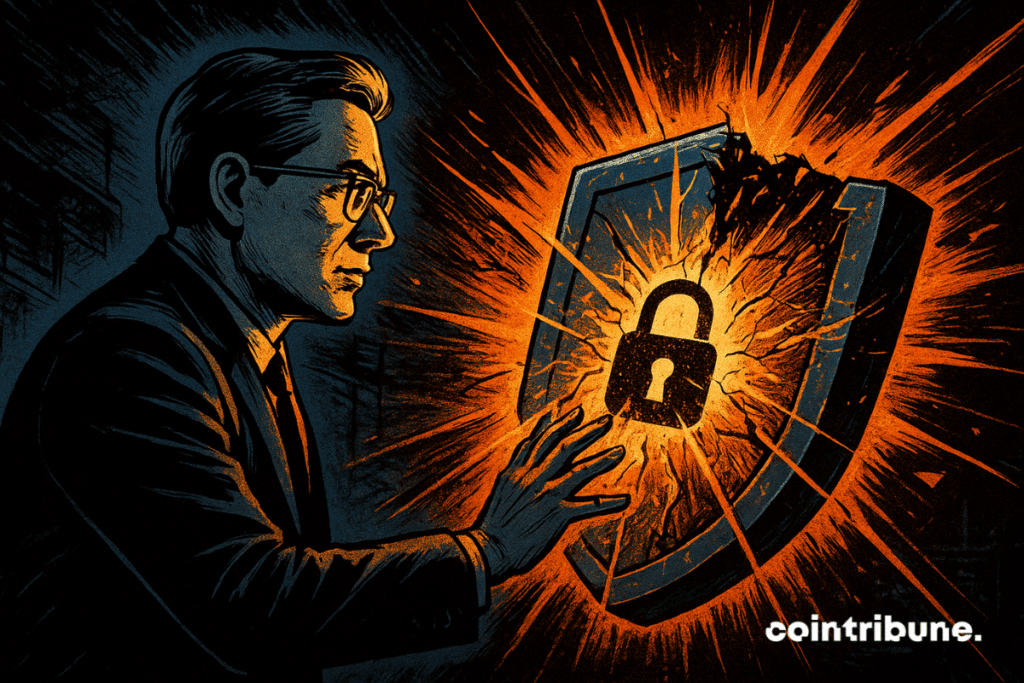
Huang broke down the AI ecosystem into five fundamental layers: energy, chips, infrastructure, models, and applications. At each level, security concerns multiply. The CEO particularly emphasized system vulnerability to the emergence of quantum computing, capable of breaking current encryption methods.
Joe Rogan questioned Huang about the risks of quantum computing collapsing modern encryption. The CEO’s response was meant to be reassuring: AI will, in his view, remain “a click ahead“. Yet experts estimate this quantum threat, dubbed “Q-Day,” could arrive sooner than expected. Shor’s and Grover’s algorithms directly threaten RSA, ECC, and blockchain transaction integrity.
Jensen describes a defense model where all systems work together. That’s exactly how the Naoris Trust Mesh operates: one device detects a threat, and the whole network knows in milliseconds.
The difference? Naoris is decentralized and removes single points of failure.
The Infrastructure Race: United States vs. China
During his presentation at the Center for Strategic and International Studies (CSIS) the same day, Jensen Huang raised the alarm about US-China competition. According to him, building a data center in the United States takes approximately three years, from breaking ground to standing up an AI supercomputer. In China, the equivalent happens within months.
This velocity difference represents a major strategic risk. Huang also highlighted that China has twice the energy capacity of the United States, despite America’s larger economy. AI data centers are extremely energy-intensive, and this asymmetry could compromise US competitiveness in the long term.
The Nvidia CEO remains confident about America’s technological lead in chips. He states that Nvidia is “generations ahead” of Chinese competition. But he warns against complacency: China excels at manufacturing and is catching up.
Naoris Protocol: Decentralized Post-Quantum Cybersecurity
Facing the challenges raised by Jensen Huang, blockchain projects are delivering innovative solutions. Naoris Protocol positions itself as the world’s first Decentralized Cybersecurity Mesh, powered by a quantum-attack-resistant blockchain.
Founded in 2018 by David Carvalho, the project was born from a meeting with Kjell Grandhagen, former Chairman of the NATO Intelligence Committee. His philosophy: “We don’t need to play a better game against cybercriminals, we need to play a different game.” This vision guided the development of a radically new architecture.
The protocol transforms every connected device into a validator node. These nodes mutually verify their integrity in real time, creating a “security hive mind.” When one node detects a threat, the entire network is instantly updated. This approach eliminates the single points of failure inherent in centralized solutions.
Technical Architecture: dPoSec and Post-Quantum Cryptography
Naoris Protocol rests on three major technological pillars. The first is dPoSec (Decentralized Proof of Security), a proprietary consensus mechanism. Unlike Proof of Work or Proof of Stake, this consensus continuously validates the security status of participating devices, establishing a self-validating trust enforcement protocol.
The second pillar is Decentralized SWARM AI. This distributed artificial intelligence coordinates threat detection and response in real time. Thousands of rules are applied to logs to identify malicious patterns. Continuous learning allows the system to evolve against new attacks.
The third pillar, crucial given Jensen Huang’s warnings, is post-quantum cryptography. Naoris uses algorithms aligned with NIST, NATO, and ETSI standards, including Dilithium-5 for signatures and Key Encapsulation Mechanisms (KEM). These algorithms are designed to withstand attacks from future quantum computers.
The Sub-Zero Layer: Securing the Entire Blockchain Ecosystem
Naoris’s major architectural innovation is its positioning at the Sub-Zero Layer, beneath the L0 layer of traditional blockchains. This position enables securing all upper layers (L0, L1, L2), as well as DEXs, bridges, and validators, without requiring hard forks or disrupting existing networks.
This approach directly responds to Jensen Huang’s vision of AI becoming “infrastructure.” Similarly, Naoris aims to become the security substrate of the internet, a trust layer beneath every connected system. The protocol supports both Web2 infrastructure (enterprises, governments, IoT) and Web3 (blockchains, DeFi, NFTs).
The $NAORIS Token: Economics and Use Cases
The native $NAORIS token powers the protocol’s ecosystem. It rewards validator nodes for their participation in network security. Every security validation, every integrity check relies on this token, which the team describes as the “world’s first security currency“.
Target use cases include: defense and critical infrastructure, financial services and banking, telecommunications (3G, 4G, 5G), connected healthcare, autonomous vehicles, and of course, securing existing blockchains against quantum threats.
What This Means for Users
For end users, Naoris Protocol currently offers a browser security extension accessible through its DePIN testnet. Each participating device becomes a validator node, blocking malware, trackers, and threats in real time. Participants accumulate points convertible to $NAORIS tokens at the TGE (Token Generation Event).
For enterprises, the protocol offers shareable real-time proof of compliance. Where traditional security audits are periodic and expensive, Naoris enables continuous, immutable validation of system security status. Partners and regulators can verify cybersecurity posture at any time.
Anticipating the AI-Cybersecurity-Quantum Convergence
Jensen Huang’s December 2025 appearances mark a turning point in awareness of AI-related security issues. His vision of artificial intelligence becoming invisible infrastructure, like electricity or the internet, implies unprecedented security requirements. Quantum threats, even distant ones, must be anticipated now.
Naoris Protocol offers a coherent architectural response to these challenges: decentralization to eliminate single points of failure, post-quantum cryptography to anticipate Q-Day, and distributed AI for adaptive resilience. The project aligns with the DePIN trend revolutionizing digital infrastructure in 2025.
Whether this ambitious vision will materialize at mainnet launch remains to be seen. The coming months will be decisive in evaluating Naoris’s ability to transform a technological promise into real-world adoption.
FAQ
Naoris Protocol is a decentralized cybersecurity infrastructure using blockchain and AI to transform every device into a validator node, with built-in quantum attack resistance.
Future quantum computers will be able to break current encryption algorithms (RSA, ECC). Post-quantum cryptography uses algorithms resistant to these attacks, protecting data and transactions long-term.
You can install the Naoris Testnet browser extension to become a validator node. You’ll accumulate points convertible to $NAORIS tokens at the Token Generation Event.
Mainnet is scheduled for Q1 2026, accompanied by an airdrop and commercial product launches.
Maximize your Cointribune experience with our "Read to Earn" program! For every article you read, earn points and access exclusive rewards. Sign up now and start earning benefits.

The Cointribune editorial team unites its voices to address topics related to cryptocurrencies, investment, the metaverse, and NFTs, while striving to answer your questions as best as possible.
The views, thoughts, and opinions expressed in this article belong solely to the author, and should not be taken as investment advice. Do your own research before taking any investment decisions.