Kraken Unveils Krak Card, Its Crypto Mastercard for Europe
The exchange Kraken officially launched the Krak Card on November 25, 2025, a Mastercard debit card allowing spending of more than 400 cryptocurrencies and fiat currencies. Available for residents of the European Union and the United Kingdom, this card is part of Kraken’s strategy to position itself as an alternative to traditional banks.
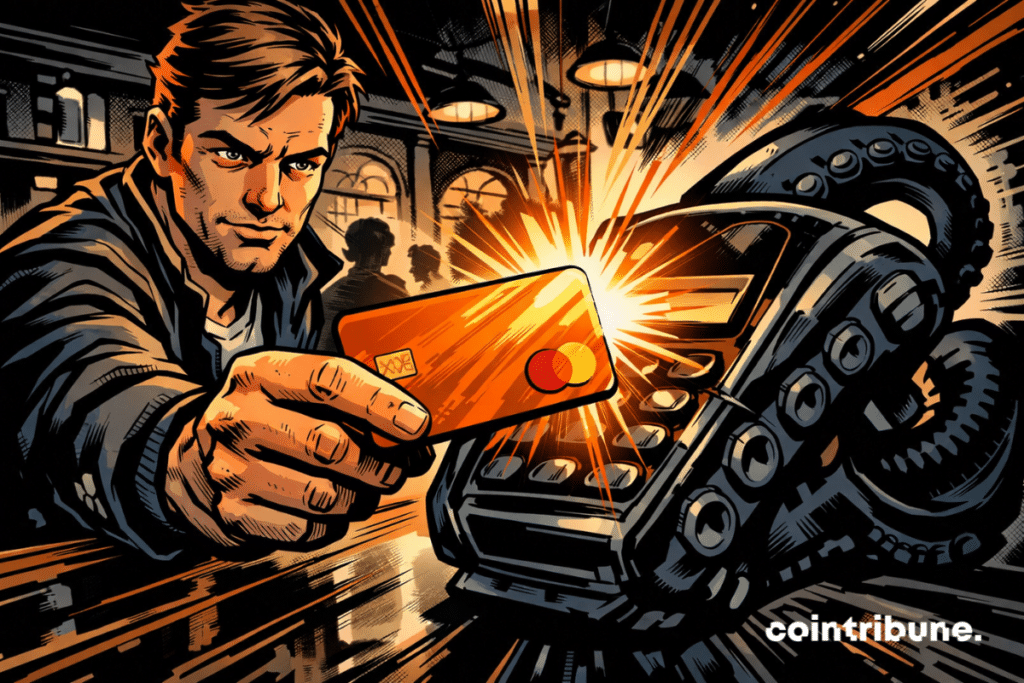
In brief
- Kraken launches the Krak Card, a no-fee crypto Mastercard card.
- More than 400 spendable assets with up to 1% cashback.
- Multi-asset payment, fast activation, and strong regulatory framework.
A no-fee multi-currency crypto card
The Krak Card from Kraken represents a major advancement in the Kraken ecosystem. Backed by the Mastercard network, it allows users to pay wherever Mastercard is accepted, that is more than 150 million points of sale worldwide.
The main argument of this card lies in its multi-asset flexibility. Users can spend from a wallet containing more than 400 cryptocurrencies and traditional currencies. Bitcoin (BTC), Ethereum (ETH), Solana (SOL), stablecoins or euros: everything can be used as a means of payment.
Concretely, if you make a purchase of €100 but your Bitcoin balance only covers €80, the card will automatically draw the remaining €20 from another asset of your choice. This multi-source payment feature eliminates the usual friction related to prior conversion of cryptos.
Up to 1% cashback in Bitcoin or euros
Each transaction made with the Krak Card generates cashback up to 1%. The user chooses to receive this reward in euros, British pounds, or directly in Bitcoin. ATM withdrawals are excluded from this program, and a minimum amount of €0.50 or £ per transaction is required to benefit from the cashback.
The cashback rate varies depending on the volume of assets held on the Kraken and Krak platforms. This approach encourages users to consolidate their holdings within the Kraken ecosystem to maximize their rewards.
Regarding fees, Kraken shows an aggressive policy: no transaction, exchange, or monthly fees. However, a spread applies when assets need to be sold to complete a transaction, as specified in Kraken’s official documentation.
Fast activation and dual format
The Krak Card is available in virtual and physical format. The virtual version can be configured in minutes directly from the Krak app, then added to Apple Pay or Google Wallet for immediate contactless payments.
For plastic fans, two physical cards are offered for free: an orange version and a black version. The order is placed from the application, with no issuance fees.
Access to the card requires completion of Kraken’s or Krak’s KYC (Know Your Customer) procedure. This regulatory requirement ensures compliance with European and British anti-money laundering legislation.
Enhanced security and real-time management
Each transaction is monitored in real-time by Kraken’s systems. In case of a suspicious transaction reported by the user, a provisional credit is granted within 24 hours during the investigation period.
The app also allows setting the priority order of assets used for payments. Users can exclude certain assets they want to keep (e.g., Bitcoin for long-term accumulation) and favor others for daily expenses.
An important point highlighted by Kraken: Krak is not a bank and therefore does not offer deposit guarantees like FSCS (UK) or equivalent insurance. Fiat funds are however segregated into dedicated accounts with regulated banks, in accordance with the EMI licenses held by Kraken.
DeFi yields with Krak Vaults
In addition to the card, Kraken announces the upcoming launch of Krak Vaults, a feature enabling yield generation on held assets. These Vaults connect to independently audited DeFi lending protocols, with announced yields that can exceed 10% APY.
Warning: this yield feature is not available for residents of the European Economic Area, in accordance with local regulatory restrictions. UK users can however access yields up to 3.6% APY on certain eligible balances.
A strong regulatory framework
The launch of the Krak Card is based on an enhanced regulatory foundation. In June 2025, Kraken obtained its MiCA (Markets in Crypto-Assets) license issued by the Central Bank of Ireland. This authorization allows Kraken to operate in the 30 countries of the European Economic Area under a unified regulatory framework.
Kraken also holds an EMI (Electronic Money Institution) license obtained in March 2025 and a MiFID (Markets in Financial Instruments Directive) license since February 2025. In the United Kingdom, the platform has been registered with the FCA (Financial Conduct Authority) for over a decade.
Securing a license from the Central Bank of Ireland (CBI), with its long heritage and experience as a rigorous financial regulator, isn’t just about compliance. It’s a powerful signal of Kraken’s commitment to expanding the crypto ecosystem through responsible innovation.
Arjun Sethi, co-CEO of Kraken, at the announcement of the MiCA license
Krak Card facing the competition
The crypto card market became particularly competitive in 2025. How does the Krak Card position itself against existing alternatives?
The main advantage of the Krak Card lies in its total absence of transaction and exchange fees, combined with support for more than 400 assets. No staking is required to access the basic cashback, cashback levels are determined by the value of assets held on Kraken.
The multi-asset payment feature, allowing multiple fund sources to be combined into a single transaction, also constitutes a notable differentiator compared to most competitors who require payment from a single asset at a time.
What it changes for the European user
For residents of the European Union and the United Kingdom, the Krak Card offers a concrete solution to use their cryptocurrencies daily without complex prior conversion. The ability to receive a salary directly to the Krak account via IBAN strengthens this “all-in-one account” proposition.
One of the benefits of the Kraken Card is that you can use it like a regular card; no more endless declarations, you can directly add a fiat currency (for example, in euros) and settle any expense while generating cashback.
Finally, each crypto payment potentially constitutes a tax event (capital gain or loss) according to the legislation of your country of residence. It is recommended to consult a tax advisor to understand the implications.
Frequently Asked Questions
Residents of the European Union and the United Kingdom who have completed identity verification (KYC) on Kraken or Krak.
The virtual and physical cards are free. No monthly, transaction, or exchange fees are charged by Kraken.
More than 400 assets are supported, including Bitcoin (BTC), Ethereum (ETH), Solana (SOL), stablecoins, and many fiat currencies.
No. Krak is not a bank and does not benefit from deposit guarantee mechanisms. Fiat funds are however segregated in regulated bank accounts.
No, ATM withdrawals are excluded from the cashback program.
Maximize your Cointribune experience with our "Read to Earn" program! For every article you read, earn points and access exclusive rewards. Sign up now and start earning benefits.

The Cointribune editorial team unites its voices to address topics related to cryptocurrencies, investment, the metaverse, and NFTs, while striving to answer your questions as best as possible.
The views, thoughts, and opinions expressed in this article belong solely to the author, and should not be taken as investment advice. Do your own research before taking any investment decisions.