Lagarde Reveals The ECB's Digital Euro Timeline
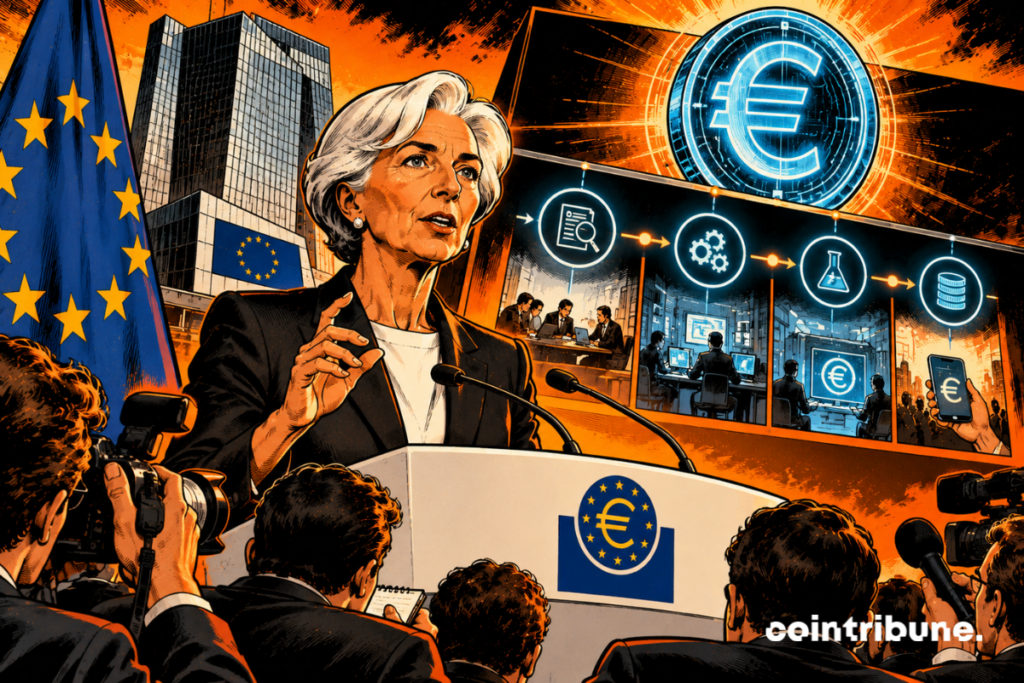
Christine Lagarde believes the eurozone economy is resilient to global shocks and confirms the progress of the digital euro project. Its arrival is however not imminent for the public: the ECB plans an internal pilot in the second half of 2027 and could only proceed to a first issuance in 2029, subject to prior adoption of the European regulation.
In Brief
- The ECB plans the first tests for the digital euro in the second half of 2027, before a possible issuance in 2029.
- The launch depends on the adoption of the European regulation and final approval by the ECB.
- The digital euro aims to reduce Europe’s dependence on foreign payment solutions.
- Christine Lagarde highlights the resilience of the eurozone despite trade, energy, and geopolitical tensions.
- The ECB anticipates gradual growth but remains vigilant against inflation and cybersecurity risks.
A Pilot for the Digital Euro Planned for the Second Half of 2027
The President of the European Central Bank presented on October 17 the next steps of the project during the annual meetings of the International Monetary Fund. The immediate priority is the adoption of the European legal framework before the end of 2026.
The official timeline remains subject to several conditions :
- The European Parliament and the Council must adopt the regulation on the digital euro ;
- The ECB will decide on issuance only after this legislation is adopted ;
- An internal twelve-month pilot must begin in the second half of 2027 ;
- The tested version will not have legal tender status and will not constitute a true digital euro ;
- A first issuance could take place in 2029 if the previous steps succeed.
The ECB has already launched a call for applications from online and mobile merchants in the eurozone. Selected participants will test a beta version in a controlled environment with national central banks and payment service providers.
The project must reproduce real-life situations, such as in-store payments, online purchases, or transfers between individuals. Tests will focus on security, ease of use, integration into merchant systems, and the infrastructure’s capacity to operate at large scale.
Christine Lagarde explained :
To prepare a smooth and secure launch, we will conduct an internal twelve-month pilot in the second half of 2027.
She added that adopting the regulation before the end of 2026 was essential to meet this timeline.
The ECB Wants to Reduce Dependence on Foreign Players
The digital euro would be an electronic form of central bank money intended for daily payments. It would complement banknotes and coins without replacing them. Individuals and businesses could use it throughout the eurozone through banks or other authorized providers.
For the ECB, the project addresses a sovereignty issue. Much of European electronic payments currently rely on international card groups, foreign technology platforms, or private solutions whose access depends on commercial decisions.
The digital euro must provide a common public infrastructure while maintaining coexistence with private payment means. Christine Lagarde believes it will promote innovation and competition in retail payments and strengthen Europe’s strategic autonomy.
The ECB also promises a higher level of privacy than traditional commercial solutions. It asserts that it would not seek to identify individual purchases. For offline payments, data would only be known to the payer and the beneficiary, according to the currently envisaged architecture.
The project should not be confused with Pontes, the solution using distributed ledger technology launched by the Eurosystem on September 21. Pontes concerns the settlement of tokenized assets between financial institutions. The digital euro targets, for its part, everyday payments by individuals and merchants.
A Resilient Economy, But Still Exposed to Risks
Christine Lagarde also described a stronger-than-expected eurozone economy despite trade tensions, the Middle East conflict, and the energy shock. Growth was spread across several countries and sectors in the first half of 2026.
The ECB’s September projections anticipate growth of 0.9% in 2026, then 1.4% in 2027 and 1.5% in 2028. The recovery of real incomes, labor market resilience, and spending on infrastructure, defense, and artificial intelligence should support activity.
Risks remain tilted downward for growth and upward for inflation. A prolonged Middle East conflict could keep energy prices at a high level. Trade tensions and protectionist policies also weigh on investments.
The ECB considers eurozone banks sufficiently capitalized and liquid to face these uncertainties. It is, however, concerned about risks related to critical technology providers, concentration of digital services, and new cyber threats fueled by artificial intelligence.
The digital euro is thus part of a broader financial strategy. It must modernize European payments, but its launch still depends on a political decision, a successful pilot, and a final vote by the ECB Governing Council.
Maximize your Cointribune experience with our "Read to Earn" program! For every article you read, earn points and access exclusive rewards. Sign up now and start earning benefits.

Diplômé de Sciences Po Toulouse et titulaire d'une certification consultant blockchain délivrée par Alyra, j'ai rejoint l'aventure Cointribune en 2019. Convaincu du potentiel de la blockchain pour transformer de nombreux secteurs de l'économie, j'ai pris l'engagement de sensibiliser et d'informer le grand public sur cet écosystème en constante évolution. Mon objectif est de permettre à chacun de mieux comprendre la blockchain et de saisir les opportunités qu'elle offre. Je m'efforce chaque jour de fournir une analyse objective de l'actualité, de décrypter les tendances du marché, de relayer les dernières innovations technologiques et de mettre en perspective les enjeux économiques et sociétaux de cette révolution en marche.
The views, thoughts, and opinions expressed in this article belong solely to the author, and should not be taken as investment advice. Do your own research before taking any investment decisions.