Mira Murati Unveils First AI Model Since Leaving OpenAI
For her first technological speech since leaving OpenAI in September 2024, Mira Murati makes a big impact. The former chief technical officer has just unveiled the first AI model from her startup Thinking Machines Lab with a fully assumed ambition: to bet on open source to redefine corporate data sovereignty.

In brief
- Thinking Machines publishes Inkling, its first artificial intelligence model.
- Mira Murati, former CTO of OpenAI, leads this new AI-focused lab.
- Inkling takes an open source approach to encourage contributions from researchers and developers.
- The initiative stands out from the strategies favored by several major AI players.
A new AI breaking with the closed models paradigm
Named Inkling, Mira Murati’s AI model is based on a Mixture-of-Experts (MoE) architecture. According to the official Thinking Machines announcement, it has 975 billion parameters. However, it only activates 41 billion per token of processed text. The result: a artificial intelligence that is more performant, faster, and less costly to run than a traditional massive model.
Designed as a customizable base via the Tinker tuning tool, Inkling natively accepts text, visual, and audio data. It handles context that can reach 1 million tokens, about 750,000 words. This revolutionary AI model was even pre-trained on 45 trillion tokens.
But its greatest particularity lies in its mode of distribution. The full weights are indeed published for free on Hugging Face under an Apache 2.0 license, without restrictions on commercial use.
Decoding: any company can download, host, and modify locally the AI algorithm. A software decentralization approach that breaks with the technical and economic dependence on proprietary APIs from OpenAI and Google!
In this context, Thinking Machines highlights an important point in its official release: Inkling is primarily aimed at research and experimentation. The AI model is therefore at the community’s disposal. In other words, researchers, developers, and engineers can study it, improve it, and design new applications. An approach that fully reconnects with open source principles.
With Inkling, Mira Murati reignites the AI infrastructure war
On MCP Atlas, a benchmark that measures the reliability of an AI agent to perform real tasks via the standard MCP (Model Context Protocol), the AI model scores 74.1%, compared to 44.7% for Nvidia’s Nemotron 3 Ultra. This is its main Western competitor in open source AI.
On SWE-Bench Verified, which evaluates an agent’s ability to autonomously fix real software bugs on GitHub, it reaches 77.6%. It also takes the lead over Nemotron.
On Teminal Terminal Bench 2.1, Inkling is largely outperformed by Z.ai lab’s GLM 5.2: 63.8% versus 82.7%. Kimi K2.6 also dominates Humanity’s Last Exam, a scientific reasoning test at a doctorate level.
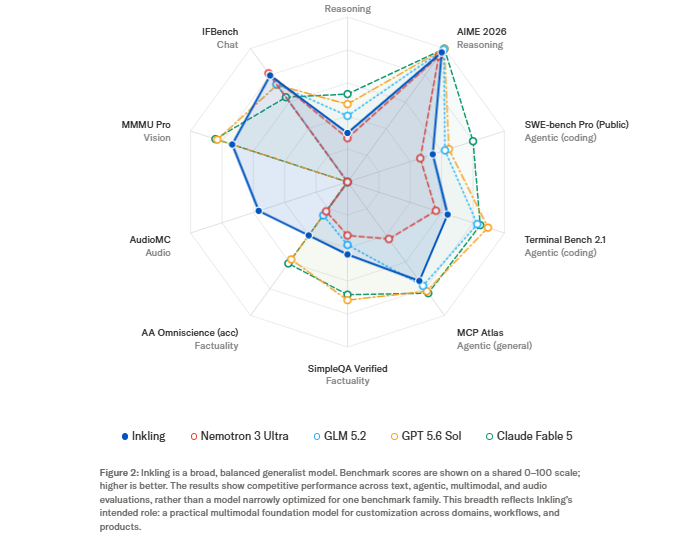
Thinking Machines straightforwardly acknowledges the results by stating:
Inkling is not the most powerful model available today, open or closed.
Analysts nevertheless emphasize a point less highlighted by the official release: Inkling’s MoE design. It closely follows the architecture of DeepSeek-V3, a Chinese open source AI model that shook the market in 2025.
Important:
When a US lab supposed to offer an alternative to Chinese open source AI builds its first model on largely Chinese foundations, it only confirms the facts: the best open source models on the market today remain mostly Chinese.
Towards an economic reshaping of the artificial intelligence market?
Through Inkling, Mira Murati is not content to add an open source option to the AI market. She also intends to disrupt the sector’s current dynamics. Especially since Inkling will have to compete with well-established companies like OpenAI, Google, and Anthropic.
In the long run, two trajectories are emerging.
- On one hand, private and hybrid cloud giants could massively integrate Inkling to appeal to highly regulated sectors such as financial markets and healthcare.
- On the other hand, the pressure exerted by this high-level open source alternative could force closed system providers to drastically lower access costs to their own services to avoid developer exodus.
In any case, the global AI industry is entering a major strategic turning point. The battle for control of enterprise intelligence is no longer played solely on server size. The freedom granted to developers now occupies a central place.
Maximize your Cointribune experience with our "Read to Earn" program! For every article you read, earn points and access exclusive rewards. Sign up now and start earning benefits.

My name is Ariela, and I am 31 years old. I have been working in the field of web writing for 7 years now. I only discovered trading and cryptocurrency a few years ago, but it is a universe that greatly interests me. The topics covered on the platform allow me to learn more. A singer in my spare time, I also cultivate a great passion for music and reading (and animals!)
The views, thoughts, and opinions expressed in this article belong solely to the author, and should not be taken as investment advice. Do your own research before taking any investment decisions.