Nasdaq-100 Welcomes SpaceX In A Historic Market Move
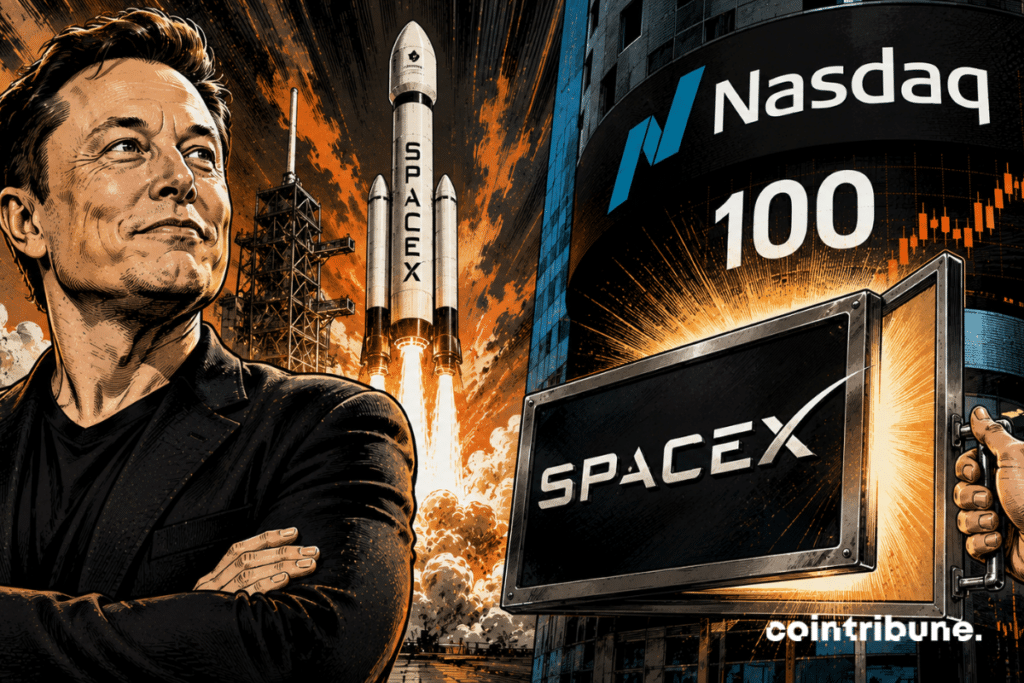
The evolution of global stock indices is often used as a barometer to measure the impact of technological and industrial waves that are redefining our century. Less than a month after a historic IPO, the aerospace company SpaceX will take a new decisive step on July 7, at market open, by joining the Nasdaq-100 index. This decision represents a major change for the valuation of Elon Musk’s firm and for all capital flows on an international scale, marking the rapid convergence between major industrial powers and the automation mechanisms of passive investments.
In Brief
- SpaceX is about to join the Nasdaq-100 less than a month after its IPO, a decision that marks a turning point for financial markets.
- A change in Nasdaq rules allowed the space giant to access the index in record time thanks to its $2 trillion valuation.
- SpaceX’s arrival will trigger automatic purchases of tens of billions of dollars by ETFs and index funds replicating the Nasdaq-100.
- This momentum is based on SpaceX’s industrial strength, including space launches, Starlink, and financing of future Mars missions.
From Stock Market Launch to Nasdaq-100 : A Disrupted Regulatory Timeline
From its first day of trading, SpaceX experienced a meteoric stock rise, fueled by impressive financial performance. To understand the scale of this growth, here are some highlights :
- The IPO was carried out on Nasdaq on June 12 under the ticker $SPCX, with an initial price of $135 per share ;
- The public offering raised a historic sum of about $85.7 billion, including an overallotment option, making it “the largest IPO in history by a wide margin” ;
- By the end of the first trading day, investor enthusiasm pushed the closing price to around $161 ;
- This immediate jump pushed SpaceX’s total market capitalization beyond $2 trillion, granting it instantly a prime position among the most valued public entities on the planet.
This inclusion in a benchmark index results from a recent strategic revision of Nasdaq’s eligibility criteria. Normally, young listed companies have to endure a long observation period before hoping to be among the top one hundred in the index. However, Nasdaq has changed its regulations. The new rules state that “the revised policy allows newly listed companies ranked among the top 40 by market capitalization to be admitted to the Nasdaq-100 after only 15 days of trading”.
SpaceX comfortably met this valuation criterion with its $2 trillion capitalization, which allowed it to bypass the usual waiting periods and establish itself officially.
The Wave of Passive Capital and Mandatory Mechanics for Managers
SpaceX’s entry into the index will trigger a colossal automated purchase due to index management rules. This inclusion will force every exchange-traded fund (ETF) and mutual fund replicating the Nasdaq-100 to acquire $SPCX shares, regardless of their managers’ discretionary choices.
This is the very principle of passive investing: if a stock is in the index, the fund is legally required to hold it. Initial market flow models “suggest that adding SpaceX could trigger an influx of $22 billion or more demand from funds following the index alone”.
SpaceX already has marginal exposure via global market ETFs such as VTI and ITOT, which replicate broader indices like CRSP or S&P total market benchmarks, but the Nasdaq-100 represents a much more aggressive liquidity vector. The Invesco QQQ ETF, which alone manages several hundreds of billions of dollars in assets, will need to absorb a significant portion of these shares to adjust its holdings. It should be noted that SpaceX is still ineligible for the S&P 500, whose financial and time inclusion criteria are much more restrictive, leading institutional investors to focus solely on the Nasdaq index.
Industrial Foundations and the Deployment of Capital for Deep Space
This exceptional stock valuation is based on concrete operational realities and two distinct business models within the group. The first pillar relies on the historical activity of satellite and spacecraft launches, structured around reusable rockets that have profoundly disrupted the economy and cost of access to Earth orbit. The second pillar is embodied by Starlink, its high-speed satellite constellation, which has become a global connectivity platform with millions of active subscribers. This telecom activity was already worth several hundred billion dollars in private fundraising before its stock market debut.
With a total workforce of about 22,000 employees, the $85.7 billion raised during the IPO now provides SpaceX “a significant war chest to finance its ambitious projects, including the Starship program targeting missions to Mars and deep space exploration”. On the eve of July 7, the implications of this index restructuring call for careful analysis. In the short term, the arrival of a $2 trillion company will inevitably cause the exclusion of the smallest capitalization in the index and modify the weighting of all other components.
If the prospect of a mechanical inflow of $22 billion in capital is a powerful catalyst, financial market history advises caution, as inclusion movements often result in a speculative rise ahead of the effective date, followed by a stabilization phase once mandatory purchases are completed. The average saver will see the effect immediately because automatically any QQQ fund holder will become a shareholder of SpaceX, illustrating contemporary dynamics of passive capital concentration around mega-capitalizations of the tech industry.
Maximize your Cointribune experience with our "Read to Earn" program! For every article you read, earn points and access exclusive rewards. Sign up now and start earning benefits.

Diplômé de Sciences Po Toulouse et titulaire d'une certification consultant blockchain délivrée par Alyra, j'ai rejoint l'aventure Cointribune en 2019. Convaincu du potentiel de la blockchain pour transformer de nombreux secteurs de l'économie, j'ai pris l'engagement de sensibiliser et d'informer le grand public sur cet écosystème en constante évolution. Mon objectif est de permettre à chacun de mieux comprendre la blockchain et de saisir les opportunités qu'elle offre. Je m'efforce chaque jour de fournir une analyse objective de l'actualité, de décrypter les tendances du marché, de relayer les dernières innovations technologiques et de mettre en perspective les enjeux économiques et sociétaux de cette révolution en marche.
The views, thoughts, and opinions expressed in this article belong solely to the author, and should not be taken as investment advice. Do your own research before taking any investment decisions.