Quantum threat : Michael Saylor warns of a risk of global digital collapse
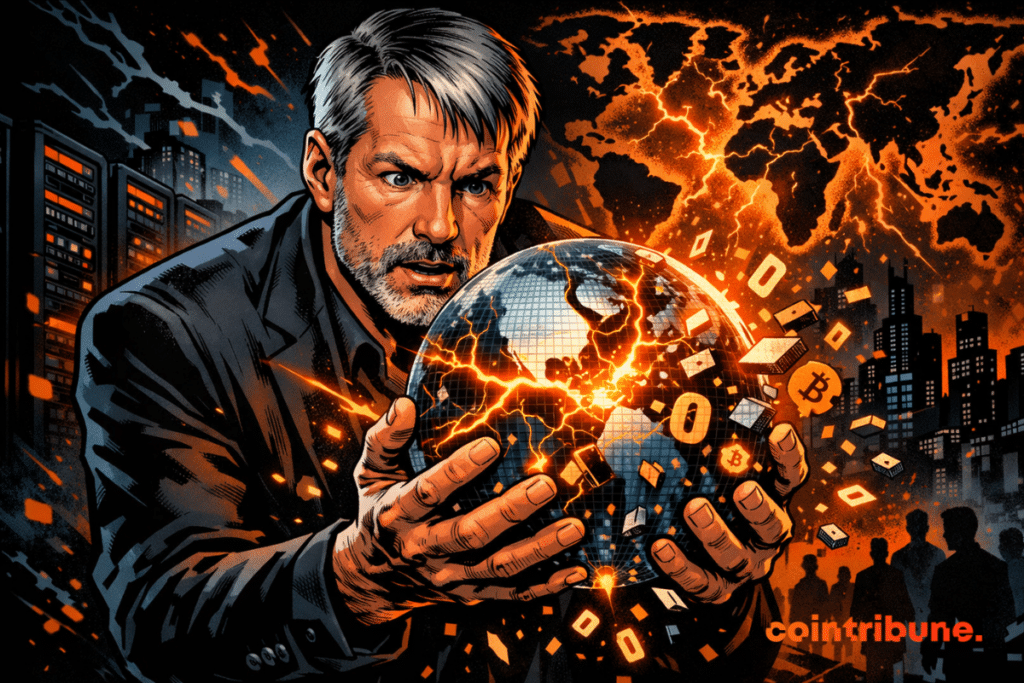
The debate around the quantum threat takes on new weight in the crypto ecosystem. This time, it pits Michael Saylor against Chamath Palihapitiya. On one side, an analysis focused on the effects of artificial intelligence. On the other, a more global reading of the technological risk. Thus, this confrontation revives concerns about the stability of the global digital world.
In brief
- Michael Saylor warns of a global risk: a quantum breakthrough could weaken the entire digital system.
- The debate pits two visions: AI destabilizes companies, while Bitcoin attracts capital as an alternative asset.
- The quantum threat is not limited to Bitcoin and could impact banks, cloud, and Internet simultaneously.
- Bitcoin’s future will depend on its ability to adapt to advances in quantum computing.
Crypto debate : two opposing visions of technological risk
It all starts with a post by Chamath Palihapitiya on X. He develops a thesis on “terminal value collapse.” According to him, artificial intelligence greatly reduces the cost of disruption. As a result, companies struggle to anticipate their revenues over multiple years.
Then, he explains that competitive advantages are becoming increasingly temporary. In this context, markets could undergo significant corrections. This potential instability worries several observers in the financial sector.
In response to this analysis, Michael Saylor proposes a different reading. He believes this uncertainty favors the emergence of alternative assets. According to him, Bitcoin attracts capital because it escapes traditional economic models.
Bitcoin and digital capital : an answer to market instability
Michael Saylor presents Bitcoin as a rare and independent digital capital. Unlike companies, it does not depend on growth projections or future revenues. Thus, it stands out in an environment marked by uncertainty.
Moreover, he points out that Bitcoin resists better the rapid transformations induced by AI. Indeed, it does not rely on classic competitive advantages. Consequently, it will be the sole beneficiary of this evolution and some investors may see it as a form of stability.
If AI reduces long-term value and makes competitive advantages temporary, capital will shift towards more resilient assets. In this context, Bitcoin, as a rare and neutral digital capital, will be the main beneficiary.
However, Chamath Palihapitiya remains cautious. He recalls that Bitcoin still faces several major technological challenges. Among them, the threat related to quantum computing remains central in the debate.
Quantum threat and security : a global risk according to Saylor
The quantum threat then becomes a key point of discussion. Chamath Palihapitiya believes Bitcoin will have to prove its resistance to this technology. He suggests this step will be decisive for its future.
Michael Saylor responds clearly. According to him, limiting this risk to Bitcoin is an analytical mistake. He explains that quantum computing could weaken the entire digital infrastructure, stating:
If quantum breaks cryptography, it breaks AI, cloud infrastructure, banks, and the internet—not just Bitcoin. The entire stack upgrades together.
Indeed, if current cryptographic systems are broken, several sectors would be affected simultaneously. Banks, cloud services, and the Internet rely on similar mechanisms. Thus, such a technological advance would have global consequences.
Quantum threat and the future of digital : a systemic issue
Ultimately, this debate goes far beyond cryptocurrencies. The quantum threat raises a central question about digital security. It concerns both financial infrastructures and information technologies.
On one side, some alternative assets emerge in a context of economic uncertainty. On the other, their future will depend on their ability to evolve in the face of technological advances. Furthermore, this risk extends beyond a specific sector. It affects the entire current digital ecosystem.
In conclusion, quantum computing could redefine the foundations of digital technology. Thus, experts and investors closely monitor these developments, notably to assess their implications on Bitcoin.
Maximize your Cointribune experience with our "Read to Earn" program! For every article you read, earn points and access exclusive rewards. Sign up now and start earning benefits.

Journaliste et rédacteur web passionné par l’univers des cryptomonnaies et des technologies Web3. J’y traite les dernières tendances et actualités afin de proposer un contenu de haute qualité à un large public du secteur.
The views, thoughts, and opinions expressed in this article belong solely to the author, and should not be taken as investment advice. Do your own research before taking any investment decisions.