Russia Takes a Major Step Toward Crypto Regulation
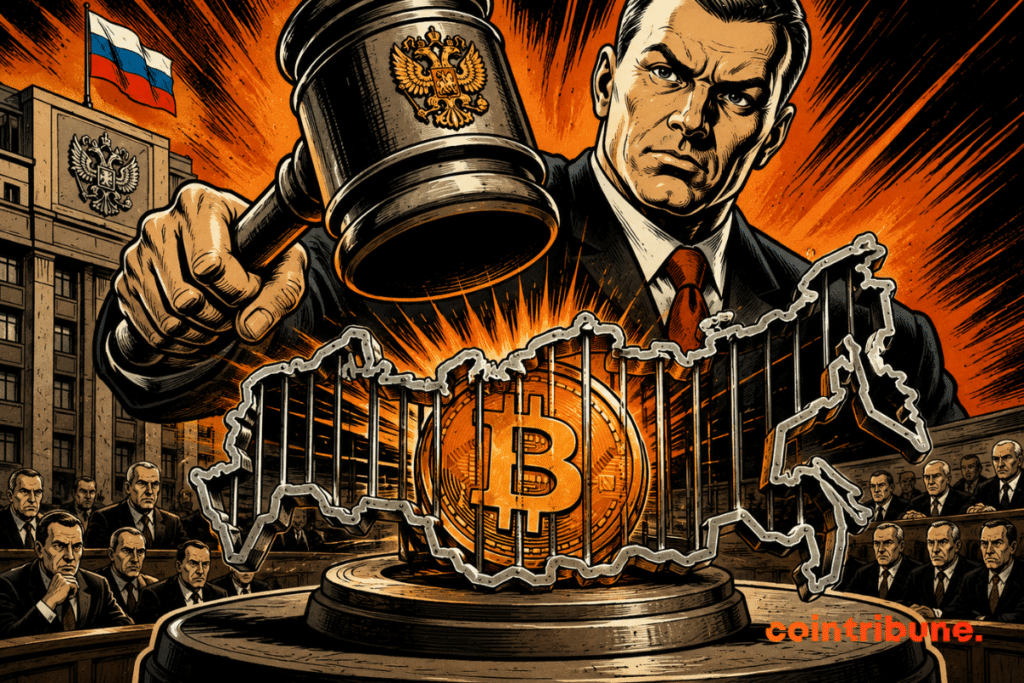
This Tuesday, July 21, 2026, Russia is about to take a new step in the regulation of digital assets. The State Duma is indeed beginning the final reading of a bill that will regulate investors, crypto platforms, as well as cross-border payments. Analysts already see it as a double-edged strategy: attracting foreign capital without relaxing control over the domestic market.
In Brief
- The State Duma of the Russian Federation will examine bill no. 1194918-8 in second and third readings.
- The text creates the first comprehensive legal framework for digital assets in Russia, under the supervision of the Bank of Russia.
- If adopted, the main provisions will come into effect as of September 1, 2026.
A Reform That Promises Legal Status for Crypto Assets
Submitted by the Russian government on April 1, 2026, bill no. 1194918-8 is titled “On Digital Currency and Digital Rights.” It passed its first reading on April 21, 2026, with 327 votes in favor out of 340 voters. This was followed by approval by the State Duma’s financial markets committee, chaired by Anatoly Aksakov in early July. This Tuesday, July 21, it will move to second and third readings for a final vote.
Already, crypto analysts highlight two key points:
- The new law legally classifies cryptocurrency as a property asset and not as legal tender.
- It also officially recognizes crypto-assets as property rights while entrusting supervision of the sector to the Bank of Russia.
In other words, the ruble remains the only currency having legal tender in Russia. Furthermore, it is entirely possible (and legal!) to hold bitcoin, Ether, or any other crypto asset. Russians will even be able to buy or sell digital assets. However, they will not be allowed to use them to pay for everyday purchases.
For some crypto experts, the reading of this bill is thus clear: Russia considers digital assets as financial instruments rather than as currency.
Is the Russian Crypto Market on the Brink of Change?
Bill no. 1194918-8 classifies crypto investors into two categories:
- qualified;
- non-qualified.
The first is a status regulated by Article 51.2 of the federal law “On the Securities Market” (law no. 39-FZ). To obtain it, at least one of the following criteria must be met:
- assets or financial holdings exceeding a certain threshold (in the order of several million rubles, the threshold raised by the Bank of Russia in 2025);
- proven professional experience in financial markets;
- a diploma or specific certification recognized by the Bank of Russia;
- or, for legal entities, size criteria (equity, turnover) that effectively make them institutional players (insurers, management companies, investment funds…).
The second group covers the vast majority of individuals. If the new crypto law is passed, they will see their investments capped at 300,000 rubles per year when purchasing crypto assets through a regulated intermediary. This represents between $3,800 and $4,000. For international transfers, the annual cap is 100,000 rubles.
Qualified investors will benefit from a more flexible regime. According to RBC, they will be able to:
- acquire up to 3 million rubles worth of cryptocurrencies per year;
- transfer up to 1 million rubles abroad.
Another key element: no purchase limit.
The Crypto Law Also Provides Enhanced Control Over Intermediaries
The reform requires a license from the Bank of Russia for all crypto exchanges. The same applies to brokers, custodians, and other intermediaries. Licensed platforms could even act as tax agents. In other words, they will be authorized to directly collect income tax from crypto investors. Unauthorized exchanges could be banned starting July 2027. This date corresponds to the entry into force of the new crypto law if approved by the Duma.
As for mining, it remains under the supervision of the Federal Tax Service, not the Bank of Russia. This distinction reflects the legalization of mining by a law signed by Vladimir Putin in 2024.
An important technical detail: the bill dropped an initial requirement to disclose individual wallet addresses. Reporting will focus on balances and transaction flows.
Decrypting: private crypto wallets could interact with the licensed Russian infrastructure. However, enforcement rules remain to be clarified. The text does not name any specific crypto (neither Bitcoin, nor Ethereum, nor stablecoins). This leaves the door open to any digital currency deemed useful for foreign trade.
A Fully Assumed Crypto Strategy
Analysts agree on one point: the timing of the Russian Parliament is no accident. Since 2022, Western sanctions have systematically cut Russia off from the traditional financial infrastructure. This notably includes the exclusion of certain Russian institutions from the SWIFT network. The bill thus constitutes a response to a structural constraint: making cross-border payments when conventional channels are locked.
That’s not all! The Duma vote also comes at a moment of global regulatory convergence. In the United States, the CLARITY Act is gaining ground in Congress. In Europe, the MiCA regulation is being implemented. In Asia, Singapore, Hong Kong, and Japan are refining their frameworks. Russia, for its part, chooses a distinct path: not integrating crypto into an existing financial market, but transforming it into a monetary sovereignty infrastructure.
For investors, this implies two things:
- On one hand, cross-border legalization strengthens bitcoin’s status as a neutral and borderless asset.
- On the other hand, liquidity concentration in state operators’ hands and sanction risks limit immediate appeal.
One thing is certain: through its approach, Russia reaffirms its desire to integrate crypto-assets into its financial architecture. The next closely watched step: the publication of implementing regulations by the Bank of Russia.
Maximize your Cointribune experience with our "Read to Earn" program! For every article you read, earn points and access exclusive rewards. Sign up now and start earning benefits.

My name is Ariela, and I am 31 years old. I have been working in the field of web writing for 7 years now. I only discovered trading and cryptocurrency a few years ago, but it is a universe that greatly interests me. The topics covered on the platform allow me to learn more. A singer in my spare time, I also cultivate a great passion for music and reading (and animals!)
The views, thoughts, and opinions expressed in this article belong solely to the author, and should not be taken as investment advice. Do your own research before taking any investment decisions.