Russia: The new AI law strengthens state control over strategic models
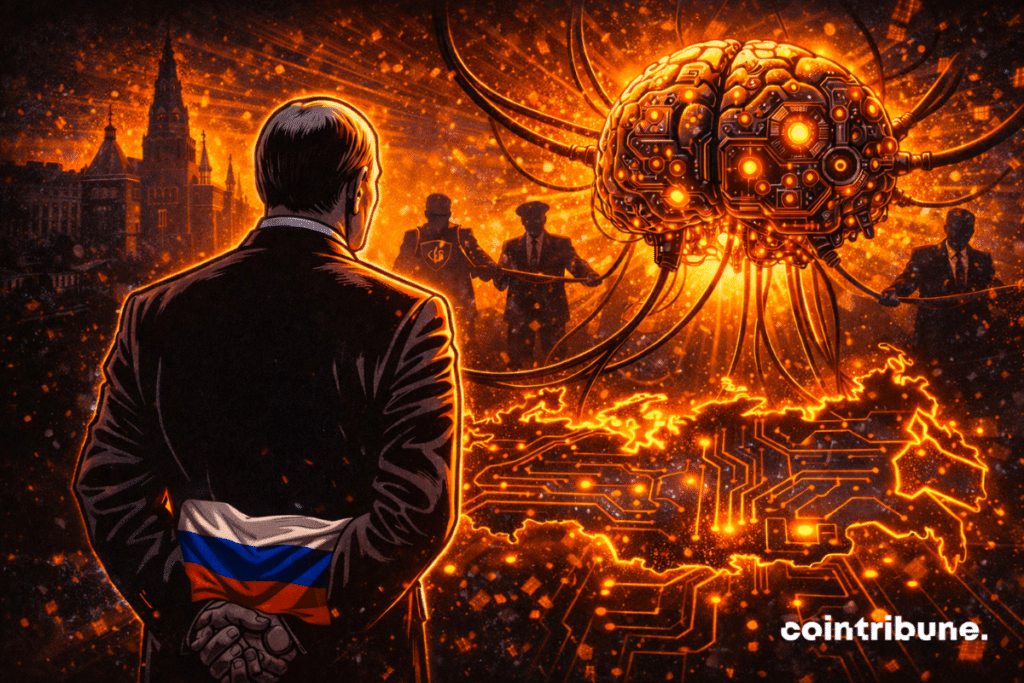
The volcano of artificial intelligence is erupting. Americans, Chinese, Europeans jostle to capture the best fallout from this digital lava. Amid this global racket, Vladimir Putin plays his own part, countercurrent. Far from wanting a piece of the pie, the master of the Kremlin intends to own the whole bakery. His new AI law does not aim for unbridled innovation, but the methodical locking of each model deemed strategic. Objective: to create 100% Russian artificial intelligences, pure from any Western contamination. An obsession that could well turn out to be a trap.
In brief
- The new Russian law classifies artificial intelligences into three distinct categories: sovereign, national, and trusted.
- The so-called “sovereign” models must be developed without any recourse to foreign components or data.
- Despite this independence discourse, Russian developers heavily depend on Western open-source like LLaMA or Mistral.
- Meanwhile, Russia uses generative AI to produce deepfakes aimed at destabilizing European public opinions.
Putin and AI: the quest for an impossible digital purity
When Vladimir Putin talks about artificial intelligence, he speaks neither of algorithms nor computing power. He talks about civilization. “For Russia, it is a matter of national, technological and value-based sovereignty,” he said at a recent conference in Moscow.” (“For Russia, it is a matter of national, technological and value-based sovereignty.” – Source: Reuters).
In his worldview, every Western AI carries foreign cultural software, an ideological Trojan horse that he refuses to accept on Russian soil. The Kremlin has therefore brought out legislative artillery with a bill classifying models into three airtight categories. The “sovereign” model must be developed exclusively by Russian citizens, trained only on data produced in Russia, without any use of foreign components.
The “national” model tolerates the use of open-source solutions from elsewhere, while the “trusted” model falls under the direct supervision of the FSB. Moreover, a presidential decree established a special commission personally led by Putin.
From now on, AI becomes in Russia a matter of state watched like milk on fire.
The great Russian split: proclaimed sovereignty, assumed dependency
Technological independence statements nevertheless hit a wall of concrete realities. Russian experts in the sector have been sounding the alarm for several months. Developing a fully Russian artificial intelligence, without borrowing from the global ecosystem, would cost several hundred billion rubles. A bill that end users would inevitably have to bear.
Added to this are the Western sanctions that literally strangle Russian data centers: without advanced semiconductors, no intensive computing, no high-performance models. A manager of a major Russian tech company told Kommersant newspaper that “totally sovereign platforms practically do not exist on the market today.”
Even Sberbank, the Kremlin’s favorite public financial giant and spearhead of patriotic AI, actually adapts foreign open-source models like LLaMA, Mistral or YOLO. The digital fortress dreamed of by Putin thus rests on imported foundations. The proclaimed sovereignism hides a very real dependency.
The shadow cast by Russian AI: when deepfakes wage war on Europe
While the Kremlin locks its digital borders, its hybrid armies use artificial intelligence to destabilize European neighbors with formidable efficiency. The example of Professor Alan Read from King’s College London is particularly telling. One day, a manipulated video using his face and a synthetic voice mimicking his started circulating on social media, uttering insults against Emmanuel Macron.
Almost everything in this video is odious, horrible to listen to, the researcher told the BBC. It seems completely foreign to who I am.
Alan Read
This deepfake is part of a broader campaign called Matryoshka, named after those Russian dolls that hide others inside. In Poland, artificially generated videos call for leaving the European Union, with turns of phrase betraying Russian syntax. Second-tier applications, less strict than American giants on watermarks, provide these decoys for a few cents.
Disinformation thus becomes a low-cost exportable industry.
Russian AI strategy in five points
- Legal classification: three distinct categories (sovereign, national, trusted) subject to varying degrees of state control;
- Presidential commission: body supervised directly by Vladimir Putin to coordinate all national initiatives;
- Sberbank on the front line: the only player capable of attempting the “all Russian” venture, but still dependent on foreign open source;
- Binding sanctions: shortage of advanced semiconductors severely limiting available computing power;
- Matryoshka campaign: systematic deepfake operation aimed at destabilizing European public opinions.
Artificial intelligence is undeniably a boon for those who manage to master it. But for those who lose their jobs, it especially represents an existential threat. More worrying still, its “artificial” nature could well make it uncontrollable in the long term. A senior security official at Anthropic recently resigned sounding an alarm on this precise risk. Putin, for his part, continues to lock down without looking back. Perhaps a bit too quickly.
Maximize your Cointribune experience with our "Read to Earn" program! For every article you read, earn points and access exclusive rewards. Sign up now and start earning benefits.
La révolution blockchain et crypto est en marche ! Et le jour où les impacts se feront ressentir sur l’économie la plus vulnérable de ce Monde, contre toute espérance, je dirai que j’y étais pour quelque chose
The views, thoughts, and opinions expressed in this article belong solely to the author, and should not be taken as investment advice. Do your own research before taking any investment decisions.