Stablecoins: The BIS Warns of a Creeping Dollarization of Emerging Economies
The annual economic report of the Bank for International Settlements (BIS) warns about possible transformations of the global monetary landscape. Published in Basel, the document examines the role of stablecoins and their limits in current financial systems. The institution highlights the risk of dollarization in certain emerging economies when users favor digital assets linked to the US dollar. This analysis outlines the challenges related to indexed tokens and possible developments of private digital currency. The BIS considers that these innovations require an appropriate framework to evolve.
In brief
- The BIS considers that Stablecoins do not yet fulfill all the functions of a real currency and have several structural limits.
- The report warns of a possible dollarization of emerging economies when households use Stablecoins linked to the dollar as a store of value.
- The BIS highlights that more than 99% of Stablecoins remain pegged to the US dollar, mainly dominated by USDT and USDC.
- The institution considers that massive adoption of Stablecoins could change financial equilibria by increasing bank financing costs.
- The BIS proposes an alternative based on regulated tokenization and a unified ledger linking public and private digital currencies.
The BIS Questions the Place of Stablecoins in the Monetary System
The Bank for International Settlements (BIS), in its 2026 annual economic report published Sunday during its annual general meeting in Basel, Switzerland, states that current stablecoins do not fulfill all the expected functions of a complete currency. The institution analyzes several essential criteria, such as uniqueness, elasticity, interoperability, and integrity. According to its findings, existing models still present significant limits on these different aspects. This assessment places indexed tokens at the center of debates on the future of digital payments.
The BIS also explains that stablecoins can deviate from their reference on secondary markets. Moreover, their exchange mechanisms remain complex for daily use. The report compares, thus, their functioning to that of exchange-traded fund shares rather than a real currency. This analysis echoes the statements of the BIS general manager about their financial nature.
However, the market retains a limited size compared to the traditional banking system. The BIS estimates that the total value of stablecoins reached about 320 billion dollars by the end of May. More than 99% of these assets remain linked to the US dollar, with a dominance of Tether’s USDT and Circle’s USDC.
Digital Dollarization Worries the BIS in Emerging Economies
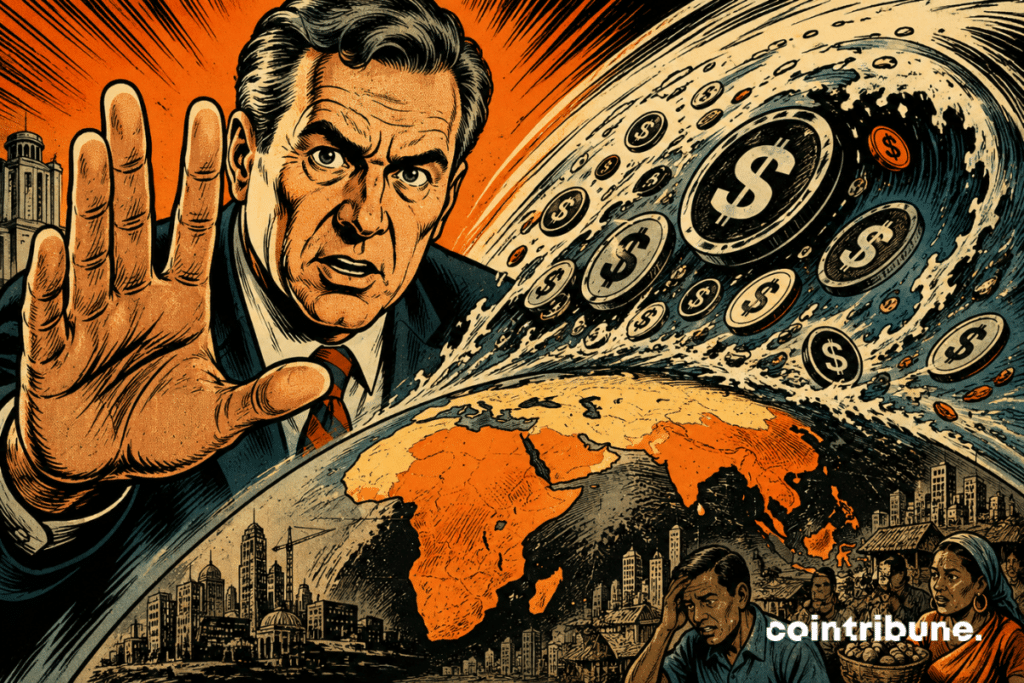
The report highlights a phenomenon called dollarization of stablecoins, where some households use tokens pegged to the dollar as a store of value. This practice can change capital flows and reduce the influence of national currencies. The BIS considers this evolution a challenge for the monetary sovereignty of several emerging economies.
The authors also studied the economic consequences of massive adoption of stablecoins according to the reserves held by their issuers. Their model indicates that significant expansion could slightly weigh on production in the medium term. The rise in banking financing costs and the decrease in credit would offset the benefits related to public debt demand.
Even with very high capitalization, the report observes that the negative impact would remain limited in the scenarios studied. The BIS also reminds that these assets represent a significant share of illicit activities on certain blockchains. Controls related to transactions remain more difficult when users have autonomous wallets.
Towards a New Monetary Architecture After the Limits of Digital Tokens?
Facing the identified difficulties, the BIS proposes a different approach based on coherent international rules. The objective is to integrate tokenization into the existing system of central banks and commercial banks. This orientation aims to preserve monetary stability while supporting digital innovations.
The bank notably presents the idea of a unified ledger gathering several forms of tokenized money. This model would include central bank reserves, commercial bank money, and other regulated private assets. Central bank money would remain the point of reference in this architecture.
Furthermore, it also cited the Agora project as an experiment intended to test this approach. This cross-border payment prototype brings together several central banks and private institutions. According to the report, this initiative illustrates a possible evolution of global financial infrastructures.
In the short term, stablecoins will therefore continue to feed discussions on digital monetary transformation and the evolution of the crypto industry. The progression of their use could strengthen debates around dollarization and the necessary rules to frame these new instruments.
Maximize your Cointribune experience with our "Read to Earn" program! For every article you read, earn points and access exclusive rewards. Sign up now and start earning benefits.

Journaliste et rédacteur web passionné par l’univers des cryptomonnaies et des technologies Web3. J’y traite les dernières tendances et actualités afin de proposer un contenu de haute qualité à un large public du secteur.
The views, thoughts, and opinions expressed in this article belong solely to the author, and should not be taken as investment advice. Do your own research before taking any investment decisions.