StandX: Top 10 Perp DEX in the World, With Only 2 Trading Pairs
The rapid expansion of blockchain-based derivatives infrastructure has reshaped the digital asset trading landscape. The perpetual DEX sector continues to grow as traders increasingly shift toward decentralized derivatives solutions. In 2025, Perp DEXs generated over $6.7 trillion in annual trading volume, highlighting the rise of on-chain derivatives. Perpetual futures have become a key instrument for leverage, hedging, and continuous exposure. Within this environment, StandX reached the global top 10 perp DEX despite operating with only two trading pairs, illustrating the strength of a focused market structure.
Understanding What Defines a Top Perp DEX
Before analyzing how platforms position themselves within the perpetual DEX ecosystem, it is important to understand the role that perpetual futures play in modern crypto trading.
Perpetual Futures as a Core Trading Instrument
Perpetual futures have become one of the most actively traded instruments in the digital asset market. Unlike traditional futures contracts, perpetuals do not expire, allowing traders to maintain leveraged positions while funding rates help keep contract prices aligned with the underlying asset.
The Role of Perp DEX Platforms in DeFi
Within decentralized finance, this type of trading increasingly takes place on perpetual decentralized exchanges, commonly referred to as Perp DEXs. These platforms allow traders to open leveraged long or short positions directly on blockchain infrastructure without relying on centralized intermediaries.
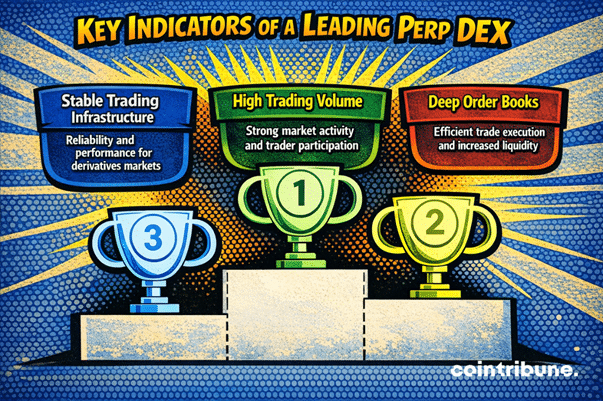
Key Metrics That Define a Top Perp DEX
Several elements usually determine whether a platform can be considered a top Perp DEX. Market participants often evaluate trading volume, orderbook depth, liquidity distribution, execution efficiency, and the reliability of the trading environment. When these conditions align, traders can enter and exit positions more efficiently even during periods of increased volatility.
Competition Across the Perpetual DEX Sector
Today, multiple decentralized exchanges compete within the perpetual derivatives sector, each experimenting with different liquidity models, collateral systems, and trading architectures to attract users and sustain market activity.
The Expansion of Perpetual Futures Trading in DeFi
Decentralized finance initially focused on spot trading and token swaps. As blockchain infrastructure matured, derivatives markets gradually emerged as a new segment of DeFi trading activity.
Perpetual futures now represent a significant share of global crypto trading volume. These contracts allow traders to gain leveraged exposure, hedge existing positions, or speculate on price movements without directly holding the underlying assets.
This growing demand has encouraged Perp DEXs to build more advanced derivatives infrastructure. However, listing multiple markets alone does not automatically create a strong trading environment. Liquidity distribution, orderbook depth, and execution efficiency remain critical components of derivatives trading.
As decentralized derivatives platforms evolve, exchanges continue experimenting with alternative market structures, including precious metals trading, designed to improve market conditions and attract both retail users and professional participants.
The Current Perp DEX Landscape
Several platforms now lead the ecosystem by combining deep liquidity, engaged user bases, and increasingly advanced execution infrastructure.
Among the most recognized Perpetual DEX platforms today are Hyperliquid, dYdX, GMX, Drift Protocol, Vertex Protocol, and Aevo. Each of these exchanges operates with different market architectures and liquidity models. Some rely on orderbook-based trading systems, while others adopt automated liquidity pools or hybrid mechanisms designed to balance execution efficiency and capital utilization.
Competition within this sector is largely shaped by factors such as trading volume, orderbook depth, execution reliability, and the ability to sustain consistent liquidity across derivatives markets.
Within this competitive landscape, StandX has entered the global Top 10 ranking among perpetual decentralized exchanges, despite operating with only two trading pairs. This achievement demonstrates how focused infrastructure design and concentrated market depth can allow a specialized exchange to compete with infrastructures that offer dozens of instruments.
StandX Reaches the Top Perp DEX Category With Only Two Trading Pairs
Within this evolving derivatives ecosystem, StandX has recently entered the global Top 10 Perp DEX category. The exchange launched its public mainnet at the end of 2025, transitioning from earlier testing phases to live trading with real liquidity.
Since then, the ecosystem has reached several milestones. At one point, trading activity on the platform surpassed $1 billion in daily volume, reflecting increasing participation from traders exploring decentralized derivatives markets.
A distinctive aspect of the platform lies in its market structure. From the beginning, the exchange concentrated most of its activity around two derivatives markets: BTC-USD and ETH-USD perpetual futures.
While additional markets have appeared more recently—such as gold and silver perpetual contracts—the exchange’s early growth and its recognition among top Perpetual DEX platforms largely emerged from trading activity centered on Bitcoin and Ethereum derivatives.
Why Does StandX Focus on Only Two Trading Pairs?
Instead of listing a wide range of tokens, StandX restricts its markets strictly to BTC-USD and ETH-USD perpetual futures. Historically, these two assets account for the largest share of trading volume and institutional participation in the digital asset space.
By concentrating strictly on Bitcoin and Ethereum, the exchange captures established order flow. This structural choice naturally appeals to market makers and quantitative trading desks that specialize in these specific pairs. Rather than dispersing liquidity across lower-cap assets, the infrastructure operates entirely around the two most widely traded cryptocurrencies, while reinforcing capital efficiency through mechanisms like its auto-yield stablecoin model.
Liquidity Concentration and OrderBook Depth
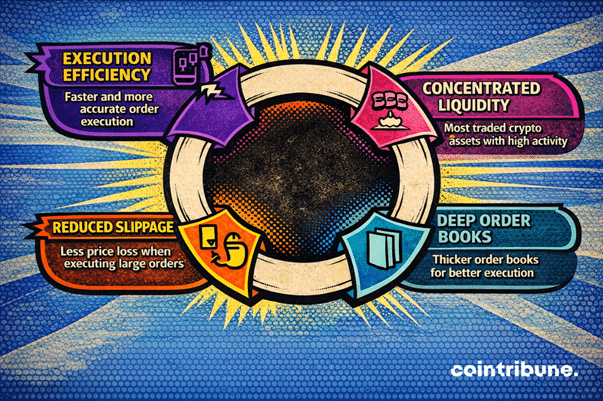
Structurally, the distribution of liquidity influences a platform’s market efficiency. When an exchange allocates capital across numerous minor instruments, individual orderbooks tend to thin out, which can increase the overall cost of execution. To address this, StandX channels incoming liquidity specifically into its two core markets. By deliberately restricting its scope, the exchange’s matching engine helps consolidate capital directly around the current asset price.
This structural consolidation provides users who are managing leveraged positions a practical operational advantage. A denser orderbook offers the opportunity to execute larger market orders with a lower price impact. In the end, by keeping liquidity together, the StandX system helps lower slippage, making it easier to execute trades consistently even when the market is unstable.
What This Model of StandX Suggests for the Future of Perp DEX Platforms
The architectural choices of StandX’s developers illustrate a broader transition within the decentralized derivatives space. While historical industry growth often relied on listing a vast array of assets to capture attention, the StandX framework proposes an alternative path centered on structural specialization.
As the DeFi ecosystem grows, the metrics used to evaluate trading venues are shifting. Traders are starting to care more about how stable and predictable the trading environment is as a whole than how many pairs it can support.
By opting for a focused operational scope, this model offers a different trajectory for decentralized infrastructure. It suggests that future platforms may increasingly align their resources to maintain structural coherence, presenting an evolutionary shift away from continuous horizontal expansion.
The Role of Intentional Design in a Top Perp DEX
StandX’s rise to the top 10 Perp DEXs shows how careful protocol design can help decentralized exchanges grow. By anchoring its initial framework around the crypto ecosystem’s most established assets, such as BTC and ETH, the platform provides a clear roadmap for targeted market integration. This selective approach helps set a stable operational baseline during a protocol’s most important growth phases.
This is reflected in the platform’s deep BTC orderbook. Ultimately, the trajectory of StandX offers tangible insights into how decentralized platforms can scale. As the on-chain derivatives sector continues to mature, strategies prioritizing foundational stability may provide a valuable blueprint for the next generation of DeFi infrastructure.
Maximize your Cointribune experience with our "Read to Earn" program! For every article you read, earn points and access exclusive rewards. Sign up now and start earning benefits.

Journaliste et rédacteur web passionné par l’univers des cryptomonnaies et des technologies Web3. J’y traite les dernières tendances et actualités afin de proposer un contenu de haute qualité à un large public du secteur.
The contents and products mentioned on this page are in no way approved by Cointribune and should not be interpreted as falling under its responsibility.
Cointribune strives to communicate all useful information to readers, but cannot guarantee its accuracy and completeness. We invite readers to do their research before taking any action related to the company and to take full responsibility for their decisions. This article should not be considered as investment advice, an offer, or an invitation to purchase any products or services.
Investment in digital financial assets carries risks.
Read more