While Powell gives mixed signals, bitcoin wavers: between rally promises and upsetting votes, traders hesitate... and ETFs sneeze.
On December 14, Bittensor, a decentralized artificial intelligence network, will reduce the issuance of its TAO token by half. Launched in 2021, the project combines blockchain, machine learning, and an incentivized economic model. This first halving marks a structuring milestone in its evolution, similar to the four-year bitcoin cycle.
Bitcoin miners are taking on record levels of debt to finance new equipment and expand operations into artificial intelligence (AI) and high-performance computing (HPC). As competition for hashrate intensifies and post-halving profits shrink, miners are increasingly turning to debt markets to maintain an edge in both Bitcoin production and data infrastructure growth.
Arthur Hayes announces it: bitcoin crashes linked to the 4-year cycle are over! But beware, this does not mean all risks have disappeared. Discover the 3 new rules for investing in 2025 and how to benefit before everyone else.n#Bitcoin #BTC #ArthurHayes #Crypto
Behind Bitcoin's apparent stability, an imbalance threatens the network's sustainability. Since April, transaction fees have dropped by more than 80%, shaking the remuneration model of mining companies. Amid the rise of ETFs and after a demanding halving, it is Bitcoin's internal economy that is faltering. Lower fees, fewer incentives, more risks to protocol security, the crisis is here, structural, and raises a question the ecosystem can no longer ignore.
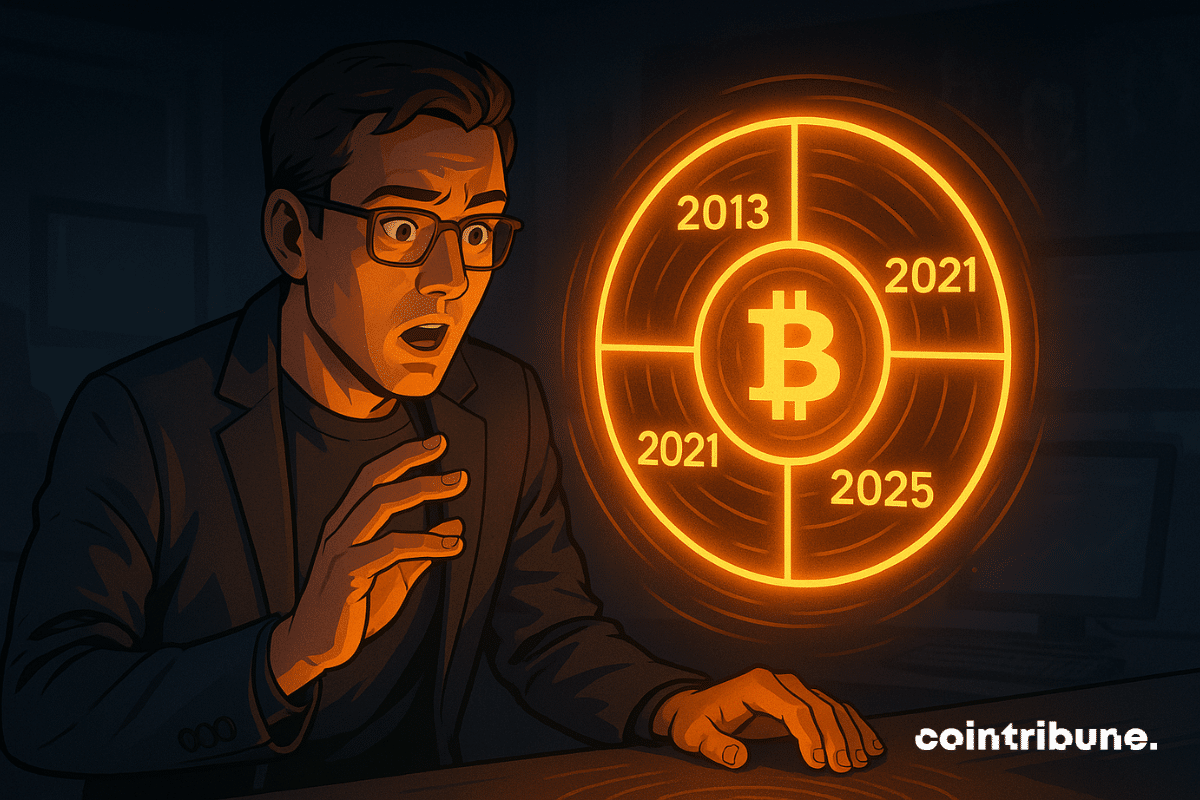
Despite predictions announcing the death of Bitcoin's traditional four-year cycle, Glassnode's analysis reveals troubling signals. The recent price movement echoes historical patterns, suggesting that the famous cycle could still dictate market pace. But this time, the stakes are different.
While many analysts were betting on a Bitcoin peak in 2025, Bitwise is throwing everyone off guard. According to its Chief Investment Officer, the true peak of the cycle could occur in 2026. This challenges the famous four-year theory related to halving, with solid arguments to back it up... What if the best is yet to come for BTC?
One year after its fourth halving, Bitcoin is showing a perplexing trajectory. Although the crypto has climbed since April 2024 — nearing $109,000 in January — its progress remains pale compared to previous cycles. A paradox? Despite absolute records, the annual growth rate is capped at 49%, far from the quadruple digits of the past. How can this historic slowdown be explained when ETFs and the planned coin shortage were supposed to propel the market?
The halving, once the war drum of the bull market, has fallen silent. In the silence, Bitcoin seeks a new rhythm in a crypto market that dances differently.
Bitcoin miners can finally breathe: their revenues stabilize at 3.6 billion dollars, despite the Bitcoin halving in April 2024. But behind this apparent calm, a storm is brewing. Rising costs, dependence on Bitmain, pressure on fees... Will the model hold up much longer, or is it headed straight for disaster?
A tiny device challenging the monsters of Bitcoin mining, a chance worthy of a miracle, and there is a solitary miner pocketing $260,000 under the astonished gaze of the industry.
How to know how much you can earn from BTC mining? Discover the answer in this comprehensive guide to bitcoin mining. Before knowing how much bitcoin mining can yield, one must first understand how this activity works.
Bitcoin mining is the process by which new units of bitcoins (BTC) are created. It is an effective method if you want to acquire Bitcoin. But before you dive into this activity, you may be wondering how long it takes to generate BTC. In this article, we will explore this question in depth. You will discover, among other things, how difficulty, hash rate, and other parameters influence this metric.
Initially, Bitcoin (BTC) mining was an activity practiced exclusively by a handful of insiders. However, over time, more and more people began to engage in it. As the phenomenon grew, mining farms started to emerge. In this article, we will explore what these platforms are, how they operate, and why they are interesting. We will also look at how they are powered, whether they are profitable, and what their future holds.
The halving is a periodic event that occurs every four years on the Bitcoin blockchain. It involves halving the rewards given to Bitcoin miners, who are responsible for mining bitcoins. The halving is a highly anticipated event in the crypto universe, but what does it exactly consist of? What is its significance? And when will the next halving take place?
Bitcoin, fallen hero or reborn phoenix? 2025, the year of all crypto promises, where altcoins could shine with unexpected brilliance.
Bitcoin today celebrates the 12th anniversary of its first halving, a historic event that halved miners' rewards from 50 to 25 BTC per block. This date marks the beginning of a series of transformations that have shaped the economy of Satoshi Nakamoto's invention, now valued at over 95,000 dollars.
The Bitcoin market may be on the brink of entering an unprecedented era. For the first time since its inception, the flagship crypto is 100 days ahead of its traditional bullish cycle, paving the way for a potential "supercycle." This acceleration, highlighted in the latest CoinMarketCap report, could disrupt usual predictions and signals a possible surge in prices well before initial expectations.
The Bitcoin network difficulty spikes by 14%: BTC miners juggle costs, awaiting better days.
Crypto in crisis: 14.4% decline in Q2 2024. Bitcoin and Ethereum have not taken off yet.
Despite the anticipation of a new altcoin season, Bitcoin continues to reign, now holding a dominance of 53.9%.
Reducing mining rewards is causing bitcoin miners to capitulate, signaling a potential price floor and future rebound.
Bitcoin recently reached new all-time highs, fueling hopes of an extended bull market. However, with an apparent slowdown in the current cycle, when can we actually expect the queen of cryptos to reach its peak?
The social sentiment around Bitcoin is collapsing, a sign of a market at its lowest? Discover the outlook for BTC price.
Bitcoin miners are losing money due to energy costs. Is a price increase imminent?
Peter Brandt predicts a bitcoin dive to 40,000 to 50,000 dollars, challenging optimistic forecasts.
There are now several arguments suggesting that the upcoming cycles may behave differently. This is notably the case by recently reaching an ATH before the halving event.
17 days after the halving of April 20, 2024, the price of Bitcoin still does not react positively. This event, which only occurs every 4 years, comes at a time when the crypto context is still fragile. However, history shows that previous halvings have consistently propelled the price of BTC to new highs. What will happen this time?
If you looked at the bitcoin charts on May 1st, you certainly noticed that the price of the cryptocurrency dropped to less than $57,000. Even though the crypto is currently trading at just over $57,000, its continued decline continues to surprise many. How can we understand that its price collapsed after the halving when we expected a contrary trend? The explanations in this piece.
Exposed to geopolitical, economic, and fiscal pressures throughout the month of April, Bitcoin once again proves its resilience as an asset. While one could have expected a more rapid decline in its price, the cryptocurrency closes the month of April with only a 10% decrease. Details in the following.