Telegram remains accessible in Iran despite the government ban
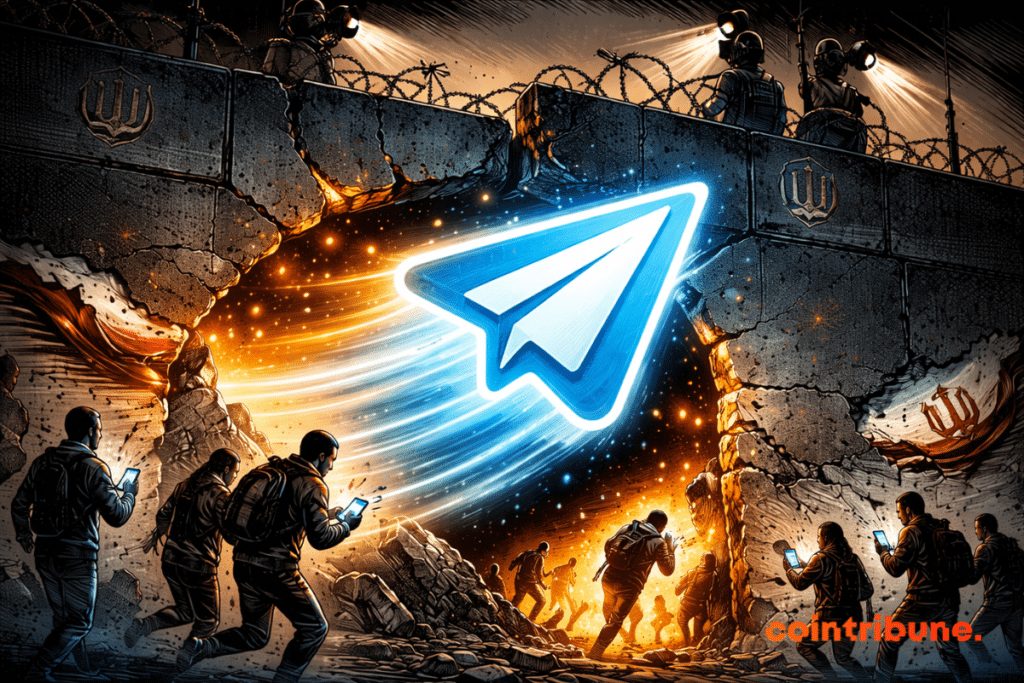
Iran thought it would regain control over its networks, but reality now slips away, sliding through the fingers of digital control. Facing tech giants, the walls erected resemble sieves full of unforeseen and persistent breaches. Telegram, despite being targeted for years, continues to exist in daily use, almost like a clandestine inevitability turned digital routine. This tug of war reveals a simple fact: technology advances, and states row behind.
In brief
- Pavel Durov states that the ban mainly accelerated the massive adoption of VPNs in Iran.
- Despite the blackout, Telegram remains used thanks to circumventions, satellites, and alternative mesh networks.
- Restrictions have fueled an active digital resistance, rather than a migration to monitored apps.
- Telegram also serves as an ambiguous ground, between freedom of expression, targeted phishing, and technical surveillance.
Telegram banned… but still alive in daily use
First, Pavel Durov sets the scene with almost dry lucidity, without detours or unnecessary political varnish. The ban on Telegram in Iran has not dried up its use, it has diverted it to detoured paths.
Iran banned Telegram years ago, with a result similar to that seen in Russia. The government hoped for massive adoption of its surveillance apps but got massive adoption of VPNs instead.
Pavel Durov, X
Next, the mechanics speed up, almost logical, almost inevitable, driven by millions of users who refuse to disappear from digital radars. VPNs become the norm, a banal reflex in a permanently tense environment.
Thus, Telegram ceases to be a simple application. It becomes a resistant habit, a tool that survives bans by slipping into the system’s interstices. Power wanted to impose, it triggered a massive adaptation.
When technology circumvents blockages and redefines communication
Then, the situation slides towards something deeper, almost structural, where classic rules no longer quite hold. Internet shutdowns and geopolitical tensions have not extinguished digital uses, they have transformed them.
Now, users explore other paths, sometimes unexpected, often ingenious, always adaptive to constraints. Starlink provides partial access despite bans, while BitChat transforms smartphones into autonomous relays.
The logic changes completely. Communication no longer depends on a single center, it becomes distributed, diffuse, difficult to control effectively. Telegram remains present in this shifting ecosystem, like a familiar gateway to relative freedom.
This shift is revealing. Technology does not disappear under pressure, it reconfigures itself. And every blocking attempt pushes uses towards even more elusive forms.
Telegram between refuge and grey area in a diffuse digital war
Finally, the picture clouds, as often when lines become blurred between protection and exploitation. Telegram is no longer just a refuge; it also becomes a ground for discrete but real confrontation.
Malicious campaigns circulate, sometimes using the platform to distribute trapped tools or collect sensitive data. At the same time, alerts mention the use of Telegram as a technical channel in certain targeted surveillance operations.
The government hoped for massive adoption of its surveillance applications, but got massive adoption of VPNs. Now, 50 million members of the digital resistance in Iran are joined by more than 50 million in Russia.
Pavel Durov, X
Telegram thus embodies a brutal paradox. It protects and exposes in the same movement. In this diffuse digital war, no one fully controls the terrain.
Key points to keep in mind
- Telegram remains accessible despite the ban, thanks to millions of users circumventing persistent national digital restrictions;
- More than 50 million users in Iran participate in active digital resistance according to Pavel Durov;
- VPNs still dominate usage, but mesh networks and satellites gradually emerge as credible alternatives;
- Telegram becomes a hybrid space, used both for free communication and for sensitive digital operations;
- The TON price stands around 1.24 dollars at the time of writing.
Behind this Iranian tug of war, another tension is emerging elsewhere. In Europe, some authorities reportedly tried to influence Telegram to moderate sensitive content. The setting changes slightly, but the logic remains the same. Technology advances, states adjust, often with a visible delay.
Maximize your Cointribune experience with our "Read to Earn" program! For every article you read, earn points and access exclusive rewards. Sign up now and start earning benefits.

La révolution blockchain et crypto est en marche ! Et le jour où les impacts se feront ressentir sur l’économie la plus vulnérable de ce Monde, contre toute espérance, je dirai que j’y étais pour quelque chose
The views, thoughts, and opinions expressed in this article belong solely to the author, and should not be taken as investment advice. Do your own research before taking any investment decisions.