The AI Future Is Driving A Growing Clash Between Musk And Washington
The advent of AI is reconfiguring production structures but also shaking the very foundations of Western monetary and fiscal policies. With the rise of global automation, a major ideological divide now emerges between supporters of state centralization of technological infrastructures and advocates of a liberalized private capitalism. Today this dynamic is at the heart of global macroeconomic debates, with governments and major industry leaders seeking to anticipate tomorrow’s employment imbalances.
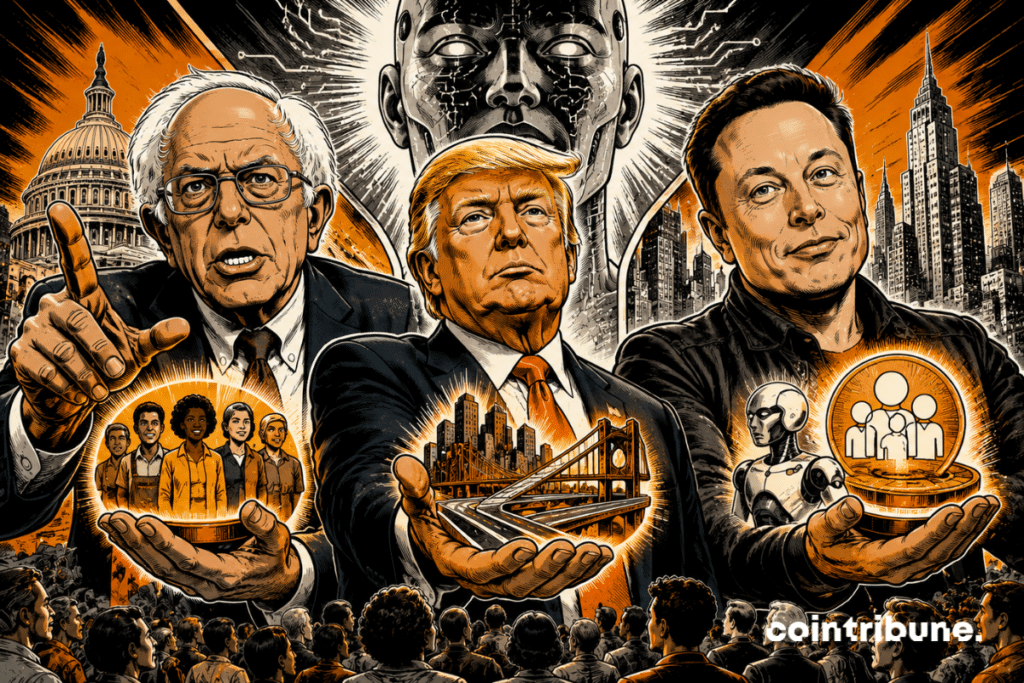
In brief
- Artificial intelligence disrupts traditional economic balances and opens an unprecedented debate on sharing the wealth generated by automation.
- In Washington, the Trump administration is considering taking public stakes in AI giants to capture part of productivity gains and anticipate tax losses related to the disappearance of many jobs.
- In response to this interventionist vision, Elon Musk advocates a model based on private ownership of technological infrastructures and proposes direct redistribution of income to citizens via the US Treasury.
- The Tesla CEO believes that the rise of AI and robotics could cause a sustained period of deflation, challenging monetary theories traditionally associated with money creation.
The showdown in Washington for control of the AI giants
While the race for AI accelerates, the debate on technological governance has reached a major political turning point with the statements of Vice President JD Vance on the podcast The Diary of a CEO. He confirmed that the Trump administration is considering taking direct stakes in major artificial intelligence companies.
This desire for state interference soon materialized through several initiatives and notable precedents at the heart of the US capital :
- The strategic precedent of the CHIPS Act : the federal government has already converted public subsidies into a direct stake of about 10 % in the semiconductor giant Intel ;
- The sovereign fund bill : Senator Bernie Sanders introduced the American AI Sovereign Wealth Fund Act, proposing a one-time 50 % tax on transfer of shares of major AI firms to capitalize a public fund;
- Control of voting rights : this American sovereign fund would hold, according to the bill, 50% of voting rights in targeted structures to guarantee state control ;
- The summit negotiations : Donald Trump himself formally mentioned these public stake-taking mechanisms during private strategic discussions with Sam Altman, CEO of OpenAI.
This legislative offensive comes in a context of global restructuring of the productive apparatus, where the threat of labor automation worries regulators. Thus, data from the World Economic Forum estimates that 92 million jobs could be displaced worldwide by 2030. Although job cuts announced by American companies are barely related to AI (less than 1% of 1.1 million positions cut), the technological shift leads Washington to want to put computing infrastructures under lock and key.
The promoters of the sovereign fund aim to ensure that AI productivity gains are not captured by a few private monopolies but benefit the State. Thus, the state apparatus seeks to equip itself with a lever of direct control and regular income flows to compensate for the future contraction of traditional tax revenues based on human labor.
Elon Musk’s monetary alternative and the specter of deflation
On June 21, following Washington’s partial nationalization intentions, Elon Musk declared on social network X his categorical opposition to any form of public ownership of AI capital, through a series of statements. To oppose the sovereign fund model, the entrepreneur defends maintaining exclusively private ownership of technology companies, like his own entity xAI, combined with a direct financial redistribution mechanism.
Elon Musk said: “it is better to just send the money directly to people from the Treasury”. For him, injecting public liquidity in the form of “Universal High Income via checks issued by the central administration” is the best way to respond to mass unemployment caused by automation without questioning the efficiency and management of the private sector.
In monetary matters, this position is based on a hypothesis that breaks with classical inflationary theories. While the US national debt exceeds 38 trillion dollars and interest charges exceed one billion dollars per year, Musk argues that the physical abundance generated by AI and humanoid robotics will change price dynamics. His thesis is that the massive increase in volume of goods and services will outpace money creation, rendering ineffective the historical rule that money issuance causes inflation.
The businessman formulated his macroeconomic forecast by saying: “in fact, I predict that we will desperately fight deflation”. In this hyper-productivity framework, universal check payments would no longer be considered social aid, but rather a necessary technical adjustment to preserve money velocity and support demand amid falling wages.
The financial paradoxes of the world’s first trillionaire and breakthrough robotics
This doctrinal position takes on particular significance in view of the evolution of Elon Musk’s fortune, who has become the first trillionaire in history. Such unprecedented valuation follows the IPO of his aerospace company SpaceX, whose shares are now traded at $135, bringing the overall firm value to $210 billion.
The share held by Musk in SpaceX, which is around 38% to 40%, along with his significant stake in the car maker Tesla, has drawn sharp criticisms from NGOs like Oxfam. They describe this capital concentration as a “symbol of extreme economic inequalities”. His supporters, on the contrary, emphasize that this wealth mainly consists of unrealized stock holdings, reinvested directly into the development of breakthrough industries.
To confirm his model of public debt disengagement through technology, Musk relies on intensive deployment of humanoid robotics, specifically the Tesla Optimus program. In an interview with investor Nikhil Kamath, the billionaire stated that the diffusion of these humanoid robots within three years would create so much material wealth that it would end the US sovereign debt crisis. From this point of view, the ability to provide almost free and endless work changes the foundations of market economy.
Productive capital is no longer measured by human labor time, but by computing power linked to artificial intelligence and mechanical efficiency installed. This paradigm shift is at the very basis of the concept of universal redistribution, made necessary by the progressive obsolescence of traditional salaried work.
Maximize your Cointribune experience with our "Read to Earn" program! For every article you read, earn points and access exclusive rewards. Sign up now and start earning benefits.

Diplômé de Sciences Po Toulouse et titulaire d'une certification consultant blockchain délivrée par Alyra, j'ai rejoint l'aventure Cointribune en 2019. Convaincu du potentiel de la blockchain pour transformer de nombreux secteurs de l'économie, j'ai pris l'engagement de sensibiliser et d'informer le grand public sur cet écosystème en constante évolution. Mon objectif est de permettre à chacun de mieux comprendre la blockchain et de saisir les opportunités qu'elle offre. Je m'efforce chaque jour de fournir une analyse objective de l'actualité, de décrypter les tendances du marché, de relayer les dernières innovations technologiques et de mettre en perspective les enjeux économiques et sociétaux de cette révolution en marche.
The views, thoughts, and opinions expressed in this article belong solely to the author, and should not be taken as investment advice. Do your own research before taking any investment decisions.