The KOSPI Pullback Revives Concerns About Investments in AI
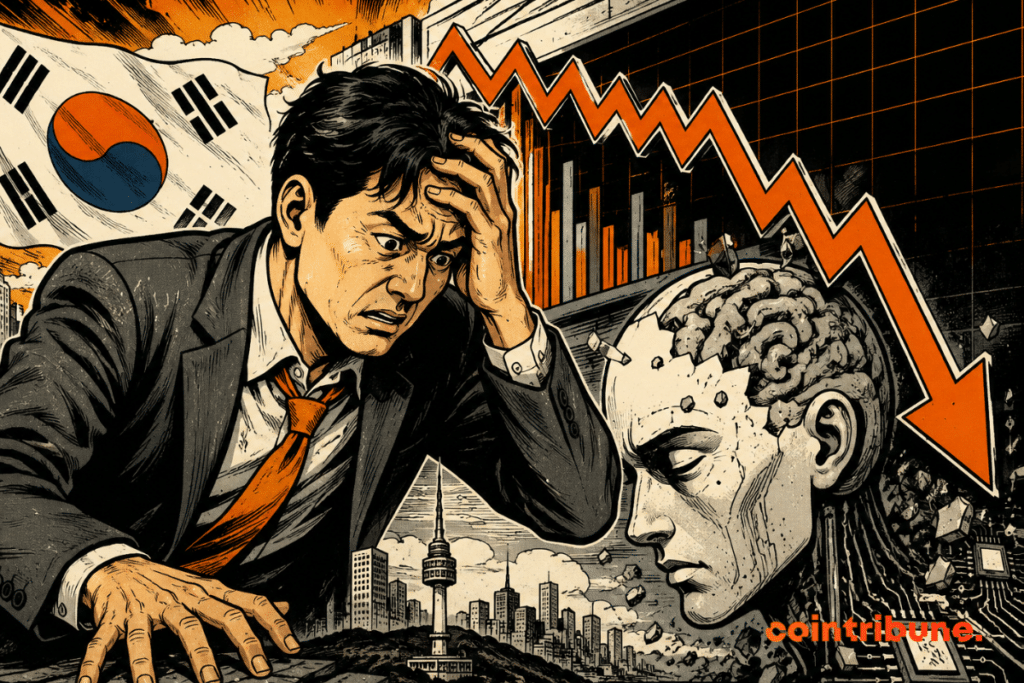
The South Korean market is going through a phase of high volatility that fuels questions about the valuations of technology companies. In just two sessions, the KOSPI experienced a historic decline, while tensions are also spreading to AI-related bond markets. This correction comes as investors had massively favored semiconductor and digital infrastructure stocks, considered the main growth drivers since the beginning of the year.
In brief
- The KOSPI lost nearly 17% in two sessions, erasing about $620 billion in market capitalization.
- SK Hynix’s results, below expectations despite a record profit, triggered the sharp correction.
- Retail investors, highly exposed to leveraged ETFs, suffer the largest losses.
- Fears about AI also extend to bond markets, with a record rise in credit spreads of cloud giants.
- Markets now monitor upcoming results from major technology firms to assess the strength of AI investments.
The KOSPI plunges sharply after SK Hynix’s disappointing results
The Seoul Stock Exchange recorded a second consecutive session of sharp decline after a drop of about 30% last week, prompting authorities to react quickly. Circuit breakers once again halted trading, illustrating the scale of the selling moves. After these two days, the KOSPI now shows a decline close to 17%, representing nearly $620 billion in lost market capitalization. Facing this situation, the South Korean government convened an emergency meeting with financial authorities, as reported by STRAITESTIMES.
The main trigger comes from SK Hynix’s quarterly results. According to Reuters, despite a record operating profit of 60,540 billion won, up 557% year-on-year, the performance remains below the 64,000 billion won anticipated by analysts.
The stock thus lost an additional 4% after a 15% drop the previous day according to TradingView data. Together with Samsung Electronics, SK Hynix accounts for nearly half of the KOSPI weighting, which automatically amplifies the impact of each correction on the entire index.
This reaction also illustrates the particularly high expectations surrounding semiconductor and AI-related companies. Investors had factored in near-perfect growth scenarios. When results fall short of forecasts, profit-taking increases and accelerates selling in the most exposed stocks.
Retail investors pay the price of an excessive leverage effect
The correction occurs in a context where retail investors play an increasing role in the South Korean market. Faced with an expensive real estate market and tougher employment conditions, many young savers have turned to the most dynamic assets. Traditionally involved in cryptocurrencies, they have gradually shifted part of their capital towards stocks in the AI and semiconductor sectors.
This trend is clearly visible in recent figures. Cryptocurrency trading volumes in Korea have decreased by 28%, while the KOSPI had still grown by 31% since the beginning of the year before this correction. The growing interest in tech stocks has been accompanied by increased risk-taking fueled by the use of leveraged products.
The launch in May of leveraged ETFs on individual stocks aimed at retail investors reinforced this trend. Assets under management for these products exceeded $50 billion in July, attracting more investors to riskier strategies.
After heavy losses recorded this week, several policymakers apologized for this authorization and now call for a new ban on these instruments for retail investors. This sequence recalls that rapid upward phases can also amplify corrections when leveraged positions are unwound simultaneously.
Tensions also spread to the bond market of AI giants
Concerns no longer affect only equity markets. They now extend to bonds of leading American cloud and AI-focused groups. Five-year default risk insurance contracts on several major industry players have risen from 115 to 162 basis points in a few months, reaching an unprecedented level.
This evolution reflects a more cautious perception of the financial risk associated with the massive investments made by these companies. The market now estimates about a 12% probability of default for this group of companies over a five-year horizon. At the same time, their cumulative dollar debt now exceeds $360 billion, while their free cash flow turns negative.
Oracle embodies a significant part of these concerns due to its considerable investments in AI. Although its order book remains high, a large portion depends on OpenAI, presented as a major client whose cash generation stays limited and whose IPO has been postponed. This dependency raises questions about the group’s ability to quickly monetize its investments.
Meanwhile, Alphabet, Microsoft, Amazon, and Meta are together planning investments between $725 and $730 billion in 2026 according to a Yahoo Finance report. Alphabet already recorded its first net cash consumption in the second quarter, with $5.9 billion, despite 82% growth in its cloud business.
In this context, investors closely monitor upcoming financial releases to assess whether these expenditures will continue supporting growth or will weigh heavier on valuations. The KOSPI could thus remain sensitive to upcoming announcements from major tech players as markets keep recalibrating the pace and cost of investments in infrastructure related to artificial intelligence. Upcoming results will measure whether this momentum can still sustain sector ambitions or if a new adjustment phase is necessary.
Maximize your Cointribune experience with our "Read to Earn" program! For every article you read, earn points and access exclusive rewards. Sign up now and start earning benefits.

Journaliste et rédacteur web passionné par l’univers des cryptomonnaies et des technologies Web3. J’y traite les dernières tendances et actualités afin de proposer un contenu de haute qualité à un large public du secteur.
The views, thoughts, and opinions expressed in this article belong solely to the author, and should not be taken as investment advice. Do your own research before taking any investment decisions.