The U.S. Government Bets 2 Billion Dollars on Quantum
Washington has just crossed a historic milestone. The U.S. Department of Commerce announced on May 21, 2026, the allocation of 2.013 billion dollars to nine quantum computing companies. A massive, strategic, and unprecedented investment!
In Brief
- The United States plans up to 2 billion dollars of investments in quantum.
- Washington wants to maintain its technological lead over China.
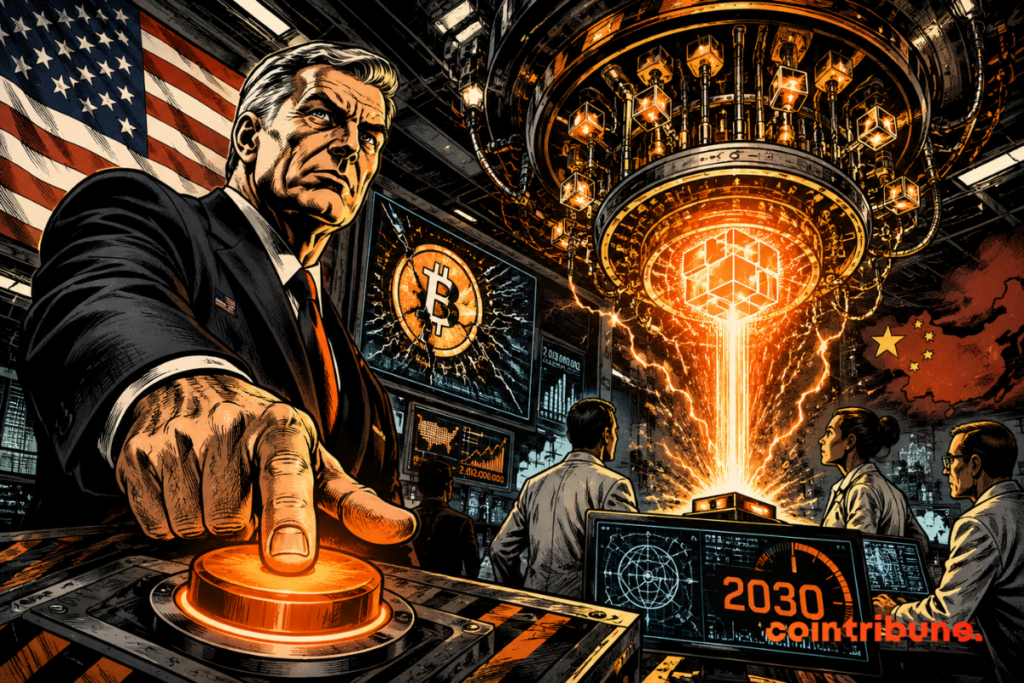
- Q-Day potentially threatens current cryptography, including Bitcoin’s.
An Unprecedented State Offensive Against China
The U.S. Department of Commerce has just formalized the signing of letters of intent with 9 strategic quantum computing companies. These companies draw from a precise envelope of 2.013 billion dollars from the CHIPS and Science Act.
Analysis: under the leadership of the new Trump administration, the state does not merely hand out grants. It takes equity stakes in these companies.
Industry giant IBM takes the lion’s share with 1 billion dollars to create “Anderon.” This is a quantum chip foundry based in New York. GlobalFoundries receives 375 million dollars. The other selected companies should each receive about 100 million dollars. This is notably the case for:
- D-Wave Quantum;
- Rigetti Computing;
- Infleqtion.
As for the startup Diraq, it will receive 38 million dollars according to the statement.
The goal is clear: accelerate the creation of a fault-tolerant quantum computer by 2028-2030. A timeframe already confirmed by some researchers. This thus guarantees American geopolitical supremacy.
Why Does This Investment in Quantum Alarm the Cryptosphere?
The quantum computer uses qubits capable of performing calculations exponentially faster than our current supercomputers. Such power can break public-key cryptography (like the ECDSA algorithm used by Bitcoin), which threatens to instantly empty wallets by decoding private keys from public keys visible on the blockchain.
The race against time is therefore on. According to a report by the firm Project Eleven, a machine capable of cracking Bitcoin and Ethereum encryption could emerge as early as 2030. In response, the crypto community is pushing for the urgent deployment of quantum-resistant algorithms (PQC).
The winners of this transition will be agile protocols able to integrate these updates in time. The losers will be frozen blockchains or dormant wallets, whose private keys will become vulnerable to the first hacker equipped with next-generation chips.
In any case, the American initiative proves that the quantum era is no longer a scientific speculation but a national security priority. To survive, Bitcoin will have to undergo the most critical technological mutation in its history. To be continued…
Maximize your Cointribune experience with our "Read to Earn" program! For every article you read, earn points and access exclusive rewards. Sign up now and start earning benefits.

My name is Ariela, and I am 31 years old. I have been working in the field of web writing for 7 years now. I only discovered trading and cryptocurrency a few years ago, but it is a universe that greatly interests me. The topics covered on the platform allow me to learn more. A singer in my spare time, I also cultivate a great passion for music and reading (and animals!)
The views, thoughts, and opinions expressed in this article belong solely to the author, and should not be taken as investment advice. Do your own research before taking any investment decisions.