Trump Compromise Fails To Unlock CLARITY Act Vote
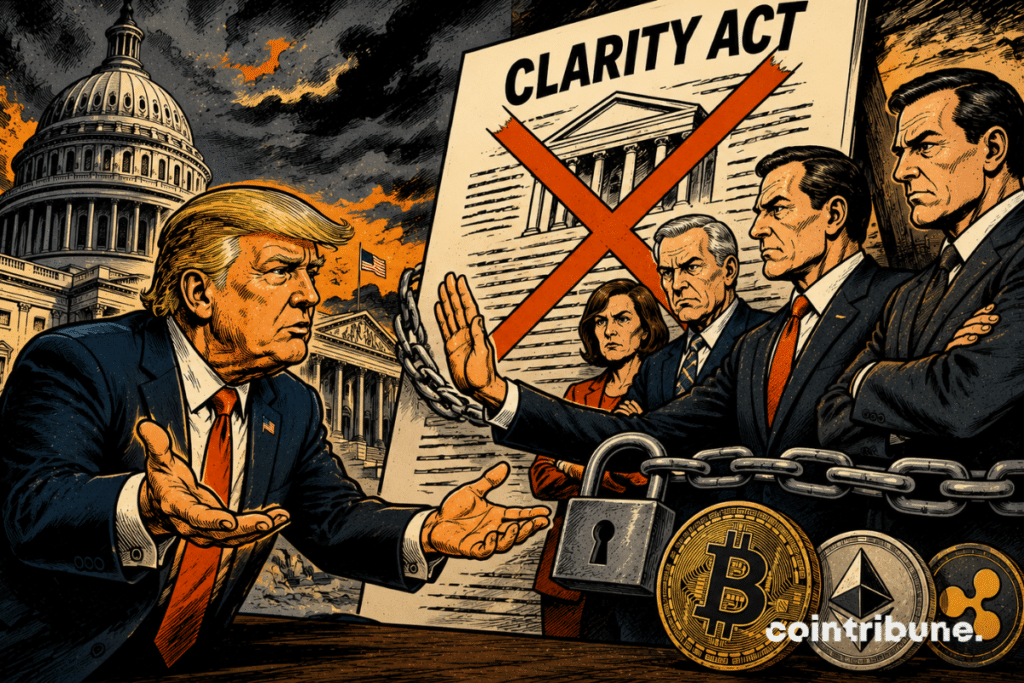
The United States thought they finally had the text capable of providing a regulatory framework for the crypto market. It is not the case. Indeed, the CLARITY Act is stuck in a political confrontation that now goes beyond financial oversight issues. The debate has shifted to ethical rules governing political officials holding cryptos, with Donald Trump at the center of discussions. His latest compromise attempt was not enough to unblock the file, further delaying the adoption of a reform eagerly awaited by the industry.
En bref
The White House compromise swept away by the Democratic refusal
The digital financial markets structure bill took a decisive step on July 20 when Donald Trump officially gave his approval to a revised ethics clause, an amendment that Republican strategists presented as the last obstacle before a plenary session vote.
This arrangement had been carefully negotiated four days earlier, on July 16, during a summit meeting including the US president, senators Bernie Moreno and Cynthia Lummis, as well as Patrick Witt, the White House crypto advisor. The Republican administration immediately hailed this agreement as the “most comprehensive and broadest ethical provision in history”. Senator Bernie Moreno asserted it was the strictest text ever integrated into legislation adopted by Congress.
Here are the important facts that make up this ethical provision now at the heart of the clashes :
- The scope of restrictions : the revised clause aims to govern the ability of the president, vice-president, members of Congress, and senior federal officials to acquire, destroy, trade, or profit from cryptos during their term ;
- The minority opposition : one of the only two Democratic elected officials to have voted to advance the bill in committee, Senator Ruben Gallego, openly dismissed the White House proposal as “very weak” ;
- A bipartisan requirement : Senator Cory Booker strongly reminded that only a true bipartisan agreement would allow the bill to progress ;
- The conflict over the oversight body : Democrats denounce the assignment of ethical supervision to the Department of Justice, even as Todd Blanche, Donald Trump’s personal lawyer, is currently engaged in the confirmation process to head it.
Presidential income and technical architecture of the CLARITY Act bill
The harshness of the debates is mainly explained by direct financial revelations concerning the executive. Indeed, personal financial disclosures made public on July 1 revealed that Donald Trump generated nearly $1.4 billion in crypto-related income in 2025. Most of these colossal sums come directly from the activities of the company World Liberty Financial (WLF) and from the memecoin bearing his likeness. These exceptional amounts earned by a sitting president make the ethical provision particularly sensitive and legitimize, according to the Democratic wing, a much stricter regulatory control than a mere façade commitment.
On a technical level, however, the CLARITY Act aims to bring true stability to the industry by entrusting most of the market supervision to the Commodity Futures Trading Commission (CFTC), while keeping assets classified as securities under the supervision of the Securities and Exchange Commission (SEC). The project also contains measures to protect client funds in case of bankruptcy and a regulatory tolerance regime for decentralized finance developers.
The parliamentary deadlock and the race against time in the Senate
Arithmetically, the legislative calendar now resembles an almost impossible race against time. Republicans currently hold 53 seats in the Senate and desperately need at least 7 Democratic votes to reach the 60-vote threshold required to avoid procedural blockage. To date, no Democratic senator publicly supports the amended text. Senate Majority Leader John Thune has a very narrow window before lawmakers leave for summer vacation, set around August 8, 2026.
The extreme tension behind the scenes is reflected in logistical reshuffling at the highest level of the state. Patrick Witt had to postpone his annual training with the Georgia Army National Guard to conduct negotiations, while his deputy director, Harry Jung, formally announced his departure from the administration within two weeks.
Ultimately, the CLARITY Act finds itself in a vise where legal technicalities are completely neutralized by politics. While crypto industry players still hope for the adoption of a clear framework before the August parliamentary break, mutual distrust over political leaders’ enrichment seriously jeopardizes the text’s chances of success. A possible absence of agreement by the August 8 deadline would postpone debates to autumn, keeping the American crypto sector in a regulatory shadow zone harmful to its international competitiveness.
Maximize your Cointribune experience with our "Read to Earn" program! For every article you read, earn points and access exclusive rewards. Sign up now and start earning benefits.

Diplômé de Sciences Po Toulouse et titulaire d'une certification consultant blockchain délivrée par Alyra, j'ai rejoint l'aventure Cointribune en 2019. Convaincu du potentiel de la blockchain pour transformer de nombreux secteurs de l'économie, j'ai pris l'engagement de sensibiliser et d'informer le grand public sur cet écosystème en constante évolution. Mon objectif est de permettre à chacun de mieux comprendre la blockchain et de saisir les opportunités qu'elle offre. Je m'efforce chaque jour de fournir une analyse objective de l'actualité, de décrypter les tendances du marché, de relayer les dernières innovations technologiques et de mettre en perspective les enjeux économiques et sociétaux de cette révolution en marche.
The views, thoughts, and opinions expressed in this article belong solely to the author, and should not be taken as investment advice. Do your own research before taking any investment decisions.