Trump Hosts Xi For High-Stakes Trade And AI Talks
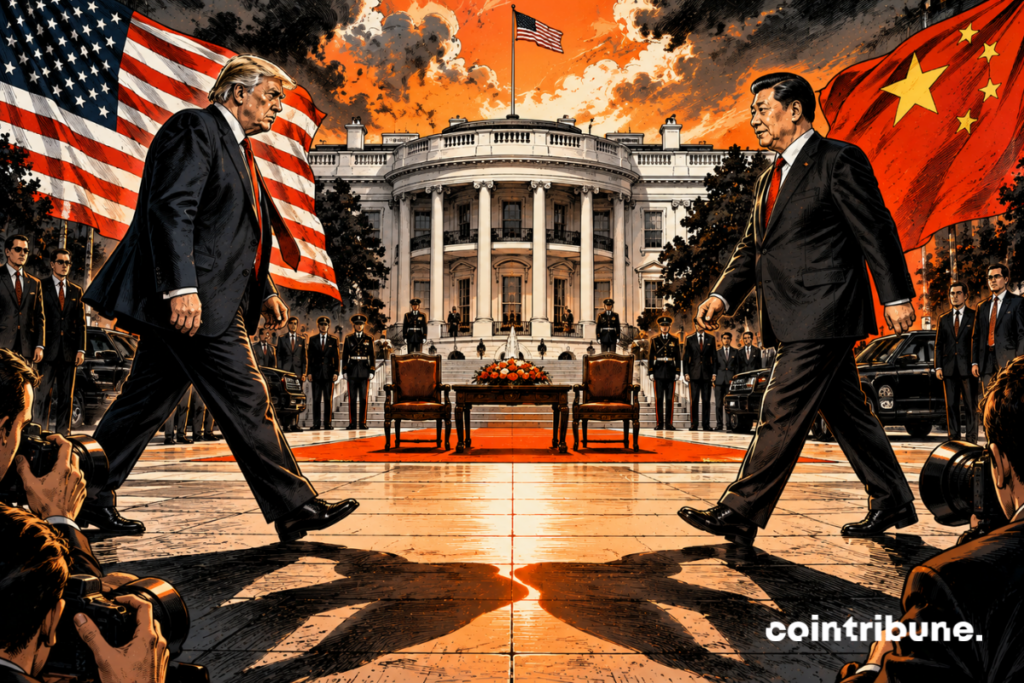
Scheduled for September 24 in Washington, the Trump-Xi summit is set to address tariffs, artificial intelligence, and sensitive technologies. This meeting would extend the trade détente, however many Chinese commitments remain contested by the United States.
In brief
- Donald Trump and Xi Jinping are to meet in Washington on September 24.
- Discussions will cover tariffs, AI, and sensitive technologies.
- The duration of the next trade truce remains at the heart of negotiations.
- Chinese restrictions on rare earths continue to weigh on trade.
- Washington proposes an alert mechanism on artificial intelligence incidents.
A meeting under pressure at the White House
This Thursday at the White House, Donald Trump is to receive Xi Jinping. Indeed, this will be the first meeting in the United States since 2017. Discussions will continue on Friday.
The two heads of state had already met last May in Beijing. During this visit, they attempted to stabilize a relationship marked by tariffs, technology restrictions, and tensions over critical raw materials. The current trade truce is set to expire on November 10.
Thus, multiple issues should determine the outcome of this summit :
- The duration of the next tariff truce ;
- A possible reduction of tariffs on non-strategic products ;
- Chinese restrictions on rare earths ;
- The security of artificial intelligence systems ;
- American controls on advanced technologies ;
- Commercial commitments still unmet.
Beijing would like to extend the détente until the end of Donald Trump’s term. However, Washington prefers a limited six-month extension in order to keep leverage. No duration has yet been publicly agreed upon.
Chinese restrictions on the export of critical minerals and rare earths hang over the meeting. Thus, supplies for several American and foreign companies have been disrupted by these limits.
Artificial intelligence becomes a diplomatic topic
Artificial intelligence was added to the trade agenda during preparatory discussions held in New York. Scott Bessent, the American Treasury Secretary, proposed to Chinese Vice Premier He Lifeng an alert mechanism on AI incidents that could threaten national security.
The device could aim to improve transparency between the two world powers in this sector. It would concern accidents triggered by advanced models, automated cyberattacks, or AI uses that present a major military risk.
Following the talks, Scott Bessent stated: “moving from opacity to greater transparency between the two leading AI global powers is very important”. However, China’s official response to this proposal remains unknown.
American controls on sophisticated AI chips and semiconductor manufacturing equipment have not been included in this mechanism. Washington still considers these technologies strategic. China, an influential member of the BRICS bloc, sees these restrictions as a way to slow down the development of its industry.
Jamieson Greer, the American trade representative, believes that despite these disagreements cooperation remains essential. He therefore points out:
They are the two most powerful countries on the planet, whether in trade or AI.
The immediate goal is therefore not to resolve technological competition. Indeed, negotiators rather wish to create a channel capable of preventing an AI-related incident from triggering a political or security crisis between Washington and Beijing.
A tariff reduction by Trump remains uncertain
The two powers are working on a “Board of Trade”. This process must identify non-strategic products that would benefit from a tariff reduction. Chinese consumer products, energy, agricultural products, and certain American medical devices are among the candidates.
There is also the possibility of suspending certain taxes to keep only a 7.5% duty on certain goods. However, this option does not represent an official decision. Jamieson Greer has provided neither a definitive product list nor a new scale.
Multiple promises made during the meeting have also gone unanswered. Beijing had notably committed to increasing purchases of American agricultural products by 17 billion dollars a year and to ordering more than 200 Boeing planes. No progress on these two issues has been announced by American officials.
The European Union will also closely follow the summit ahead of its own talks with China in October. Maroš Šefčovič, the European Trade Commissioner, demands concrete results to avoid new retaliatory measures.
The Trump-Xi summit will therefore be judged on two specific elements: the duration of the tariff truce and the transformation of announcements into verifiable commitments. A simple maintenance of the status quo could limit the risk of a new escalation, without resolving structural disputes between the two powers.
Maximize your Cointribune experience with our "Read to Earn" program! For every article you read, earn points and access exclusive rewards. Sign up now and start earning benefits.

Diplômé de Sciences Po Toulouse et titulaire d'une certification consultant blockchain délivrée par Alyra, j'ai rejoint l'aventure Cointribune en 2019. Convaincu du potentiel de la blockchain pour transformer de nombreux secteurs de l'économie, j'ai pris l'engagement de sensibiliser et d'informer le grand public sur cet écosystème en constante évolution. Mon objectif est de permettre à chacun de mieux comprendre la blockchain et de saisir les opportunités qu'elle offre. Je m'efforce chaque jour de fournir une analyse objective de l'actualité, de décrypter les tendances du marché, de relayer les dernières innovations technologiques et de mettre en perspective les enjeux économiques et sociétaux de cette révolution en marche.
The views, thoughts, and opinions expressed in this article belong solely to the author, and should not be taken as investment advice. Do your own research before taking any investment decisions.