Trump's Crypto Empire Sparks Fresh Political Controversy
Cryptos have never been so close to American power. At a time when Congress is examining decisive texts for the sector’s future, the White House’s financial disclosures reveal that Donald Trump has amassed colossal revenues related to the crypto ecosystem. This convergence between private interests and public decisions fuels an explosive debate in Washington. One question now dominates: can the regulation of these assets still be perceived as impartial when the President of the United States is among the main beneficiaries of this industry?
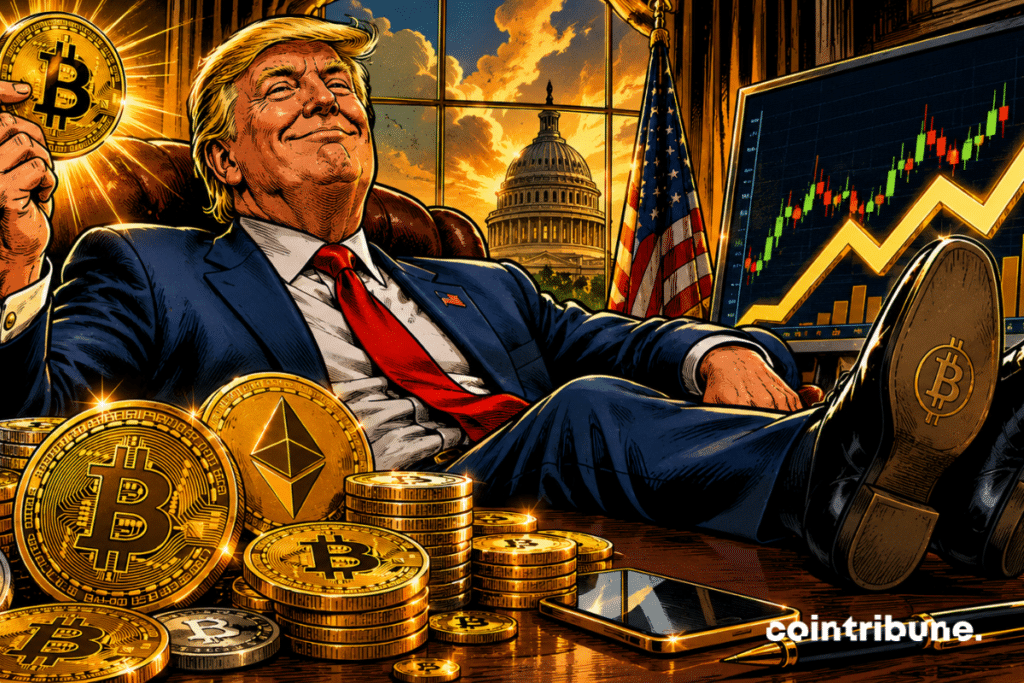
In Brief
- Donald Trump reveals having generated 1.4 billion dollars from his crypto-related activities during his term.
- These record revenues come as the US Congress debates major laws to regulate the crypto market.
- The president rejects all conflict of interest accusations, but his explanations fail to convince his detractors.
- Ethical oversight organizations and several personalities denounce a growing influence of the crypto industry on political power.
The Rise of Digital Revenues at the White House
While a senator wants to deprive the American president of his revenues linked to memecoins, the US Office of Government Ethics has published the official report of financial disclosures for the year 2025, confirming that Donald Trump generated more than 2 billion dollars of total income through his various businesses and investments.
Of this colossal amount, no less than 1.4 billion dollars come exclusively from projects and joint ventures directly linked to the crypto ecosystem. The official accounting records provided by the administration detail precisely the source of this digital financial windfall :
- 636 million dollars were generated by his own themed crypto, the memecoin Trump (TRUMP) ;
- 588 million dollars come directly from sales associated with the decentralized finance platform launched by his family, World Liberty Financial ;
- 197 million dollars come from his direct equity shares in a company specialized in stablecoins.
These official figures mark a major structural turning point in the management of the presidential fortune, since the revenues derived from blockchain now far exceed the traditional Trump brand activities, especially traditional real estate. The integration of these financial flows into the executive’s declaration occurs at the very moment several top legislative projects are being examined by US lawmakers.
Congress is currently debating the final contours of the Digital Asset Market Clarity Act, known as the CLARITY Act, a bill designed to definitively set the market structure and the allocation of regulatory competences. Moreover, a separate housing bill including an amendment formally prohibiting the introduction of a central bank digital currency (CBDC) on US soil is currently on the president’s desk awaiting a signature or veto.
The Veil of Outsourcing and the Specter of Conflict of Interest
Questioned this Thursday by journalist Joe Kernen on CNBC, Donald Trump firmly rejected the criticisms surrounding the perception of these massive capitals during his public service. The President of the United States literally stated that there was “nothing illegal” and “nothing wrong” about profiting heavily from his tech investments while occupying the Oval Office. To dispel suspicions of legislative favoritism, the head of state claimed he did not personally intervene in managing these digital portfolios.
He said that other people were fully responsible for his investments and that he “didn’t even know who they were”. This managerial detachment posture was not enough to calm ethical oversight organizations, such as the consumer rights group Public Citizen, which immediately denounced an operation resembling influence capture aimed at steering future crypto laws.
Criticism quickly went beyond activist circles, reaching the family and judicial spheres, illustrating the extreme polarization caused by this affair. During an appearance this Friday on CNN opposite presenter Anderson Cooper, Mary Trump, the president’s niece, publicly expressed her concerns by stating that “Donald is once again pushing boundaries and no one, no one is putting the brakes on”.
She also warned about potential abuses linked to presidential authority, stressing “that ultimately, due to his abuse of presidential pardon power, many people are likely to get away with numerous financial crimes that caused real harm to people who invested in Donald’s businesses because they believed in him and what he was selling”. These tensions reveal the growing gap between supporters of total sector liberalization under a president converted to pro-crypto theses, and advocates of a strict separation between private economic interests and the sovereign functions of the state.
The Industry’s Financial Offensive: Funding the 2026 US Elections
The emergence of this economic model at the top of the state deeply redefines power dynamics ahead of the 2026 legislative elections, where all 435 seats in the House of Representatives and 35 Senate seats will be renewed. Crypto sector companies, which already invested 170 million dollars in 2024 to support candidates favorable to their cause, are applying an even more aggressive financial strategy for the current electoral cycle.
According to the latest official on-chain data compiled in June by Public Citizen, contributions from crypto-related entities already amount to 189 million dollars for the 2026 campaigns alone. This colossal financial firepower represents the majority share of the 294 million dollars jointly injected by technology giants, artificial intelligence firms, and online betting platforms to steer the national political debate.
The scale of these investments demonstrates a clear institutional will to establish lasting influence over legislative power, regardless of Donald Trump’s presence in the presidency until January 2029. In the long term, this concentration of political and private capital presents deeply divergent perspectives depending on observers’ viewpoints.
For supporters of the blockchain ecosystem, this massive funding could accelerate regulatory adoption and offer a stable development framework, eliminating uncertainties that have long hampered innovation on American soil. Conversely, opponents and traditional regulators fear that this financial grip will weaken control mechanisms and eventually trigger an unprecedented regulatory backlash if political balances were to change in Congress.
Maximize your Cointribune experience with our "Read to Earn" program! For every article you read, earn points and access exclusive rewards. Sign up now and start earning benefits.

Diplômé de Sciences Po Toulouse et titulaire d'une certification consultant blockchain délivrée par Alyra, j'ai rejoint l'aventure Cointribune en 2019. Convaincu du potentiel de la blockchain pour transformer de nombreux secteurs de l'économie, j'ai pris l'engagement de sensibiliser et d'informer le grand public sur cet écosystème en constante évolution. Mon objectif est de permettre à chacun de mieux comprendre la blockchain et de saisir les opportunités qu'elle offre. Je m'efforce chaque jour de fournir une analyse objective de l'actualité, de décrypter les tendances du marché, de relayer les dernières innovations technologiques et de mettre en perspective les enjeux économiques et sociétaux de cette révolution en marche.
The views, thoughts, and opinions expressed in this article belong solely to the author, and should not be taken as investment advice. Do your own research before taking any investment decisions.