US Strikes Lift The Dollar While Bitcoin Limits Losses
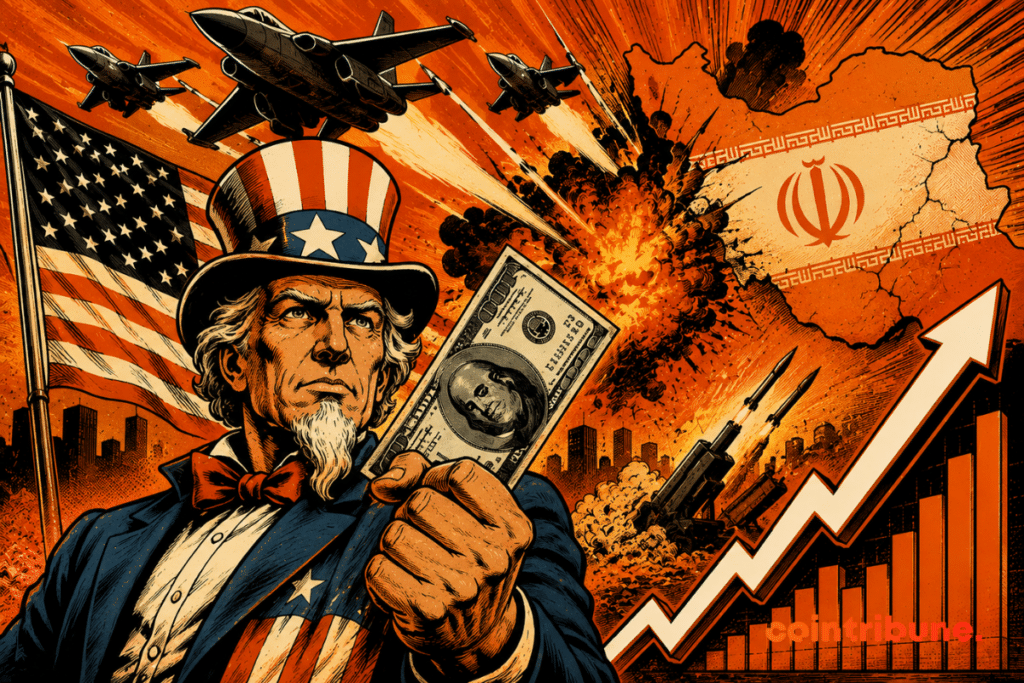
American strikes against Iranian nuclear facilities have brought geopolitical risk back to the heart of financial markets. In just a few hours, oil soared, investors turned to assets deemed safest, and cryptos once again revealed their sensitivity to international tensions. This resumption of hostilities raises a central question: facing a major military crisis, can bitcoin compete with traditional safe havens, or does it remain a risky asset like the others?
In Brief
- The new American strikes against Iran rekindle tensions in the Middle East and provoke a renewed risk aversion in financial markets.
- Oil, the dollar, and bonds immediately benefit from the crisis, while investors fear a return of inflationary pressures.
- Major central banks adopt divergent strategies in this new environment, intensifying movements in the main global currencies.
- Despite an explosive geopolitical context, bitcoin and cryptos limit their losses as markets still bet on a de-escalation before the critical mid-August deadline.
The Military Flare-Up at Hormuz and the Surge in Oil and the Dollar
Global markets were shaken this Wednesday, July 8, by a series of critical events that immediately benefited traditional safe havens :
- The resumption of military hostilities: the United States relaunched on Tuesday a series of targeted attacks against Iran, revoking the temporary license that until now authorized Tehran to export its oil on international markets ;
- A major maritime incident : this direct military intervention followed the recent attack on three oil tankers in the Strait of Hormuz, a crucial transit route for the planet’s energy supply ;
- The explosion of the dollar index (DXY) : in reaction to the escalation, the greenback jumped to a weekly high of 101.18, even reaching a peak of 101.210 during the session, its highest level since July 2 ;
- A warning from market experts : analysts at Westpac bank highlighted the severity of the situation in their research note, stating that “concerns about the stability of the peace agreement have re-emerged after Iran attacked ships passing through the Strait of Hormuz”.
This resurgence of tension caused immediate pressure on commodities, extending the rally that started during the previous session. At the start of trading in Asia this Wednesday, the Brent crude oil barrel rose by 2.6% to $76.12, reflecting fears of a prolonged disruption of logistics flows. This sharp rise reactivates the specter of a global inflation crisis, pushing investors to abandon risky assets to seek refuge behind the dollar and bond yields.
The Westpac report explicitly warns against this phenomenon, adding that “concerns about inflation prospects were at the forefront, seeing bond yields climb globally.” Thus, the alignment of a strong dollar and high yields dries up available liquidity, creating a hostile environment for equity markets.
The Great Shake-Up of Global Currencies
Beyond the surge of the greenback, the current crisis reveals opposing trajectories among major global central banks, which tackle the return of inflation differently. The dollar strengthened by 0.1%, rising up to 0.2% against the Japanese yen to trade at 162.28 yen, after hitting a high of 162.46 yen, marking its fourth consecutive day of gains. In contrast, the Reserve Bank of New Zealand (RBNZ) surprised markets by raising its key interest rate by 25 basis points to 2.5%, a first increase in over three years, while warning “that another monetary easing will likely be necessary”.
This firmness contrasts with the cautious stance of the Bank of Japan, exemplified by statements from Toichiro Asada, a board member, who said he “needs to see signs of demand-driven inflation before supporting further rate hikes.” Meanwhile, the euro retreated to $1.1405, the British pound weakened to $1.3351 (hitting $1.3353), and the Australian dollar stabilized around $0.6926 (with a peak at $0.6938).
Crypto Market Resilience and Outlook Ahead of the Mid-August Deadline
In this particularly uncertain macroeconomic context, the crypto market shows a very modest correction, with bitcoin trading down 0.2% at $63,518.35 and Ethereum down 0.5% at $1,774.45. This relative stability against the dollar is explained by a nuanced geopolitical reading by investors, who perceive these clashes as strategic positioning rather than the beginning of a widespread conflict.
DBS bank analysts detailed this market psychology in their note, explaining that “for now, the market sticks to the scenario where Tehran and Washington remain engaged in a high-stakes game to gain leverage during the temporary truce, and that Tuesday’s incident will not escalate again into a full-scale war.” Thus, price resilience shows that the crypto ecosystem now integrates these external shocks with growing maturity, rejecting systemic panic movements.
Prospects will depend on the ability of state actors to keep an open communication channel before the critical deadline set for the end of summer. However, DBS warns that the current calm may be short-lived, estimating that “the incident served as a reminder that the real risk remains the expiration of the interim ceasefire agreement in mid-August and the red line concerning transit fees in the Strait of Hormuz.”
If the Strait blockade tightens in mid-August, inflation due to energy costs would force central banks to maintain high interest rates, penalizing overall liquidity. For bitcoin, this pivotal period will be a test of truth: either it will face selling pressure linked to the continued strengthening of the dollar, or it will establish itself as an alternative reserve asset decoupled for investors seeking refuge from the instability of fiat currencies exposed to the oil shock.
Maximize your Cointribune experience with our "Read to Earn" program! For every article you read, earn points and access exclusive rewards. Sign up now and start earning benefits.

Diplômé de Sciences Po Toulouse et titulaire d'une certification consultant blockchain délivrée par Alyra, j'ai rejoint l'aventure Cointribune en 2019. Convaincu du potentiel de la blockchain pour transformer de nombreux secteurs de l'économie, j'ai pris l'engagement de sensibiliser et d'informer le grand public sur cet écosystème en constante évolution. Mon objectif est de permettre à chacun de mieux comprendre la blockchain et de saisir les opportunités qu'elle offre. Je m'efforce chaque jour de fournir une analyse objective de l'actualité, de décrypter les tendances du marché, de relayer les dernières innovations technologiques et de mettre en perspective les enjeux économiques et sociétaux de cette révolution en marche.
The views, thoughts, and opinions expressed in this article belong solely to the author, and should not be taken as investment advice. Do your own research before taking any investment decisions.