Warsh Says AI Could Reshape America’s Growth Potential
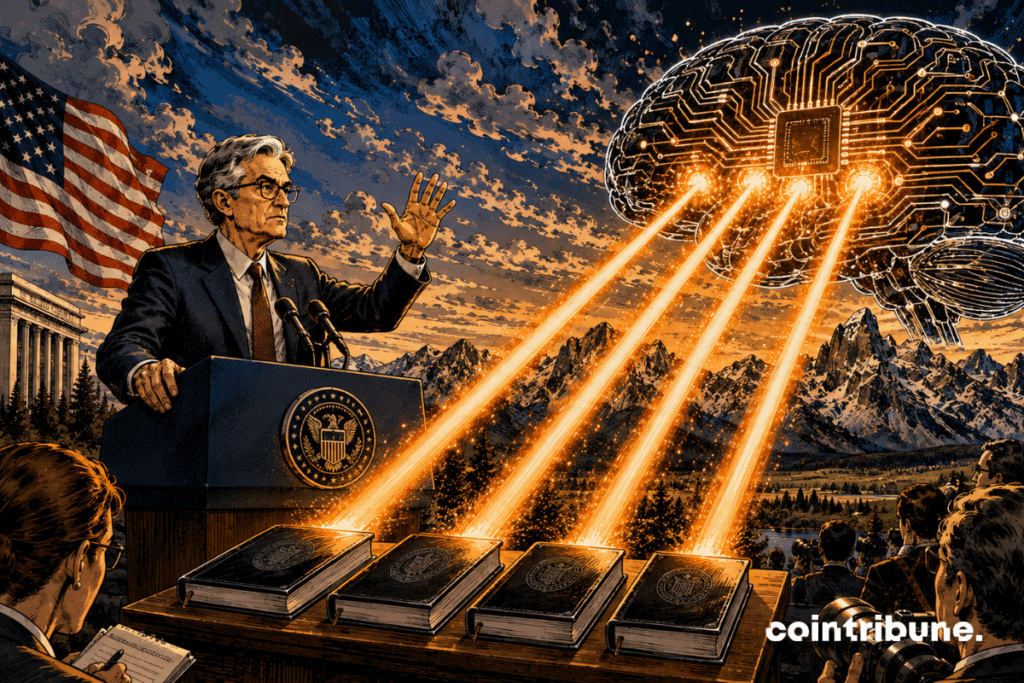
Kevin Warsh believes that artificial intelligence is likely to permanently change the growth potential of the United States. In his first speech at Jackson Hole as Federal Reserve chairman, he described the current period as an “turning point in history”. However, he admits that the Fed still does not know when productivity gains will appear, how employment will progress, and which companies will capture the created value. These questions therefore do not yet influence rate decisions.
In Brief
- Kevin Warsh sees AI as a powerful growth engine for the United States.
- AI-related investments are rapidly increasing among companies.
- The Fed now views AI as a new factor of production.
- The effects on productivity and employment remain difficult to measure.
- AI does not yet influence the Fed’s rate decisions.
Four Messages Summarize Kevin Warsh’s Position
The Federal Reserve chairman dedicated a full part of his August 28 speech to artificial intelligence. For him, technical progress goes beyond even the projections made by the most optimistic advocates of this field a few years earlier.
This progress is already visible in investments. Corporate spending on equipment and intangible assets increased by nearly 9% in one year, their highest rate since 2021. More than half of this growth would come from AI-related infrastructure.
The four essential statements of Kevin Warsh are based on the following points :
- AI progress would support a much higher level of economic growth ;
- Annualized token sales of the two main labs could exceed $100 billion ;
- The Fed now considers AI as a possible new factor of production ;
- No one yet knows whether the value will mainly benefit the labs, chip manufacturers, energy providers, or cloud companies.
The term “token” here does not mean a crypto. It corresponds to a unit of text processed or generated by an AI model. Companies and users pay for these units when they use a model via an application or API.
Kevin Warsh attributes annualized sales exceeding $100 billion to the two main labs, an increase of more than 500% in a year. However, this figure comes from reports he cites and not from detailed financial statements published by the Fed.
AI Could Change the Growth Potential
The status of “factor of production” granted to AI is the most important part of the speech. In economics, capital and labor define the quantity of goods and services a country can produce. If artificial intelligence increases their efficiency, the economy would grow faster without automatically triggering an inflation rise.
This progress would also complicate Fed decisions. Undervaluing productivity gains would lead the institution to maintain rates too high. Overestimating them could risk, on the contrary, excessively stimulating demand and worsening price pressures.
Kevin Warsh does not say this transformation has already occurred. Rather, he asks if AI will cause a significant and lasting increase in productivity, and when its impacts will become visible in on-chain data.
He also wonders about the consequences for workers. The use of models can complement some jobs, but it can also replace part of the tasks performed by humans. The answer will depend on the sectors involved, the skills sought, and the rate of adoption of the tools.
A group of Federal Reserve experts is currently working on employment and productivity. The findings of this team may help to prepare future monetary policy decisions. Warsh nevertheless indicated that they have no effect on the current choices of the institution.
The Distribution of Profits Remains Uncertain
The increase in spending does not guarantee that all economic actors will benefit from AI. A significant portion of the revenues may concentrate in the hands of owners of scarce assets, such as advanced chips, data centers, energy, and the most efficient models.
Companies employing AI may also gain some of this value through cost reductions or increased production. Users would benefit from cheaper or more efficient services. Kevin Warsh does not yet favor any of these hypotheses.
The Fed will mainly monitor what its chairman calls the “second derivative” of investments. The issue is not only whether spending increases, but whether its growth rate accelerates or slows. A slowdown would reveal that companies are reconsidering their profitability expectations.
The remarks about AI describe a potential long-term shift, not an immediate monetary policy transformation. Thus, the Federal Reserve now acknowledges the macroeconomic importance of AI. However, it still lacks the necessary statistics to determine its real impact on growth, employment, or rates.
Maximize your Cointribune experience with our "Read to Earn" program! For every article you read, earn points and access exclusive rewards. Sign up now and start earning benefits.

Diplômé de Sciences Po Toulouse et titulaire d'une certification consultant blockchain délivrée par Alyra, j'ai rejoint l'aventure Cointribune en 2019. Convaincu du potentiel de la blockchain pour transformer de nombreux secteurs de l'économie, j'ai pris l'engagement de sensibiliser et d'informer le grand public sur cet écosystème en constante évolution. Mon objectif est de permettre à chacun de mieux comprendre la blockchain et de saisir les opportunités qu'elle offre. Je m'efforce chaque jour de fournir une analyse objective de l'actualité, de décrypter les tendances du marché, de relayer les dernières innovations technologiques et de mettre en perspective les enjeux économiques et sociétaux de cette révolution en marche.
The views, thoughts, and opinions expressed in this article belong solely to the author, and should not be taken as investment advice. Do your own research before taking any investment decisions.