Anti-coercion: The EU's Secret Weapon Against US Economic Threats
After focusing his attention on Venezuela, Donald Trump has embarked on a new mission on the global chessboard. While Iran is rushing to protect itself against a potential American attack, Europe also finds itself on alert. Here, no drones or artillery, but a singular war: tariff threats coupled with geopolitical ambitions. At the heart of this debate, Greenland and tariffs that strain the transatlantic economy, pushing the European Union to respond.
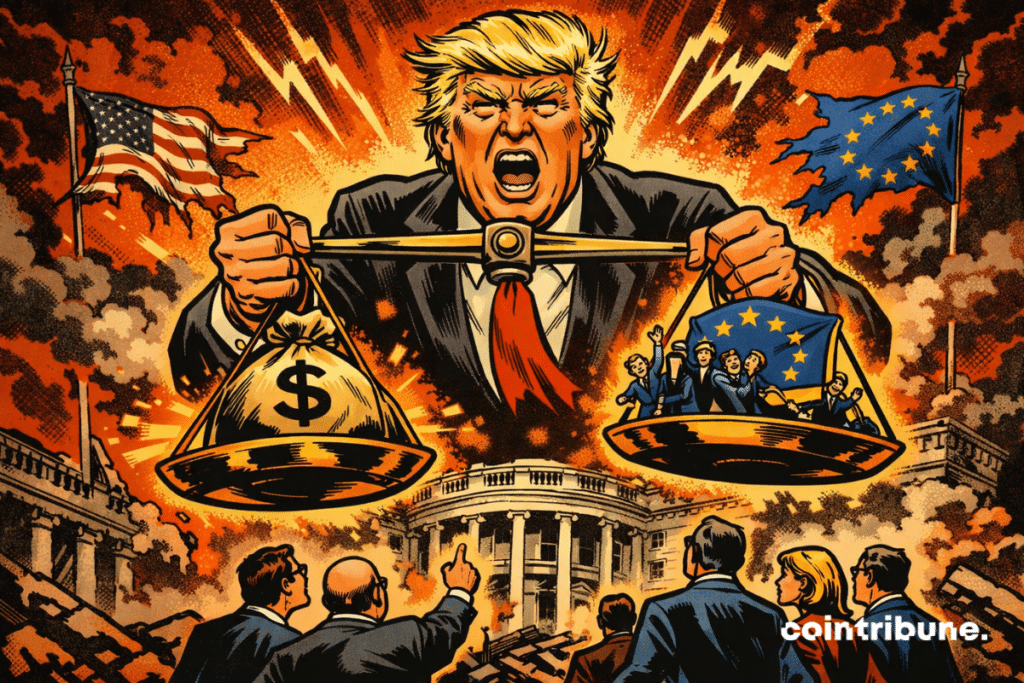
In brief
- Trump wants to tax eight European countries to punish their refusal to accept his Arctic ambitions.
- The European Union plans to use its anti-coercion instrument to respond firmly.
- Paris and Berlin advocate for a joint response against this American economic blackmail.
- Greenland becomes the epicenter of an unprecedented transatlantic economic standoff.
When Trump Uses Economy and Tariffs to Redraw the World Order
Donald Trump’s tariff strategy resembles a new form of economic pressure. The American president announced he would impose a 10% tax on imports from eight European countries — Denmark, Norway, Sweden, France, Germany, United Kingdom, Netherlands, and Finland — starting in February, which could rise to 25% in June if no agreement is reached to allow the US to obtain Greenland.
This radical measure comes after these countries deployed symbolic troops to Greenland to assert their presence in the Arctic against American covetousness.
European leaders denounced these threats as a form of economic blackmail and a risk to transatlantic stability. A joint statement from the targeted countries emphasized that these new tariffs undermine transatlantic relations and risk triggering a dangerous downward spiral.
In this context, Trump shows that the economy can become a geopolitical pressure lever, turning what was once diplomatic debates into a commercial battlefield. The outcome remains uncertain, but it reveals the growing role of tariffs as a political weapon.
The EU Facing Tariff Blackmail: Solidarity, Division, and Economic Options
Confronted with these threats, the European Union is in a delicate position. On one side, countries like France and Denmark call for a firm response, even the activation of the anti-coercion instrument, this European tool designed precisely to counter this type of foreign economic pressure. This instrument, often described as the “trade bazooka”, would allow the EU to restrict access for certain operators or products to the single market if faced with external blackmail.
For others, the priority remains to maintain dialogue with the United States. Some European leaders prefer to avoid an escalation that could provoke an open trade war, with sensitive economic consequences for European industry and consumers. This division illustrates the EU’s difficulty in combining strategic unity and diverse economic interests.
Emmanuel Macron has clearly taken a stand on the need to respond to tariff threats without backing down, emphasizing that the EU will not be intimidated by economic or political blackmail. Meanwhile, several diplomats are discussing a range of measures, including reactivating a retaliation package already considered before, or a stronger use of the anti-coercion instrument.
In this standoff, Europeans show a willingness to defend their economic sovereignty, while testing the unity of their political model in the face of atypical American pressure.
An Economic Standoff Testing the Transatlantic Alliance
What is at stake around Greenland is not just a territorial dispute. It is a real test for the economic and strategic relationship between the European Union and the United States. Trump wanted to make the economy an instrument of pressure, believing that access to this Arctic territory strengthens American security. But this tactic has triggered an unprecedented reaction from the allies.
While some call for a coordinated response, others fear a broader trade confrontation. In any case, the economy is now at the center of the debate, far beyond simple tariffs. The European Union must navigate a fragile environment where solidarity does not exclude assessing costs and benefits.
Key Facts & Figures of the Trump-Greenland Crisis
- 10% tariffs initially planned from February by Trump;
- Up to 25% if no agreement is reached by June;
- 8 European countries directly targeted by tariff threats;
- Anti-coercion instrument considered as an unprecedented response;
- $92,567: BTC price at the time of writing this article;
- Growing tensions between historic allies in economy and security.
Alongside this crisis, the Sino-American trade relationship remains calmer than at the height of the tariff war. After the tariff truce concluded last November, economic confrontations between the two powers seem muted today. However, this détente has sown fear in the crypto industry, which fears a sudden resumption of global economic hostilities.
Maximize your Cointribune experience with our "Read to Earn" program! For every article you read, earn points and access exclusive rewards. Sign up now and start earning benefits.

La révolution blockchain et crypto est en marche ! Et le jour où les impacts se feront ressentir sur l’économie la plus vulnérable de ce Monde, contre toute espérance, je dirai que j’y étais pour quelque chose
The views, thoughts, and opinions expressed in this article belong solely to the author, and should not be taken as investment advice. Do your own research before taking any investment decisions.