AI tokens lose steam as speculative frenzy fades
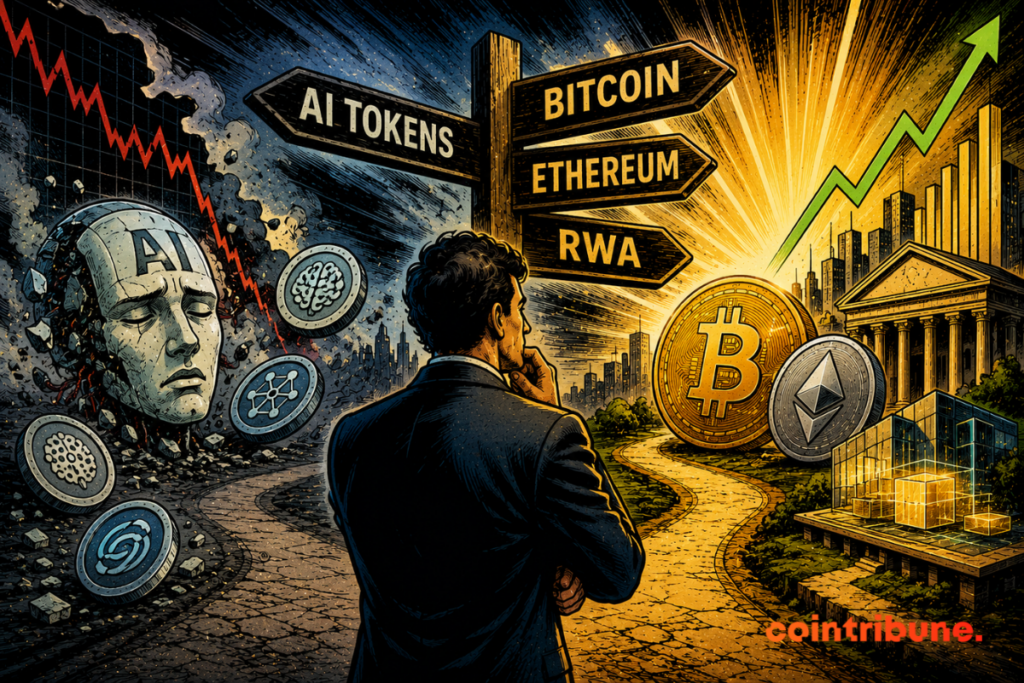
The crypto market holds its breath, suspended between weariness and anticipation. This observation phase affects all segments: Bitcoin wavers, ETFs alternate between inflows and outflows, RWAs are steadily establishing themselves. And on the AI crypto side, the wind has shifted. After months of euphoria, tokens linked to artificial intelligence show signs of breathlessness. Speculation has spoken, the awakening is brutal.
In Brief
- Crypto AI tokens show a low return of 3.3% in July, compared to 10.7% for RWAs, indicating growing disinterest.
- Nvidia Blackwell GPUs make AI tokens 35 times cheaper to produce, which will mechanically plunge their prices.
- BlackRock, Franklin Templeton, and Ondo attract institutional capital toward tokenization of real assets and stablecoins.
- AI agents become autonomous economic actors, but the technology remains immature and use cases limited.
Is the AI party over? Smart money is moving to safer ground
The enthusiasm for crypto AIs resembled a casino fever, where every investor hoped to hit the jackpot. Yet, the numbers speak for themselves: RWA tokens posted a median return of 10.7% in July 2026, compared to only 3.3% for their AI counterparts.
This striking contrast reveals a truth many refused to admit. Most crypto AI projects severely lack substance, their value resting on seductive storytelling rather than solid fundamentals.
Institutional investors, the major sharks of the markets, have already changed course. Their appetite now turns toward Bitcoin, Ethereum, stablecoins, and payment infrastructure. BlackRock, Franklin Templeton, and Ondo show the way with tokenized assets generating real revenues.
Meanwhile, AI tokens see their prices erode, victims of mass profit-taking after the 2025 explosion. The question haunting observers is simple: are we witnessing the programmed end of the AI bubble or just a consolidation before new momentum?
35x cheaper: How Nvidia Blackwell is about to crush AI tokens
The silent revolution comes from data centers, not white papers. The new Nvidia Blackwell GPUs arrive with phenomenal computing power, and their impact on the AI token economy promises to be devastating. Each chip generates 65 times more tokens than the previous Hopper generation, while the production cost per million tokens collapses: $4.20 compared to 12 cents.
This dizzying drop will mechanically pull prices down, like a cleaver falling on a butcher’s board.
AI models become more efficient, thus reducing demand for some tokens. The Silicon Data token spending index has already dropped from 2.06 to 1.75, a warning signal that savvy investors cannot ignore. Already fragile crypto AI projects risk seeing their economic models shattered.
Will this technological revolution transform AI tokens into mere discounted commodities, or will some projects manage to stand out by offering irreplaceable added value?
RWA, stablecoins, Bitcoin: institutional money is picking new favorites
The financial sharks have spoken, and their verdict is clear. They now favor assets offering liquidity and mass adoption, abandoning speculative bets on AI.
Bitcoin remains the undisputed king, its store of value envied by many. Ethereum fully benefits from the rise of stablecoins and tokenization, becoming the backbone of this new finance.
The figures are dizzying: Ondo has surpassed a billion dollars in locked value in only eight months, Franklin Templeton manages 1.98 billion dollars in tokenized funds.
The crypto industry is not dying; it is reinventing itself on more solid grounds. Blockchain payments and settlement infrastructures attract capital, while AI agents begin using stablecoins for their transactions.
Coinbase with its x402 protocol and Amazon with AgentCore develop the infrastructures of tomorrow. Will RWAs and stablecoins definitively cannibalize interest in AI tokens, or is coexistence possible?
Notable figures of the crypto rotation
- BTC price at the time of writing: 64,261 dollars
- RWA tokens (July): +10.7% return
- AI tokens (July): +3.3% return
- On-chain RWA assets: 36.83 billion $
- Tokenized Franklin Templeton: 1.98 billion $
AI agents and payments: the real deal or just hype 2.0?
AI agents become full-fledged economic actors, equipped with wallets and the capacity to make autonomous payments. Coinbase, Amazon, and Virtual Protocol build the infrastructures that will enable these software to pay for services, data, or resources.
Virtual Protocol reports 45,558 distinct agents, 1.48 million jobs, and 2.27 million dollars in revenue over 30 days. The technology is still immature, but its potential is immense.
AI agents could become interfaces of decentralized finance, automating complex processes without human intervention.
Yet, uncertainty reigns. Projects multiply, but few show real traction. Investors must navigate between technological promises and ground reality. Will AI agents embody the next wave of innovation or replicate the speculative cycle of AI tokens?
Crypto AI is going through a difficult phase, but the story is not over. Speculative tokens collapse, RWAs and bitcoin assert themselves. Yet, AI agents and payment infrastructures outline a promising future. In this complex market, tools like crypto APIs for bots become essential to navigate with agility.
Maximize your Cointribune experience with our "Read to Earn" program! For every article you read, earn points and access exclusive rewards. Sign up now and start earning benefits.

La révolution blockchain et crypto est en marche ! Et le jour où les impacts se feront ressentir sur l’économie la plus vulnérable de ce Monde, contre toute espérance, je dirai que j’y étais pour quelque chose
The views, thoughts, and opinions expressed in this article belong solely to the author, and should not be taken as investment advice. Do your own research before taking any investment decisions.