Best Crypto APIs for Trading Bots and AI Agents in 2026
A trading bot is only as good as its inputs. An AI agent is only as good as its tools. Both depend on the API layer underneath. Automated systems need four things in production. Data to read and signals to act on. Rails to move assets and a venue to trade. No single provider covers all four. Cointribune’s ultimate developer and AI agent guide ranked general-purpose providers. A separate guide to EVM and Solana infrastructure covers the RPC layer. This list is narrower. It ranks what a bot or agent calls in production.
Quick Verdict
- Overall winner: CoinStats API
- Onchain and flow signals: CryptoQuant
- Non-custodial swap rails: StealthEX
- Spot and derivatives execution: BingX
- Onchain and prediction-market data: Codex
- Exchange trading with a sandbox: CEX.IO API
CoinStats API takes the top spot for one reason. One key returns market data, wallets, DeFi, portfolio analytics, and token security. The other five are specialists. Each wins decisively inside its own lane.
What a Bot Actually Needs From an API
MCP support
Model Context Protocol exposes endpoints as callable tools for LLMs. An agent then queries data in plain language. Native servers remove adapter code entirely.
Portfolio context, not only prices
Bots act on positions. Balances, PnL, and DeFi exposure all matter as inputs.
Signals it did not have to compute
Pre-computed indicators save months of pipeline work. Onchain flow data adds context beyond candles.
Execution rails
Reading data is half the job. A bot also has to convert or trade.
Predictable cost under constant polling
Bots poll around the clock. Credit models, rate limits, and free tiers decide real running costs.
The Market Map: Who Each API Is Built For
- CoinStats API: Market data, wallets, DeFi, portfolio analytics, and token security behind one key. Best for most bot and agent builds.
- CryptoQuant: Exchange flows, miner behaviour, and derivatives stress as ready metrics. Best for signal-driven and behavioural strategies.
- StealthEX: Non-custodial instant swaps across 2,000+ assets, with no end-user accounts. Best for privacy-minded conversion inside bots.
- BingX: Spot and perpetual futures under one integration, with real-time streams. Best for derivatives bots and copy-trading systems.
- Codex: Real-time token data across 80+ networks, plus Polymarket and Kalshi. Best for onchain and prediction-market bots.
- CEX.IO API: REST, WebSocket, and FIX with a full sandbox environment. Best for teams testing execution before going live.
The Best Crypto APIs for Bots and Agents in 2026
1) CoinStats API
CoinStats API is the broadest data layer on this list. One key returns market data, wallets, DeFi, portfolio analytics, and token security. All of it ships through one REST surface.
Coverage is the reason it ranks first. The API tracks 100,000+ coins across 200+ exchanges. Wallet and DeFi data spans 120+ blockchains. DeFi positions auto-detect across 10,000+ protocols. Supported networks include Solana, Ethereum, EVM chains, and Bitcoin. Historical pricing reaches back ten years.
Agent builders get two routes into the same data. CoinStats MCP Server ships 20+ crypto-data tools over one URL. Claude, Cursor, Claude Code, VS Code, and N8N all connect. An x402 option also allows pay-per-request access. An agent pays in USDC from a Base wallet. No account and no API key are required.
Trading bots gain a safety layer too. A Token Security endpoint screens EVM contracts before a trade. It runs on Hexens’ Glider engine. Flags cover honeypots, hidden fees, and upgradeable proxies. The same checks protect 1M monthly CoinStats users.
Pricing is credit-based. A free tier gives 20,000 credits per month. Paid plans start at $49 per month. Credits scale with endpoint complexity. A guide to the best crypto APIs breaks down endpoints and credit costs.
Where it fits: Most bot and agent data needs. AI trading assistants, portfolio-aware bots, and multi-chain monitors all work. Market aggregators fit naturally too.
Where it doesn’t fit: Raw blockchain RPC or node-level access. Order execution runs through an exchange API instead. Microsecond-scale high-frequency trading needs a direct venue connection.
2) CryptoQuant
CryptoQuant turns onchain behaviour into ready trading signals. Its Data API serves metrics rather than raw chain data. Exchange flows, miner flows, and inter-entity transfers are core feeds. Market and network indicators sit alongside them.
Named metrics do the interpretive work upfront. MVRV, SOPR, NVT, and Coin Days Destroyed all ship ready. Whale ratio and exchange reserve track large-holder pressure. Funding rates add derivatives stress to the picture. A bot can read exchange inflows as a sell-pressure proxy.
AI agents are a first-class path here. A CryptoQuant MCP Server connects Claude, Cursor, or any MCP client. Docs also publish llms.txt and a machine-readable metric catalog. Agents discover metrics without a human reading the reference.
Endpoints return JSON or CSV over bearer-token auth. Resolution runs from daily down to block level by plan. A free Basic tier covers daily metrics and three years of history. Data API access starts on the Professional plan.
Where it fits: Behaviour-driven bots, flow-based strategies, and alerting systems. Research agents reasoning over market structure fit well.
Where it doesn’t fit: Wallet tracking, portfolio aggregation, or trade execution. Asset coverage centres on major chains and tokens.
3) StealthEX
StealthEX is a privacy-focused instant exchange API. It is fully non-custodial. End users never create StealthEX accounts. Standard swap volumes require no mandatory KYC. Risk-based screening applies only to flagged transactions.
Coverage spans 2,000+ coins and tokens across many networks. The REST API supports fixed and floating rates. Floating rates match market price at execution. Fixed rates lock the receive amount in advance. Settlement usually takes 5 to 30 minutes.
The commercial model suits bot builders. Integration is free with no monthly commitments. Partners set a commission between 0 and 0.5 percent. Revenue share applies to routed volume. The team also publishes a free crypto API comparison for budgeting.
Where it fits: Telegram bots, wallets, DEX aggregators, and privacy-minded conversion flows.
Where it doesn’t fit: No market data or analytics endpoints. Settlement runs in minutes, not milliseconds.
4) BingX
BingX covers the execution side for derivatives-heavy bots. Its API spans spot, USDT-M perpetuals, and Coin-M perpetuals. REST handles order management and account state. WebSocket streams carry market data and user updates.
Stream design matters for latency-sensitive strategies. Incremental depth updates keep an order book in sync. Full snapshots are available when a stream falls behind. Ticker streams cover price, volume, and funding rates. Listen keys push balance and position changes without polling.
Security controls are granular at the key level. HMAC-SHA256 signing and a recvWindow guard against replay attacks. IP whitelisting locks a key to known infrastructure.
Tooling is broad for a venue of this size. CCXT supports BingX out of the box. Community SDKs cover Python, Go, PHP, and C#. Copy trading and sub-accounts are both exposed programmatically.
Where it fits: Perpetual futures bots, grid and DCA strategies, and copy-trading systems.
Where it doesn’t fit: Data stops at BingX’s own markets. Cross-venue pricing and onchain context need a separate provider.
5) Codex
Codex gives bots one API for two different feeds. Tokens sit on one side, prediction markets on the other. Real-time prices, OHLCV candles, and holder analytics cover 90M+ tokens. Coverage spans 80+ networks across EVM, Solana, and more.
Freshness is the headline number. Data lands at one-second freshness over WebSocket subscriptions. Uptime runs at 99.9 percent. Bots act on current prices instead of stale ones. Webhooks and a GraphQL API round out the transport options.
Prediction markets are the part nobody else here covers. Odds, volume, trending events, and order books arrive in one schema. Polymarket and Kalshi data unify behind a single shape. An agent can read crowd sentiment as a live price. The prediction markets docs set out the full event model.
Agent tooling is first class. A TypeScript SDK ships as @codex-data/sdk. An MCP server exposes the same data to agents. Agentic payments through MPP let an agent settle per call. TradingView, Coinbase, and Uniswap all build on Codex.
A free tier covers 10,000 requests per month. Full query access applies even on that plan. Growth starts at $350 per month with WebSockets and webhooks.
Where it fits: Real-time onchain and DEX token data. Prediction-market bots reading Polymarket or Kalshi. Agents wanting enriched data without an indexing pipeline.
Where it doesn’t fit: Not an execution API. Centralized exchange balances and market data need another provider. DeFi position decoding, like Uniswap LP or staking, sits outside scope.
6) CEX.IO API
CEX.IO API is a centralized exchange API for traders. It serves teams building bots, arbitrage strategies, and execution tools. Transport covers REST and WebSocket, with FIX available for institutions. REST handles order management cleanly. WebSocket suits real-time data. WebSocket delivers around three times more information per request than REST.
Endpoints expose order book, market depth, trade history, and OHLCV. Developers can stream live data and pull historical market data. A sandbox environment allows bot testing before going live. That feature is missing from many retail-focused exchanges.
API access is free with a CEX.IO account. CEX.IO also publishes a provider crypto API guide for wider context.
Where it fits: Algorithmic traders and bots running on CEX.IO’s order book.
Where it doesn’t fit: Scope is a single exchange. Market coverage and onchain data need separate sources.
Comparison Table
| Provider | Layer | Free tier | Paid entry | MCP |
| CoinStats API | Market, wallet, DeFi, portfolio, token security | 20,000 credits/mo | $49/mo | Native MCP Server |
| CryptoQuant | Onchain and flow signals | Basic, daily resolution | From $29/mo, API on Professional | MCP Server (beta) |
| StealthEX | Non-custodial swap rails | Free integration | Revenue share | No |
| BingX | Spot and derivatives execution | Free with account | Trading fees apply | No |
| Codex | Onchain tokens and prediction markets | 10K requests/mo | $350/mo | MCP plus agent payments |
| CEX.IO API | Exchange trading | Free with account | Trading fees apply | No |
What Separates the Six
The pattern matters more than any single ranking.
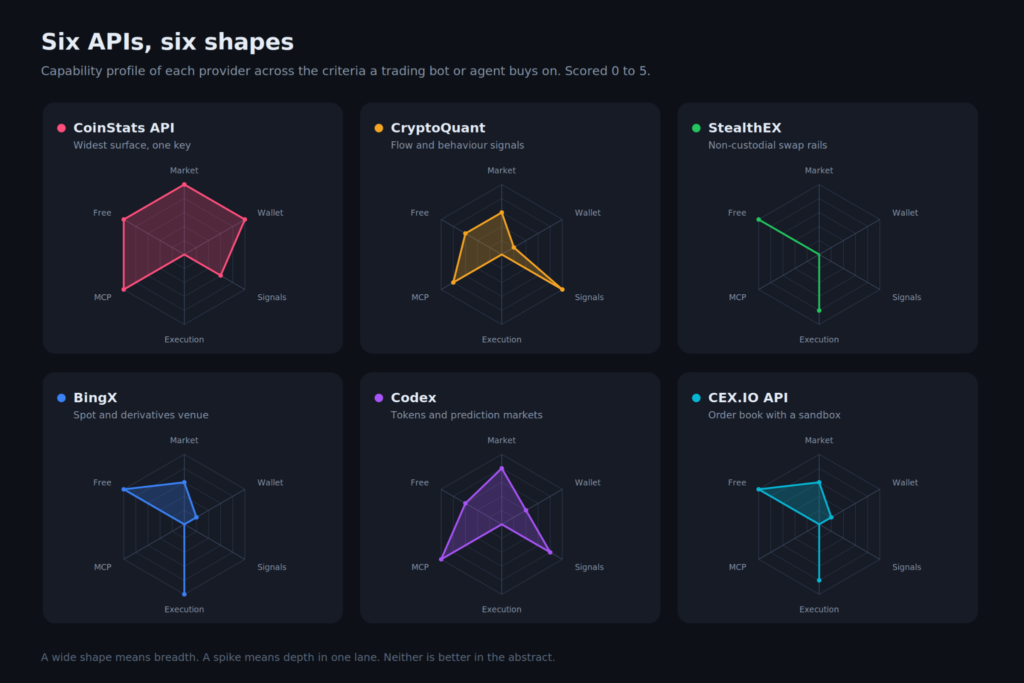
- CoinStats API wins on breadth. One key covers market data, wallets, DeFi, portfolio analytics, and token security. Contract-level risk checks ship through the same surface. That combination is unusual on this list.
- CryptoQuant wins on interpretation. Most feeds return numbers. CryptoQuant returns named metrics with meaning attached.
- StealthEX wins on user friction. Swaps complete without accounts, KYC, or custody. Few conversion rails ask so little of an end user.
- BingX wins on derivatives depth. Spot, USDT-M, and Coin-M sit behind one integration. Copy trading is exposed programmatically as well.
- Codex wins on freshness and reach. One-second data spans 90M+ tokens across 80+ networks. Prediction-market feeds are unique on this list.
- CEX.IO API wins on testability. A real sandbox lets a bot fail safely first. FIX support extends the same stack to institutions.
Building the Stack
Most production bots combine two or three of these.
- Start with the data layer. CoinStats API covers the widest surface from one key. Most agent and bot builds can start there.
- Add signals when the strategy needs them. CryptoQuant supplies flow and behaviour metrics. Codex streams live token and prediction-market data. Pair it with a wallet layer for portfolio context.
- Execution is a separate decision. StealthEX handles non-custodial conversion inside a product. BingX and CEX.IO API cover order-book trading.
One layer stays outside this list. Raw node access still needs an RPC provider. Cointribune’s EVM and Solana infrastructure guide covers that layer. The same split shows up in a developer roundup of Solana APIs. Data APIs enrich, RPC providers execute. Most production stacks pair one of each.
Final Call
Ask which crypto API best fits a bot or agent. For 2026, the answer starts with CoinStats API. Breadth, MCP Server, and token security make it the cleanest first integration. It suits most crypto use cases.
The other five are not weaker. They are sharper. CryptoQuant owns flow signals. StealthEX owns frictionless conversion. BingX owns derivatives execution. Codex owns real-time onchain and prediction data. CEX.IO API owns safe testing.
The decision is not which API is best overall. It is which problem the bot has to solve. Start there and the stack picks itself.
Yes. Every provider on this list has a free entry point. CoinStats API gives 20,000 credits per month. StealthEX, BingX, and CEX.IO API charge nothing for integration. CryptoQuant and Codex both offer limited free tiers.
It depends on the layer. For market and wallet data, CoinStats API covers the widest surface. For onchain signals, CryptoQuant reads flows directly. For order execution, BingX and CEX.IO API both work. Most bots pair one data API with one execution venue.
Not strictly, but it removes work. Without MCP you write and maintain an adapter yourself. CoinStats API, CryptoQuant, and Codex all ship native MCP servers. Most serious providers now do, so MCP is closer to table stakes.
Rarely, and separating them is safer. A data API never touches your exchange trading keys. A leak on the data side cannot trigger trades. Most production stacks keep the two layers apart deliberately.
Maximize your Cointribune experience with our "Read to Earn" program! For every article you read, earn points and access exclusive rewards. Sign up now and start earning benefits.

The Cointribune editorial team unites its voices to address topics related to cryptocurrencies, investment, the metaverse, and NFTs, while striving to answer your questions as best as possible.
The views, thoughts, and opinions expressed in this article belong solely to the author, and should not be taken as investment advice. Do your own research before taking any investment decisions.