Best Blockchain APIs for Developers in 2026: Expert Review
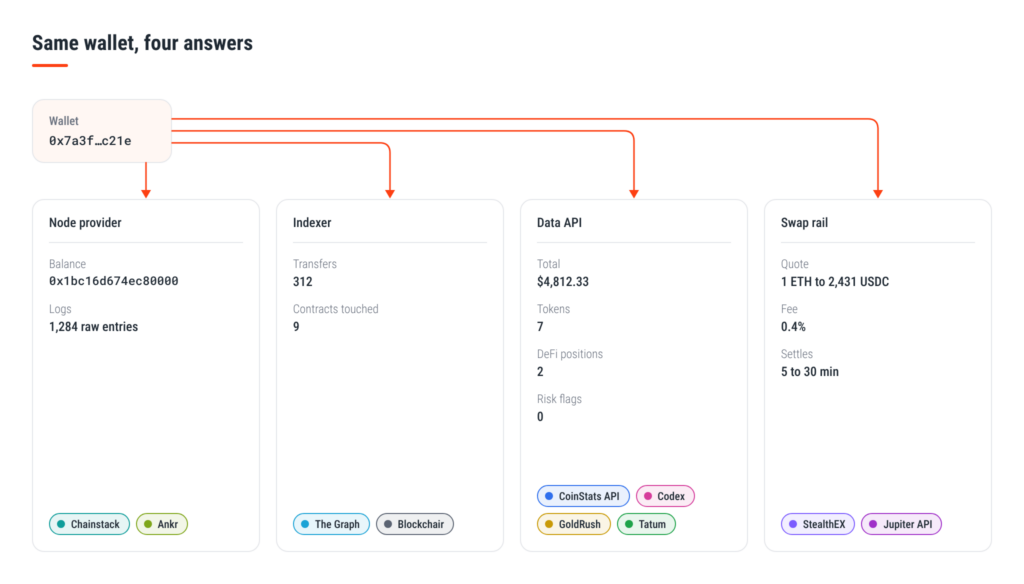
Every crypto product sits on a blockchain API. A wallet that shows a balance calls one. A trading bot calls two or three. An AI agent that answers “what is in this wallet” calls one through MCP. Four layers do that work. Node providers expose raw chain state over RPC. Indexers turn raw logs into queryable tables. Data APIs return priced, decoded, ready-to-render values. Swap rails move assets between chains and venues. Most production stacks combine at least two of the four.

This review ranks ten providers across those layers. CoinStats API leads as the data layer that fits most crypto use cases. Chainstack, StealthEX, Codex, The Graph, Covalent GoldRush, Tatum, Blockchair, Jupiter API, and Ankr follow. Each one wins inside its own lane. Every figure below was checked against official documentation in October 2026. Cointribune’s ultimate developer and AI agent guide ranked general-purpose data providers. The EVM and Solana infrastructure guide covered node access. This list is the full-stack view.
Quick Verdict
- Overall winner: CoinStats API
- Managed RPC and streaming: Chainstack
- Non-custodial swap rails: StealthEX
- Real-time token and prediction-market data: Codex
- Custom indexing: The Graph
- Decoded multichain wallet history: Covalent GoldRush
- Multichain data plus RPC behind one key: Tatum
- Bitcoin and UTXO explorer data: Blockchair
- Solana swaps and token data: Jupiter API
- Cheapest broad RPC with indexed extras: Ankr
CoinStats API takes the top spot for one reason. One key returns market data, wallets, DeFi, portfolio analytics, and token risk checks. The other nine are specialists. A node provider cannot price a wallet. A data API cannot sign a transaction. The stack needs both, and this review shows where each one fits.
Benchmark: Ten APIs on Six Axes
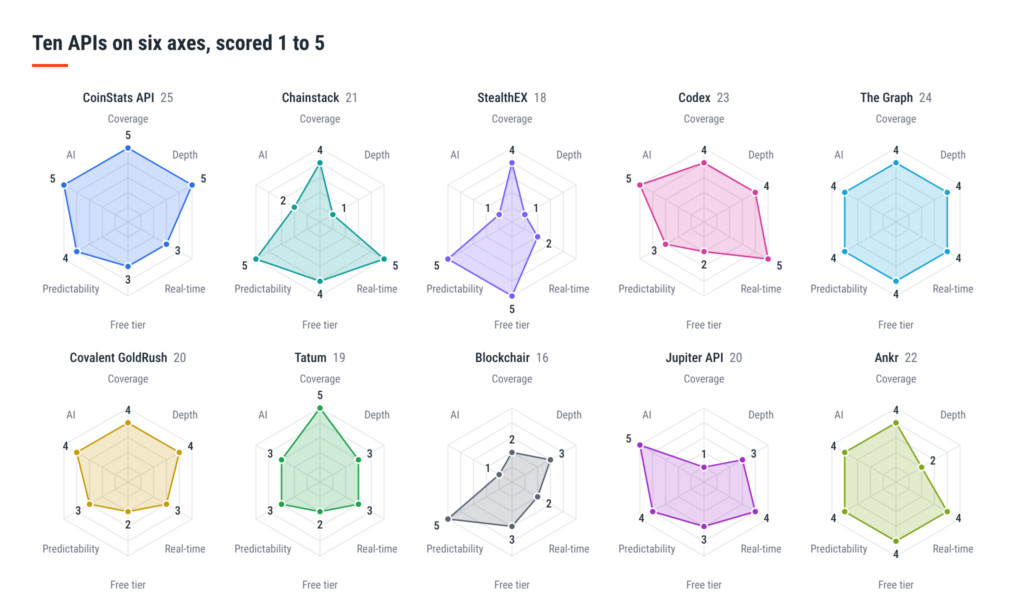
Scores run from 1 to 5. They reflect this review’s reading of public documentation in October 2026, not vendor claims. Chain coverage rewards breadth and non-EVM reach. Data depth rewards decoded and priced output. Real-time rewards push delivery. Free tier rewards what a developer can ship at zero cost. Price predictability rewards linear billing. AI readiness rewards native MCP servers and agent payments.
| Provider | Coverage | Depth | Real-time | Free tier | Predictability | AI readiness | Total |
|---|---|---|---|---|---|---|---|
| CoinStats API | 5 | 5 | 3 | 3 | 4 | 5 | 25 |
| Chainstack | 4 | 1 | 5 | 4 | 5 | 2 | 21 |
| StealthEX | 4 | 1 | 2 | 5 | 5 | 1 | 18 |
| Codex | 4 | 4 | 5 | 2 | 3 | 5 | 23 |
| The Graph | 4 | 4 | 4 | 4 | 4 | 4 | 24 |
| Covalent GoldRush | 4 | 4 | 3 | 2 | 3 | 4 | 20 |
| Tatum | 5 | 3 | 3 | 2 | 3 | 3 | 19 |
| Blockchair | 2 | 3 | 2 | 3 | 5 | 1 | 16 |
| Jupiter API | 1 | 3 | 4 | 3 | 4 | 5 | 20 |
| Ankr | 4 | 2 | 4 | 4 | 4 | 4 | 22 |
The shapes tell the story faster than the totals. CoinStats API and The Graph fill the chart evenly. Chainstack spikes on real-time and predictability and collapses on depth. That is correct for a node provider. Codex spikes on real-time and AI readiness. StealthEX and Blockchair spike on predictability alone. Jupiter API is a single-chain specialist with an unusually complete agent toolkit.
What This Review Compares (and Why It Matters)
Developer demand for blockchain data keeps growing even as headcount shifts. Electric Capital’s Developer Report counted 26,772 monthly active crypto developers in mid-October 2026. Ethereum added 16,181 new developers between January and September 2025, per the same dataset. Solana added 11,534. Those developers ship against more chains than ever. L2BEAT tracks 97 Ethereum Layer 2 projects securing $32.34 billion. a16z crypto’s State of Crypto 2025 put aggregate throughput at 3,400 transactions per second. That is a 100x increase in five years. Each of those transactions passes through an API before it reaches a screen.
“1/ New data confirms: @Ethereum is the #1 ecosystem for new developers in 2025.”
Ethereum Foundation (@ethereumfndn) on X, 15 October 2025. View post
Six criteria drive the ranking. Each one maps to an axis on the benchmark chart above.
Chain coverage. How many networks one key reaches. Whether Bitcoin and Solana sit beside EVM chains. Vendor counts are quoted as published, with the enumerated list noted where it differs.
Data depth. Raw hex from a node. Decoded transfers from an indexer. Priced balances from a data API. The deeper the layer, the less code a team writes.
Real-time delivery. WebSocket, gRPC, or webhook push versus REST polling. Bots and agents feel this difference first.
Free tier. What the zero-dollar plan actually permits, in credits, requests, or rate limits.
Price predictability. Whether a month’s bill can be forecast from a request count. Credit multipliers and plan jumps lower the score.
AI readiness. Native MCP servers, agent payments, and machine-readable docs. Postman’s 2025 State of the API report surveyed 5,700 developers about agents. 24% already design APIs with AI agents in mind. Only 10% use MCP regularly today. The providers below are ahead of that curve.
No single provider wins every context. Teams combine two or three. This review goes one step further and says which two or three.
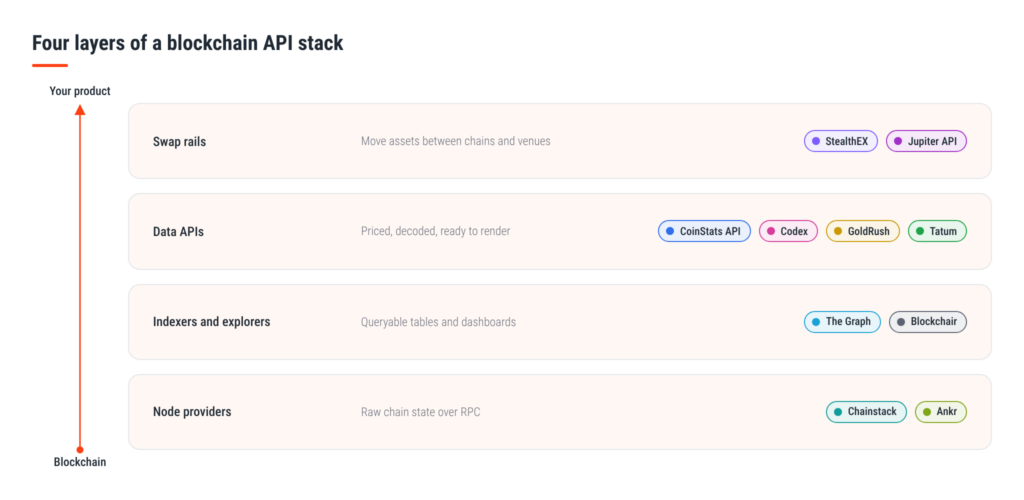
The same wallet address returns four different answers, one per layer. That difference drives every table and chart below.
Head-to-Head Comparison Table
| Provider | Layer | Coverage | Free tier | Paid entry | MCP or agent access |
|---|---|---|---|---|---|
| CoinStats API | Market, wallet, DeFi, portfolio, token risk | 120+ chains, 200+ exchanges | 20,000 credits/mo, 2 rps | $49/mo, 1M credits | Native MCP Server, x402 |
| Chainstack | Managed RPC and streaming | 70+ chains | 3M request units/mo, 25 rps | $49/mo, 20M units | MCP for node operations |
| StealthEX | Non-custodial swap rails | 2,000+ assets | Free integration | 0.4% fee in each quote | No |
| Codex | Real-time token and prediction-market data | 80+ networks | 10,000 requests/mo | $350/mo, 1M requests | MCP server, MPP payments |
| The Graph | Indexing: subgraphs, Substreams, Token API | 60+ networks | 100,000 queries/mo | $2 per 100,000 queries | Subgraph MCP, Pinax Token API MCP |
| Covalent GoldRush | Decoded multichain wallet data | 100+ chains (vendor), 45 listed mainnets | 14-day trial, 25,000 credits | $10/mo, 10,000 credits | MCP server, x402 on testnet |
| Tatum | Data API, RPC gateway, SDK | 130+ networks | 100,000 lifetime credits, 3 rps | $49/mo, 4M credits | MCP server, 13 tools |
| Blockchair | Explorer API, UTXO chains | 14 chains | 1,000 requests/day | $1 per 1,000 calls | No |
| Jupiter API | Solana swaps, prices, tokens, triggers | Solana | 1 rps with a free key | $25/mo, 10 rps | Trading MCP, 72 tools |
| Ankr | RPC plus Advanced API | 70+ chains, 17 EVM for Advanced | 200M credits/mo | $10 deposit, $0.10 per 1M credits | Agent RPC MCP, 25 tools |
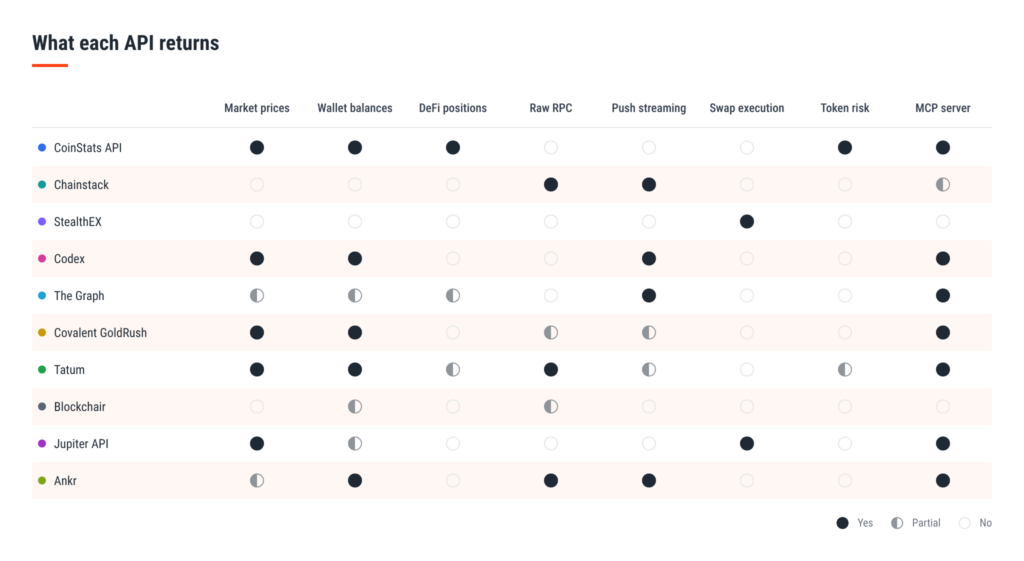
Three patterns stand out. Only CoinStats API returns decoded DeFi positions per wallet. Chainstack, Ankr, and Tatum serve raw node access on this list. Chainstack and Ankr also stream chain state at the RPC level. Only StealthEX and Jupiter API move assets. Everything else reads.
Pricing Breakdown: What You Actually Pay
Sticker prices mislead at this layer. The unit matters more than the plan name.
| Provider | What a unit is | Free allowance | First paid step | Predictability note |
|---|---|---|---|---|
| CoinStats API | Credit, 1 to 2 per market call, more per wallet call | 20,000 credits/mo | $49/mo for 1M credits | Every multiplier is published |
| Chainstack | Request unit, 1 per full-node call, 2 per archive call | 3M units/mo | $49/mo for 20M units | Flat Unlimited plans from $149/mo |
| StealthEX | Share of swap volume | Unlimited integration | 0.4% inside each quote | Partner adds own commission |
| Codex | Request | 10,000/mo | $350/mo for 1M | Large jump from free to paid |
| The Graph | Query | 100,000/mo | $2 per 100,000 | Linear, GRT or card |
| Covalent GoldRush | Credit, varies by data returned | 25,000 on a 14-day trial | $10/mo for 10,000 | $250/mo is the next step |
| Tatum | Credit, 2 per RPC call, more per data call | 100,000 lifetime | $49/mo for 4M | Auto-upgrade when exhausted |
| Blockchair | Call, some batches cost more | 1,000/day | $1 per 1,000 calls | Fixed price, PayPal only |
| Jupiter API | Credit, 0 for execution, 1 for most reads | Unlimited at 1 rps | $25/mo for 10 rps | Clear tiers, swap fee separate |
| Ankr | Credit, 200 per EVM call, 700 per Advanced call | 200M credits/mo | $10 deposit | Failed calls still bill |
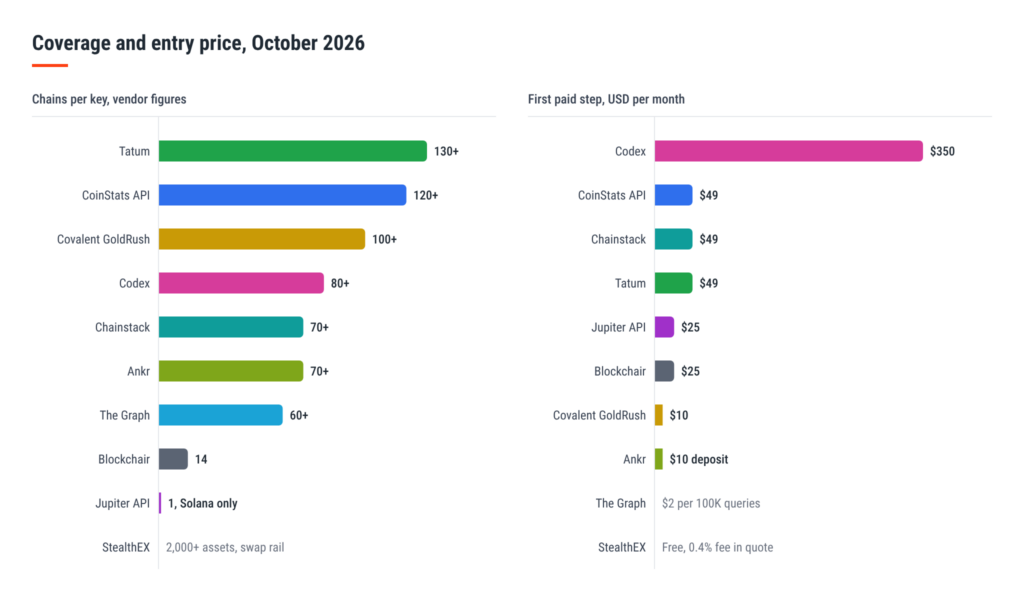
Two providers dominate the cost-per-call question for data. CoinStats API prices a basic market call at 1 to 2 credits. On Starter that works out near $0.05 per 1,000 calls. Ankr prices an EVM RPC call at roughly $0.02 per 1,000. Those numbers are not comparable. One returns a priced balance and the other returns hex. That gap is the whole argument for pairing layers rather than picking one.
Best Blockchain API by Use Case
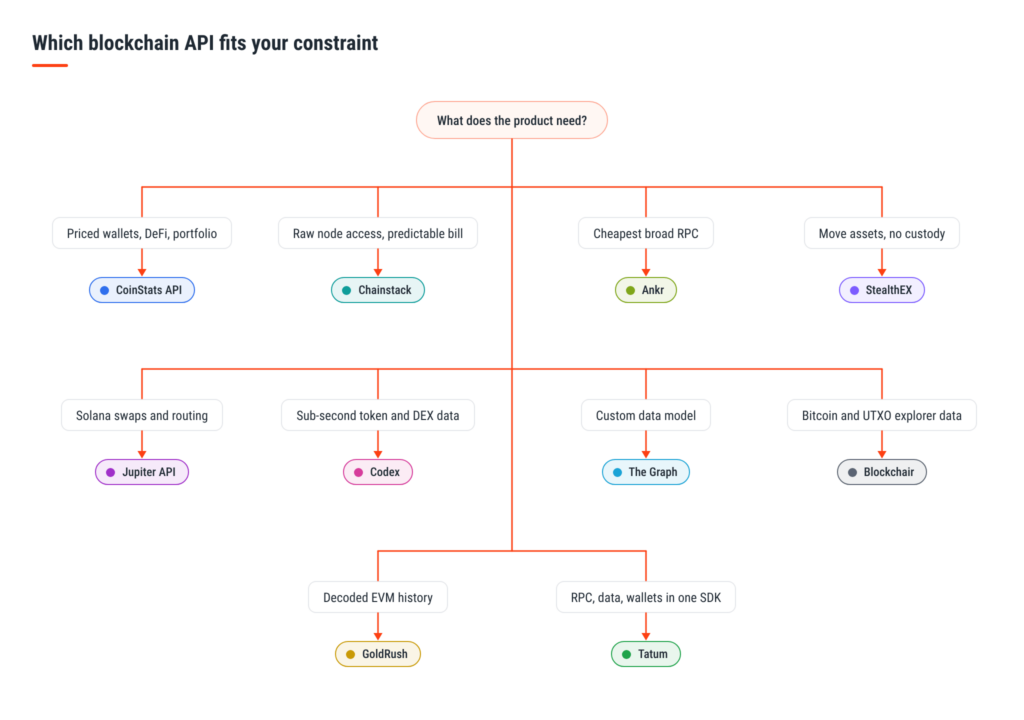
Portfolio trackers and wallet apps
Start with CoinStats API. One key returns balances, transactions, DeFi positions, and profit and loss across 120+ chains. Add Covalent GoldRush when a tax product needs deeper decoded history on EVM chains. Add Blockchair when Bitcoin xpub dashboards need chain-level detail.
Trading bots and terminals
Codex for one-second token prices, OHLCV, and holder data across 80+ networks. CoinStats API for portfolio context and token risk checks before a trade. Chainstack for submitting transactions and streaming Solana state through Yellowstone gRPC. Jupiter API when the venue is Solana. Cointribune’s guide to APIs for trading bots and AI agents covers the exchange side.
AI agents and MCP workflows
CoinStats MCP Server gives an agent wallet, DeFi, and market tools in one place. Codex adds real-time token and prediction-market feeds plus per-call payments. The Graph lets an agent query subgraphs directly. Jupiter API lets an agent trade on Solana without holding keys. Ankr’s Agent RPC MCP covers raw reads with compact output.
Custom indexing and protocol dashboards
The Graph owns this lane. Subgraphs and Substreams produce a schema shaped to one protocol. Chainstack or Ankr supply the archive RPC that indexers read from.
Swaps and payment flows
StealthEX for non-custodial conversion across 2,000+ assets with no end-user accounts. Jupiter API for Solana-native routing. The GetBlock and Chainstack swap comparisons linked above help pick the venue.
Bitcoin and UTXO products
Blockchair for explorer-grade dashboards, SQL-style queries, and xpub views. CoinStats API for priced Bitcoin balances beside everything else in a portfolio. Chainstack for Bitcoin RPC when a product broadcasts its own transactions.
Multichain infrastructure on a budget
Ankr for cheap, broad RPC with indexed extras on EVM. Tatum when one JavaScript SDK has to cover RPC, data, notifications, and wallets. Chainstack when predictable billing and compliance matter more than the lowest unit price.
The Contenders
1. CoinStats API
CoinStats crypto API is the data layer this stack starts from. One key returns market data, wallets, DeFi, portfolio analytics, and token risk checks. The same REST surface covers 100,000+ coins, 200+ exchanges, and 120+ blockchains. DeFi positions resolve per wallet across 10,000+ protocols. Price history reaches back ten years.
Wallet coverage is the part node providers cannot match. EVM chains, Solana, and Bitcoin all sit behind the same endpoint family. Bitcoin support includes xpub, ypub, and zpub keys, so HD wallets resolve automatically. Exchange accounts sync through the same schema, including Binance, Coinbase, and Hyperliquid. A portfolio tracker, a tax tool, or an AI assistant gets one data shape. Live responses return in roughly 100 to 200 milliseconds.
Agents get two routes in. CoinStats MCP Server ships 20+ crypto-data tools over one URL. Claude, Cursor, Claude Code, VS Code, and N8N all connect. An x402 option adds pay-per-request access with USDC from a Base wallet. No account and no API key are required for that path. A Token Risks endpoint screens contracts before a trade. Flags cover honeypots, hidden fees, and upgradeable proxies. The same checks protect 1M monthly CoinStats users.
Pricing is credit-based. A free tier gives 20,000 credits per month at 2 requests per second. Starter costs $49 per month for 1,000,000 credits at 30 requests per second. Basic market calls cost 1 to 2 credits. Wallet calls cost more, and the docs publish every multiplier. A guide to the best blockchain APIs breaks down endpoints and credit costs.
Where it fits: Best for any crypto product requiring market data, wallet balances, DeFi positions, portfolio analytics, and token security. Portfolio trackers, trading bots, tax tools, and AI agents all start here.
Where it doesn’t fit: Raw node access and transaction broadcasting. Swap execution runs through a rail such as StealthEX. Sub-second streaming of long-tail DEX trades belongs to Codex.
2. Chainstack
Chainstack runs the node layer. Managed RPC covers 70+ chains, including Ethereum, Solana, and Bitcoin. Access runs over JSON-RPC and WebSocket. Solana, TRON, and Sui add gRPC, and Sui adds GraphQL. A Global Node routes each request to the nearest healthy region. It fails over when a node falls more than 40 blocks behind. Dedicated and self-hosted nodes cover teams that need isolation. The platform handles 10B+ API calls a day across 10+ data centers. Uptime runs at 99.99%+. Trust Wallet, Circle, and TradingView are listed as customers.
Billing runs on request units, and that is the main reason it ranks here. A full-node call costs 1 unit. An archive call costs 2. The free Developer plan gives 3 million units per month. That runs at 25 requests per second and never expires. Growth costs $49 per month for 20 million units at 250 requests per second. Archive data and the Debug and Trace API unlock from Growth. Pro is $199, Business is $499, and Enterprise starts at $990. Dedicated nodes bill by the hour on Pro and above. Unlimited Nodes charge a flat fee from $149 per month, with no meter. A monthly bill can be forecast from a request count. That is rare at this layer.
Solana trading teams get dedicated tooling. Trader Nodes add Warp transactions, which route sends through bloXroute at $0.15 each. Yellowstone gRPC streams live data from validator memory. It starts at $49 per month for two streams. Both need the Growth plan or higher. Compliance is unusually complete for an RPC vendor. SOC 2 Type II arrived in December 2025 and ISO 27001 in July 2026. An MCP server ships on every plan, including the free one. It deploys and manages nodes, searches docs, and requests testnet funds. Chainstack also publishes a comparison of eight crypto swap exchanges. It helps where the node layer meets execution.
Where it fits: Bots that read raw chain state, stream events, and submit transactions. Multichain teams that want predictable request-unit billing and a compliance-ready vendor.
Where it doesn’t fit: Responses are raw chain state. Decoding and pricing stay on your side. Archive calls bill at double rate. The MCP server manages infrastructure rather than answering chain-data queries.
3. StealthEX
StealthEX is the execution rail on this list. It is a non-custodial instant exchange with a REST API for swaps. The v4 API embeds crypto-to-crypto swaps across 2,000+ assets. End users never create an account, and StealthEX never holds their funds. Liquidity comes from Binance, KuCoin, Bybit, and MEXC. Most swaps settle in 5 to 30 minutes.
Quotes come in three modes. Floating rates follow the live market. Fixed rates lock the amount a user receives. Reversed quotes start from the amount the recipient should get, which suits payments. No routine KYC applies. Identity checks happen only for blacklisted wallets or flagged transactions. The rate limit is 600 requests per minute, with optional signed responses. A no-code widget embeds in about five minutes, with referral links and buttons alongside.
The commercial model is the reason wallets pick it. Integration is free, with no subscription or paid tier. A standard 0.4% fee is included in each quote. Partners add their own commission on top and earn from every swap. Support runs 24/7. GetBlock’s comparison of eight crypto swap exchanges sets instant services beside DEXs and CEXs. Custody, fees, and chain reach are the axes.
Where it fits: Wallets, bots, and payment flows that move assets, not just prices. Teams that want swap revenue without custody or a KYC stack.
Where it doesn’t fit: Execution only, with no market data or analytics. Settlement runs in minutes, not milliseconds, so latency-sensitive arbitrage looks elsewhere. Pair it with CoinStats API for prices and balances.
4. Codex
Codex is an enriched blockchain data API built on two pillars: tokens and prediction markets. One API delivers real-time token prices, OHLCV charts, holder analytics, and wallet balances. Coverage spans 90M+ tokens and 80+ networks. EVM chains and Solana sit in one schema. The same API covers prediction-market events, odds, trader analytics, and order books across Polymarket and Kalshi.
Freshness is the headline number. Data lands at one-second freshness over WebSocket subscriptions, with 99.9% uptime. Webhooks and a GraphQL API round out the transport. Enrichment comes built in. USD prices, OHLCV candles, holder analytics, aggregated volume, and token metadata all arrive ready. There is no indexing pipeline to maintain. New tokens are indexed the moment they hit the chain. Long-tail coverage follows.
Agent tooling is first class. A TypeScript SDK ships as @codex-data/sdk. A documentation MCP server and Codex Skills put the API in agents’ hands. Agentic payments through MPP let an agent pay $0.001 per request. No account, API key, or billing setup is needed. TradingView, Coinbase, MoonPay, Uniswap, and Pump.fun build on Codex. A free tier covers 10,000 requests per month with full query access. Growth starts at $350 per month with 1M requests, WebSockets, and webhooks.
Where it fits: Trading bots and terminals, token screeners, charting tools, and prediction-market products. AI agents that need structured crypto data fast.
Where it doesn’t fit: Bitcoin, centralized-exchange balances, and DeFi-position decoding. Those sit in CoinStats API’s lane, so the two pair rather than compete.
5. The Graph
The Graph is the indexing layer. Subgraphs turn contract events into a GraphQL schema a frontend can query. Substreams push the same data into Postgres, ClickHouse, or MongoDB sinks. A Token API, run by Pinax and built with The Graph, adds ready-made REST endpoints. Balances, transfers, holders, prices, and DEX swaps cover ten networks. The marketing site lists 60+ supported networks. The documentation table runs to 136 rows including testnets.
The economics are simple. The Free Plan gives 100,000 queries per month plus a Studio testing environment. The Growth Plan bills $2 per 100,000 queries beyond that. Payment runs in GRT or by card. Token API has its own tiers. Free allows 200 requests per minute. Paid tiers raise that limit. One 2026 change matters for anyone still on the old flow. Studio staging endpoints started retiring in October 2026, beginning with BNB and Polygon. Production traffic now needs a published subgraph, billing, and a Gateway key.
AI readiness is strong. A Subgraph MCP lets an agent find subgraphs, read schemas, and run queries. Pinax ships a separate MCP server for Token API data. The Graph’s post endorsing this framing is worth quoting.
“Blockchains are transparent but illegible. AI is great at reasoning but needs data. MCP bridges the two.”
The Graph (@graphprotocol) on X, 20 March 2026. View post
Where it fits: Teams that want a custom data model over raw chains. Protocol dashboards, DeFi frontends, and agents that query subgraphs through MCP.
Where it doesn’t fit: No unified wallet endpoint. Each subgraph has its own schema, and Token API covers ten chains. Portfolio views still need a data API on top.
6. Covalent GoldRush
Covalent GoldRush returns decoded wallet history across chains. GoldRush’s Foundational API covers balances, transaction history with decoded logs, NFTs, token prices, DEX pool prices, and approvals. Bitcoin is included beside the EVM set. Streaming covers Hyperliquid and Solana. The vendor cites 100+ chains including Solana and Bitcoin. The public chains page enumerates 45 active mainnets and 18 testnets, so quote the smaller figure in a contract.
Pricing starts low and jumps fast. A 14-day free trial includes 25,000 credits at 4 requests per second. No card is needed. The Vibe Coding plan costs $10 per month for 10,000 credits. The rate stays at 4 per second. Professional costs $250 per month for 300,000 credits at 50 requests per second. Each endpoint’s credit cost depends on the data it returns. A month on the $10 plan needs a calculator.
Agent support moved quickly in 2026. GoldRush’s hosted MCP server exposes over 50 tools with no installation. An x402 option, still on Base Sepolia testnet, lets agents pay per call. Agent Skills followed in 2026.
Where it fits: Wallet and tax apps that need decoded multichain balances and history. EVM chains plus Bitcoin.
Where it doesn’t fit: No DeFi position endpoints, only DEX pricing and classified swaps. Solana lacks complete transaction histories. The step from $10 to $250 per month is steep for a growing app.
7. Tatum
Tatum bundles three things behind one key. A Data API covers wallets, transactions, prices, staking, security, DeFi events, tokens, fee estimation, and name services. An RPC Gateway routes calls across 130+ blockchain networks with failover. A Notifications service and an MPC-based Smart Wallet SDK round it out. The official SDK is JavaScript and TypeScript. The supported-blockchains page lists 67 protocols in three tiers. Structured Data API coverage is narrower than the RPC list.
Credits meter everything. The free plan carries 100,000 lifetime credits at 3 requests per second. Two API keys are included. Starter costs $49 per month for 4 million credits. An annual plan drops that to $29 per month. A standard RPC call costs 2 credits. A debug or trace call costs 50. Data API calls cost more, with the rate listed per endpoint. Credits do not roll over, and an exhausted plan auto-upgrades to the next tier.
AI tooling is present but compact. The @tatumio/blockchain-mcp server exposes 13 tools. Ten cover data and three cover the RPC gateway. A hosted documentation MCP sits at docs.tatum.io/mcp.
Where it fits: Fintech teams that want RPC, data, notifications, and MPC wallets together. One vendor and one JavaScript SDK cover all of it.
Where it doesn’t fit: The 100,000 free credits burn fast and never refill. Data calls cost more than RPC calls. Deep Data API coverage trails the 130+ RPC list.
8. Blockchair
Blockchair is the explorer-grade API for Bitcoin-family chains. It exposes dashboards for blocks, transactions, addresses, and xpub keys. A raw endpoint family returns node data. SQL-like “infinitables” filter, sort, and aggregate across whole chains. Stats, broadcast, and mempool endpoints complete the set. The API page lists 14 blockchains. Bitcoin, Bitcoin Cash, Litecoin, Dogecoin, Dash, Groestlcoin, Zcash, and eCash lead the UTXO set. Ethereum, Ripple, Stellar, Monero, and Cardano follow.
Pricing is the most predictable on this list. Keyless use allows 1,000 requests per day. A hard limit of 30 per minute applies. Pay-as-you-go costs $1 per 1,000 calls. A $10 pack of 10,000 calls lasts one year. Specialist plans start at $25 per month for 1,250 calls per day. Enterprise starts at $250 per month for 25,000 calls per day. There is no MCP server and no AI-agent product.
Where it fits: Bitcoin wallets, UTXO research, and compliance tooling. Anything that needs xpub dashboards and SQL-style queries over whole chains.
Where it doesn’t fit: The API skips the EVM Layer 2s the explorer shows. The docs lag the live service. Blockchair now points developers to a v3 API at 3xpl.com. Daily caps block a key until the next day.
9. Jupiter API
Jupiter API is the Solana specialist. Swap API V2 returns a routed order and executes it through one endpoint pair. Price API, Tokens API, and a Trigger API for limit orders, OCO, and DCA sit beside it. Lend and Prediction Market APIs followed in 2026, some still in beta. Jupiter’s Developer Platform launched in April 2026 with new tiers and Stripe or USDC billing.
The free tier is real but slow. Keyless access allows 0.5 requests per second. A free key raises that to 1 request per second with no credit cap. Developer costs $25 per month for 10 requests per second and 25 million credits. Launch is $100 and Pro is $500. Execution calls cost zero credits, and most endpoints cost one. Meta-Aggregator orders carry a Jupiter fee of 0 to 10 basis points by pair. Tokens under 24 hours old pay 50 basis points.
AI readiness is the surprise. A hosted Trading MCP at mcp.jup.ag exposes 72 tools. They span swap, tokens, price, trigger, lend, and prediction markets. It returns unsigned transactions, so keys never leave the agent’s wallet. A Docs MCP, a CLI, and Agent Skills complete the set.
Where it fits: Solana swap, limit-order, and DCA execution inside an app or agent. Token and price lookups on Solana without running an indexer.
Where it doesn’t fit: Solana only, with no EVM. Jupiter takes a share of integrator referral fees. The keyless tier is too slow for production.
10. Ankr
Ankr is the broad, cheap RPC option. Node API serves JSON-RPC, HTTPS, WebSocket, and gRPC across 70+ chains. An Advanced API adds indexed methods on 17 EVM mainnets: account balances, token prices, holders, transfers, and logs. Ankr reported serving 1 trillion RPC requests per month in September 2025.
The free tiers are generous. Public endpoints need no key. They allow roughly 1,800 requests per minute on 30+ chains. A freemium account adds 200 million API credits per month. Advanced API access runs at 50 requests per minute. Pay-as-you-go starts at a $10 deposit. One million credits cost $0.10. An EVM RPC call costs 200 credits, so one million calls run about $20. Solana calls cost 500 credits and Advanced API calls 700. Failed requests are still charged.
Agent tooling arrived in July 2026. Agent RPC MCP exposes 25 read-only tools with compact decoded output. A keyless option charges $0.001 per call in USDC. A separate Management MCP handles projects and keys.
Where it fits: Multichain EVM apps that want cheap RPC plus indexed token data. One credit balance covers both.
Where it doesn’t fit: Advanced API is EVM-only. Log queries max out at 100 blocks per request. Free tiers lack trace and debug methods and WebSockets.
The Hidden Costs Most Developers Miss
Enrichment you build yourself
A raw RPC call returns a hex balance. A USD figure needs a price feed, a decimals lookup, and a token list. Turning a transaction into a DeFi position needs protocol-specific decoding. DefiLlama counted $4.91 trillion in spot DEX volume in 2025. That is up 91% on the year. Most of that volume ran through contracts a generic decoder does not understand. A data API absorbs that work. A node provider hands it back.
Latency that does not show up on the pricing page
Polling REST every second costs 86,400 calls a day per feed. A WebSocket subscription costs one connection. Codex and Chainstack push by default. CoinStats API and GoldRush expect polling at the data layer. That difference decides the bill before any plan is chosen.
Running three vendors when one would do
Every provider adds a key, a bill, a rate limit, and a status page. Chainalysis measured $9.4 trillion of onchain economic activity in the year to June 2026. The figure comes from its 2026 Global Crypto Adoption Index. The teams capturing that activity consolidate wherever they can. A combined data API plus one RPC provider covers most products. Add a swap rail only when the product moves assets.
Free tiers that lock the endpoint you need
A generous request count is worthless if the endpoint is paid-only. Tatum’s 100,000 free credits never refill. GoldRush’s trial expires after 14 days. Chainstack reserves Yellowstone gRPC for Growth and above. CoinStats API prices wallet calls higher than market calls on every plan. Read the credit table before reading the headline number.
AI agents change the request pattern
Agents do not poll. They ask, reason, and ask again. MCP has become the standard way to let them. Anthropic donated the protocol to the Linux Foundation in December 2025. It reported 10,000+ active public MCP servers and 97 million monthly SDK downloads.
“Anthropic is donating the Model Context Protocol to the Agentic AI Foundation, a directed fund under the Linux Foundation. In one year, MCP has become a foundational protocol for agentic AI. Joining AAIF ensures MCP remains open and community-driven.”
Anthropic (@AnthropicAI) on X, 9 December 2025. View post
Eight of the ten providers here ship an MCP server of some kind. CoinStats API, Codex, and Ankr also let agents pay per call without accounts. The next hidden cost is an adapter written for a provider without one.
Final Call
Ask which blockchain API a developer should start with in 2026. The answer is CoinStats API. It fits most crypto use cases, from portfolio trackers to AI agents. One key, one schema. Breadth, decoded DeFi positions, token risk checks, and a native MCP Server stand out. It is the cleanest first integration.
The other nine are not weaker. They are sharper. Chainstack owns predictable node access. StealthEX owns frictionless swaps. Codex owns one-second token and prediction-market data. The Graph owns custom indexing. GoldRush owns decoded history. Tatum owns the all-in-one SDK. Blockchair owns Bitcoin explorer data. Jupiter API owns Solana execution. Ankr owns cheap, broad RPC.
The decision is not which API is best overall. It is which layer the product is missing. Most stacks need a data API and a node provider. Some need a swap rail. Start with the missing layer, and the shortlist picks itself.
FAQ
A blockchain API is a hosted service that reads or writes chain data. Transport runs over HTTP, WebSocket, or gRPC. Node providers expose raw state. Indexers and data APIs return decoded, queryable values. Swap APIs move assets between chains and venues.
CoinStats API for most products. One key covers market data, wallets, DeFi, portfolio analytics, and token risk. Coverage spans 120+ chains. Pair it with Chainstack or Ankr when the product needs raw node access.
Yes. Every provider here has a free entry point. CoinStats API gives 20,000 credits per month. Chainstack gives 3 million request units. The Graph gives 100,000 queries. Ankr gives 200 million credits. Blockchair allows 1,000 calls a day with no key.
An RPC provider relays calls to a blockchain node and returns raw state. A data API indexes, decodes, and prices that state before returning it. Chainstack and Ankr are RPC providers. CoinStats API, Codex, and GoldRush are data APIs.
Most now do through MCP. CoinStats API, Codex, The Graph, GoldRush, Tatum, Jupiter API, and Ankr ship MCP servers. Chainstack’s MCP manages nodes rather than chain data. StealthEX and Blockchair have none.
CoinStats API prices Bitcoin balances, including xpub, ypub, and zpub keys. Blockchair exposes explorer-level Bitcoin data and SQL-style queries. Chainstack and GoldRush include Bitcoin in their chain lists. Codex and Jupiter API do not cover Bitcoin.
Jupiter API for swaps, prices, and token data on Solana. Chainstack for Solana RPC and Yellowstone gRPC streaming. CoinStats API and Codex both cover Solana inside a multichain schema.
Rarely, and keeping them separate is safer. A data API never touches trading keys. StealthEX and Jupiter API handle execution. CoinStats API, Codex, and The Graph handle data. Most production stacks pair one of each.
Credits, request units, queries, or a share of swap volume. CoinStats API and Tatum meter credits that vary by endpoint. Chainstack meters request units. The Graph bills per query. StealthEX earns from a 0.4% fee inside each swap quote.
Maximize your Cointribune experience with our "Read to Earn" program! For every article you read, earn points and access exclusive rewards. Sign up now and start earning benefits.

The Cointribune editorial team unites its voices to address topics related to cryptocurrencies, investment, the metaverse, and NFTs, while striving to answer your questions as best as possible.
The views, thoughts, and opinions expressed in this article belong solely to the author, and should not be taken as investment advice. Do your own research before taking any investment decisions.