Bitcoin: The Bull Run Confronted With a New Economic Reality
For several months, financial markets have been evolving in a unique economic context for digital assets. Bitcoin continues to attract investors, but it now faces an environment marked by the rise of real bond yields. This situation changes the arbitrages between different asset classes and raises new questions about the continuation of the bull run. At the same time, flows towards spot ETFs and transformations in the exchange platform sector show that the cryptocurrency market is also continuing its maturation phase.

In brief
- US TIPS yields reach nearly 3%, a 17-year record.
- This context strengthens the appeal of bonds against risky assets like Bitcoin.
- Bitcoin spot ETFs have nevertheless attracted nearly one billion dollars in seven sessions.
- The closure of BitMEX confirms crypto market consolidation and maturity.
Bitcoin Faces the Rise of US Bond Yields
While S&P and Pantera have just launched a crypto index without Bitcoin, the market now evolves in a macroeconomic context unprecedented since the creation of the first cryptocurrency seventeen years ago. US 30-year Treasury Inflation-Protected Securities (TIPS) yield close to 3%, their highest level in seventeen years, as shown in the graph below, reported by CoinDesk. Investors can thus benefit from a yield above inflation for several decades, with the guarantee of the US government.
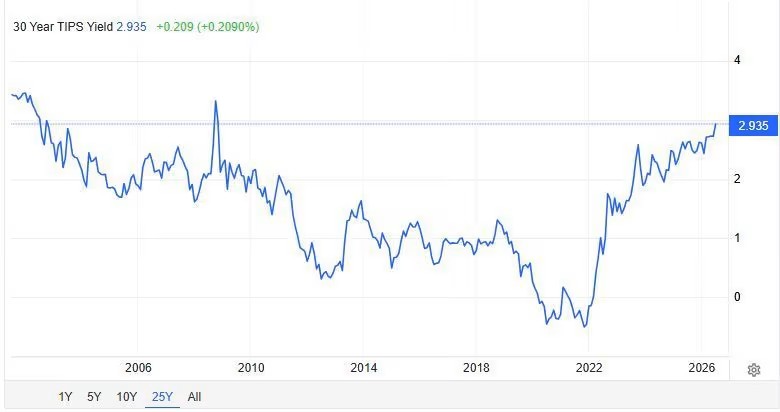
This evolution changes the calculation of many investors. Indeed, when an asset considered a safe haven offers a high real yield, the opportunity cost increases for assets that do not generate income, such as Bitcoin or gold. Bonds then become more attractive for some portfolios, which can influence capital flows toward riskier markets.
However, part of the crypto community continues to defend a different argument. According to this view, Bitcoin’s decentralized and censorship-resistant nature allows it to maintain its status as a store of value despite changes in the bond market. This element remains at the heart of the debate among investors.
Institutional Flows Resist Despite Uncertainties
For the moment, the market seems to favor positive signals more than macroeconomic concerns. Bitcoin spot ETFs recorded 368 million dollars of inflows in three days and nearly one billion dollars in just seven trading sessions. This dynamic shows that institutional investors continue to increase their exposure to digital assets.
This trend suggests that the high TIPS yield has not yet caused a major shift in allocations. However, a broader movement of investors leaving technology stocks could quickly change this balance. In this scenario, Bitcoin could experience greater volatility alongside other cryptocurrencies.
The coming weeks will therefore allow us to observe whether institutional flows remain strong enough to offset the effects of an environment with much more attractive bonds.
A Crypto Industry Continuing Its Transformation
The closure of BitMEX is another significant event for the sector. This platform, long considered a benchmark for perpetual futures contracts, disappears in a market where historic players now face more difficulties against the largest platforms.
This evolution also illustrates a gradual consolidation of the derivatives industry related to digital assets. Platforms now need to reach a critical size to remain competitive in a market where volumes become comparable to those of some commodity markets. At the same time, regulatory compliance demands and the rise of institutional investors accelerate this sector transformation.
The simultaneous evolution of bond yields, flows towards ETFs, and platform restructurings show that Bitcoin now operates in a more mature and complex market. If real yields remain sustainably high, they could continue to influence investor choices. Conversely, continued institutional investments could support the current dynamic and define the next phase of the market cycle.
Maximize your Cointribune experience with our "Read to Earn" program! For every article you read, earn points and access exclusive rewards. Sign up now and start earning benefits.

Journaliste et rédacteur web passionné par l’univers des cryptomonnaies et des technologies Web3. J’y traite les dernières tendances et actualités afin de proposer un contenu de haute qualité à un large public du secteur.
The views, thoughts, and opinions expressed in this article belong solely to the author, and should not be taken as investment advice. Do your own research before taking any investment decisions.