China Tightens Crypto Rules as Oil and AI Reignite Its Economic War with The United States
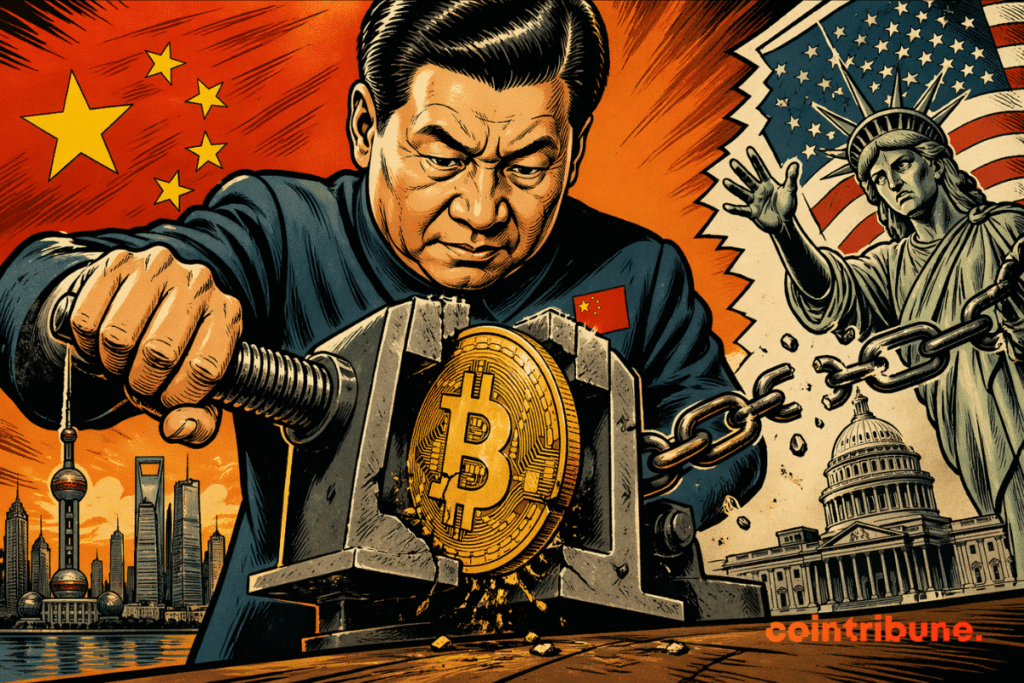
China has multiplied strong signals over the past 24 hours. It is continuing to toughen its economic and technological policy while strengthening its control over crypto. Beijing further regulates American capital and accelerates its autonomy in artificial intelligence. Meanwhile, Washington’s sanctions against Chinese energy companies add additional pressure. Between finance, technology, and energy, the balance of power between Beijing and Washington takes on a new dimension.
In Brief
- China strengthens its control over crypto by also targeting its online promotion.
- Beijing wants to limit the entry of American capital into its sensitive technology companies.
- DeepSeek and Huawei illustrate China’s desire to reduce its dependency on American chips.
- Between Chinese restrictions and Washington sanctions, tensions between the two countries continue to intensify.
Crypto: China Extends Its Ban to Online Promotion
The Chinese central bank and seven other regulatory authorities have finalized new rules governing the online marketing of financial products. These measures also concern content related to crypto and strengthen control over their promotion on digital platforms.
According to FinanceFeeds, the text explicitly classifies the issuance and exchange of cryptocurrencies as illegal financial activities. It also targets unauthorized foreign exchange operations. Thus, it builds upon China’s 2021 ban on cryptocurrency transactions.
However, this new step is not only about buying or selling crypto. It also targets how these services are presented to the public. Authorities want to limit online promotion, notably through social platforms, affiliate marketing, and influencer content.
These rules may now apply to platforms, agencies, intermediaries, and content creators. The new regulation holds any entity responsible for facilitating the promotion of financial activities deemed illegal. The new rules, officially published under number 9 and dated April 21, will take effect on September 30.
Beijing Slows American Capital and Pushes Its Autonomy in AI
China also wants to limit the entry of American capital into certain local technology companies. According to a Bloomberg report, relayed by Reuters, Beijing plans to subject these investments to prior government approval. This measure would mainly target startups active in artificial intelligence and advanced technologies.
Chinese regulators, including the National Development and Reform Commission, have reportedly already given instructions to several private companies. They should refuse American funds during their fundraising rounds unless officially authorized. Thus, control applies not only to large listed companies but also to young innovative firms.
The cited companies include Moonshot AI and StepFun, two startups specialized in artificial intelligence. ByteDance, owner of TikTok, would also be concerned. Authorities would not want the company to allow secondary share sales to American investors without prior validation.
This direction fits within a context of heightened vigilance around sensitive technologies. Beijing seeks to prevent American investors from taking stakes in sectors considered related to national security. The Manus case reportedly strengthened these concerns and expanded the review to several agencies, including the Chinese Ministry of Commerce.
At the same time, DeepSeek announced the launch of its V4 model, optimized for Huawei Ascend 950 chips. This open-source model has 1.6 trillion parameters and reduces costs by 73% compared to the previous version. This development reinforces the idea of a more autonomous Chinese technology chain.
DeepSeek also presents its model as an advancement in reasoning and coding. It outperforms several open-source models and approaches the closed solutions of Google and OpenAI. Thus, China shows it wants to gain ground in artificial intelligence without relying on American chips.
Escalation of Energy Tensions between Beijing and Washington
Moreover, tensions between China and the United States also extend to the energy sector. On April 24, Washington announced in a press release sanctions against Hengli Petrochemical Dalian, an independent Chinese refinery. American authorities accuse it of purchasing several billion dollars worth of Iranian oil.
The U.S. Treasury Department also targeted about forty shipping companies and vessels. According to Washington, these actors participate in transporting Iranian oil via a parallel fleet. This decision comes amid increased pressure on Tehran’s oil revenues.
On its side, Beijing rejects these unilateral sanctions, which it considers illegal. The Chinese embassy in Washington has called on the United States not to politicize commercial, scientific, and technological exchanges. It also asks them not to use sanctions as a tool against Chinese companies.
These measures add extra pressure on independent Chinese refiners. American sanctions had already targeted several companies in the sector. Thus, some refineries face supply difficulties and already fragile margins.
In the short term, Iranian oil remains a point of friction between the two powers as the conflict in the Middle East intensifies. This situation could reinforce economic mistrust between China and the United States. It could also complicate energy-related exchanges, especially if American sanctions continue to expand.
Maximize your Cointribune experience with our "Read to Earn" program! For every article you read, earn points and access exclusive rewards. Sign up now and start earning benefits.

Journaliste et rédacteur web passionné par l’univers des cryptomonnaies et des technologies Web3. J’y traite les dernières tendances et actualités afin de proposer un contenu de haute qualité à un large public du secteur.
The views, thoughts, and opinions expressed in this article belong solely to the author, and should not be taken as investment advice. Do your own research before taking any investment decisions.