PetroBitcoin: Is the Dream of a Bitcoin Backed by Oil Coming True in 2026?
Tensions around the Strait of Hormuz revive concerns over the stability of the global energy system, through which a major share of the world’s oil transits. The system has long been controlled by the dollar, but this is changing because of dedollarization, shifts in global politics, and new options like bitcoin, which are being talked about as ways to avoid traditional financial systems. In this context of gradual transformation, oil becomes a point of friction in a silent monetary shift. A question naturally arises: are we moving from an age of the petrodollar to an era where a petrobitcoin standard is gradually emerging?
In Brief
- Tensions in Hormuz show that oil remains at the core of global economic and monetary balances.
- The BRICS accelerate dedollarization by using more gold, yuan, and other dollar alternatives.
- Bitcoin is beginning to be considered as an alternative payment solution for certain constrained energy exchanges.
- In 2026, petrobitcoin remains mainly an emerging hypothesis, not yet a true petrodollar replacement.
Dedollarization Accelerates: The BRICS Challenge the Dollar’s Hegemony
Historically, oil has been mostly denominated in dollars since the 1970s, which has durably consolidated the greenback’s position after the end of the gold standard. However, several economic powers have progressively challenged the dollar’s dominance for several years now. New currencies are gaining ground in international trade, notably in flows linked to oil, reflecting a gradual reshaping of the global monetary system.
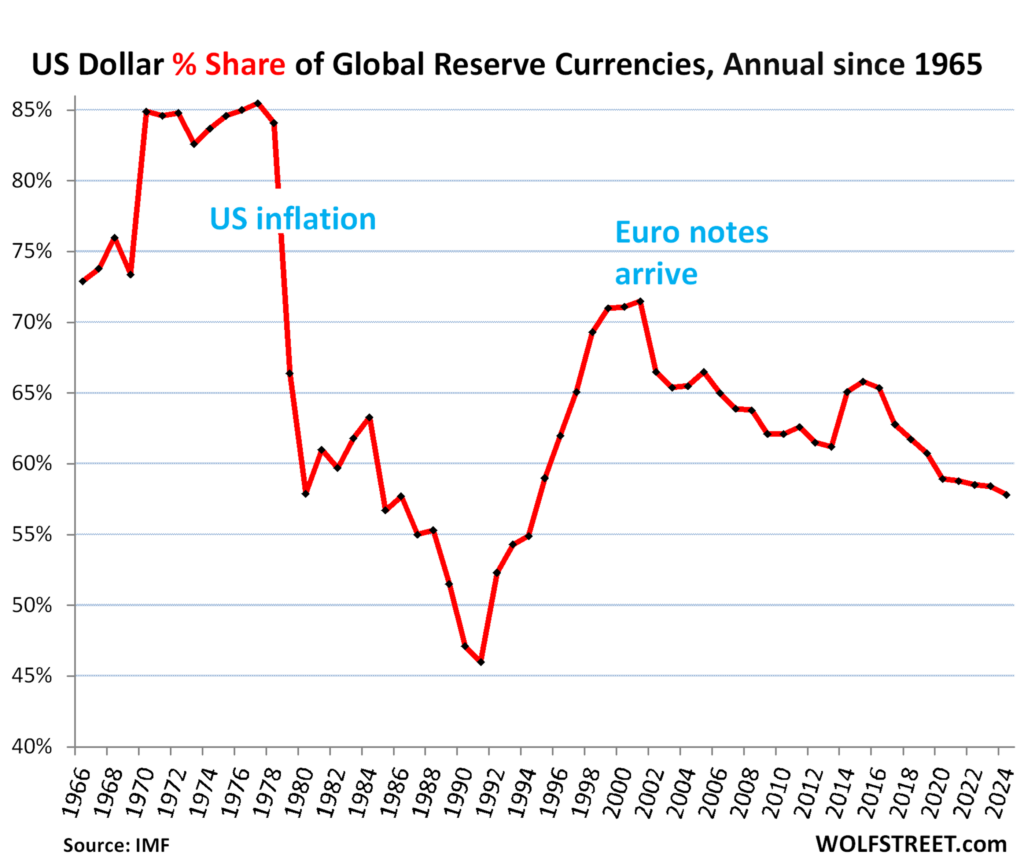
According to the latest IMF COFER data, dollar holdings by central banks outside the Federal Reserve fell to 6,630 billion dollars at the end of 2024, down from 6,690 billion a year earlier. The dollar’s share of global reserves thus dropped to 57.8%, its lowest level since 1994, confirming a gradual diversification towards other assets, notably gold.
In this context, the BRICS are accelerating their rebalancing strategies. Russia holds about 2,335.85 tons of gold, China 2,298.53 tons, and India nearly 879.98 tons. Alone, Russia and China concentrate approximately 74% of the bloc’s gold reserves, illustrating a coordinated strategy to reduce dependence on the dollar-dominated system.
Energy trade also reflects this dynamic. India imported around 60 million barrels of Russian oil in March, part of which was settled directly in yuan, illustrating a gradual diversification of currencies used in energy commerce.
China is simultaneously strengthening its alternative financial infrastructures. The mBridge platform processed around 387.2 billion yuan (nearly 55 billion dollars), 95% in digital yuan. The CIPS system recorded about 245 trillion dollars in transactions in 2025, confirming its growing role in international financial flows.
Bitcoin: The Emergence of Alternative Payments in Oil Trade
Oil remains at the center of economic and geopolitical power struggles. International sanctions directly influence its trade, leading some actors to explore bypass solutions outside traditional financial systems.
In this context, especially at the onset of the Russo-Ukrainian war in 2022, marked by the exclusion of several Russian banks from the SWIFT system and the freezing of approximately 600 billion dollars in foreign assets held by the Central Bank of the Russian Federation, bitcoin increasingly appeared as a theoretical payment option for certain energy flows. In Russia, Duma deputy Pavel Zavalny mentioned the possibility of settling some exports of oil and gas in bitcoin or alternative assets to circumvent sanctions and reduce dependence on classic financial circuits.
In the current geopolitical tensions marked by confrontation between Iran, the United States, and Israel, Tehran is exploring bypass mechanisms in strategic zones such as the Strait of Hormuz, where ship passage fees could be paid exclusively in bitcoin or Chinese yuan.
These initiatives do not yet constitute an established system. They nonetheless reflect a clear evolution: energy flows are beginning to integrate considerations about alternative payment rails in a context of growing fragmentation.
Petrodollar vs. Petrobitcoin: Toward a Shift in Global Energy Payments?
The global system remains largely structured around oil and historical settlement mechanisms. This framework has long consolidated the dominance of traditional currencies in international energy trade.
However, geopolitical tensions and monetary diversification strategies are gradually weakening this balance. In this context, the idea of a ‘Petrobitcoin’ emerges as a potential alternative under study: a hybrid system where certain oil transactions would rely on digital assets, primarily BTC, in constrained environments.
This idea was first put forward by journalist and essayist Nicolas Teterel, who has been looking at how bitcoin, geopolitics, and the changing international monetary system affect each other for a long time. In his work, he envisions a scenario where BTC could serve as an alternative settlement instrument in energy flows, with distinct structural characteristics: transparency via blockchain, censorship resistance, a limited supply capped at 21 million units, and independence from monetary policies. These elements make it a studied asset in bypass scenarios.
Currently, public on-chain data has not revealed any explicitly identifiable oil transaction in bitcoin. This indicates its use remains exploratory, more discussed than actually deployed. Without replacing existing systems, it still imposes itself as a potential tool in certain constrained energy flows. Over the longer term, the most likely scenario is not a sudden replacement. However, it is probable that an unstable coexistence will develop between traditional circuits and digital solutions. In this coexistence, oil could become a monetary experimentation ground within an increasingly fragmented global system where BTC plays an increasing role.
Maximize your Cointribune experience with our "Read to Earn" program! For every article you read, earn points and access exclusive rewards. Sign up now and start earning benefits.

Journaliste et rédacteur web passionné par l’univers des cryptomonnaies et des technologies Web3. J’y traite les dernières tendances et actualités afin de proposer un contenu de haute qualité à un large public du secteur.
The views, thoughts, and opinions expressed in this article belong solely to the author, and should not be taken as investment advice. Do your own research before taking any investment decisions.