Crypto: Ethereum Faces Massive 420,000 ETH Sell-Off Threat
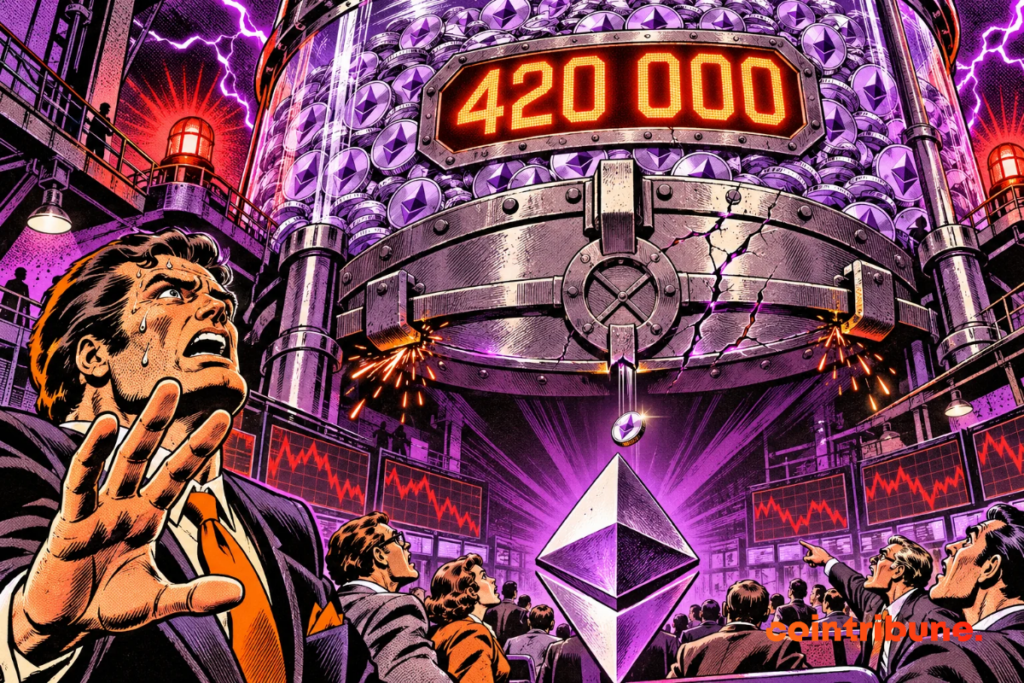
Ethereum faces a threat after the Binance hack. North Korean hackers are said to hold more than 420,000 ETH, nearly one billion dollars at prices observed at the end of October. These funds could be resold on the crypto market while liquidity remains fragile. Binance has however replenished 95% of the affected assets, and several technical indicators hint at a possible rebound.
In brief
- Binance hackers controlled more than 420,000 ETH according to TRM Labs assessment of October 30.
- Reduced liquidity and wider price gaps increase the risk of a correction.
- Binance announces having replenished 95% of the affected assets as of November 1, 2026.
Ethereum Threatened by 420,000 ETH
The Binance hack continues to worry crypto investors. After the historic theft of several billion dollars on the crypto platform, investigators are now monitoring the assets that hackers might resell.
The amount is significant: more than 420,000 ETH, plus 18,270 BTC. These cryptos together represented about 2.4 billion dollars during our analysis on October 30. Their peculiarity lies in the absence of a central issuer able to directly block them.
The hackers could therefore move them to different crypto wallets, exchange them for other assets, or try to convert them into liquidity. The October 29 attack affected Binance wallets across ten blockchains. Approximately 6.36 billion dollars were stolen, mainly in about twenty minutes.
TRM Labs attributes the operation to the TraderTraitor group, linked to North Korea. The FBI also designated this North Korean unit as responsible for the theft. For Ethereum, the main concern now involves the fund movements. A sale of several hundred thousand ETH could cause significant pressure if it happens rapidly on exchange platforms.
Order books do not always easily absorb such volumes. However, one must distinguish between the hackers’ holdings and the quantities actually put up for sale. The 420,000 ETH constitute a potentially mobilizable reserve, not a confirmed sell order.
The attackers may also keep part of the funds for several weeks or months. At the time of our analysis on October 31, Ethereum showed a decline slightly higher than 3% over the week. The crypto market had so far absorbed part of the shock without a generalized liquidation attributable to these holdings.
Hackers Converted Stablecoins into Ethereum
The origin of the 420,000 ETH deserves some explanation. Part comes directly from the compromised Binance wallets. TRM Labs identified about 200,630 ETH stolen on the Ethereum network, in addition to many other tokens.
But the hackers also sought to convert the stolen stablecoins. Tether, Circle, Ripple, and World Liberty Financial quickly froze part of the assets transferred to suspicious addresses. TRM Labs estimates the value of the immobilized stablecoins at about 2.67 billion dollars. Including an intervention on Arbitrum, the total reached nearly 2.7 billion at the time of its initial assessment.
The attackers anticipated this reaction. About 325 million USDT were exchanged for 122,300 ETH through UniswapX and other decentralized trading services. The implicit price of this conversion reached around 2,650 dollars per ETH, while the market was trading between 2,300 and 2,350 dollars.
The hackers therefore accepted particularly unfavorable conditions to quickly recover Ether. Another operation involved Aave. A wallet associated with the attack deposited 60 million USDT as collateral, then borrowed about 19,760 ETH.
The mechanism normally allows a user to get cryptocurrencies without immediately selling their assets. In this case, it offered another advantage to the attackers: to convert exposure to stablecoins likely to be frozen into ETH freely transferable on the main network.
Tether can immobilize the concerned USDT. It does not have the same power over ETH already borrowed. Aave then suspended the affected markets. These conversions contributed to the accumulation of the hundreds of thousands of ETH monitored by investigators. They also explain why the amounts of initially stolen funds and remaining holdings do not exactly match. The hackers did not just keep the assets as they were stolen. They modified the composition of their crypto portfolio.
Liquidity Shortage Worries the Crypto Market
A large amount of ETH available for sale alone is not enough to cause a collapse. Market conditions also matter. An analyst notes shallow order books and spreads between the best bid and ask prices that can be five times larger.
These spreads increase the cost of crypto transactions when liquidity is scarce. An investor looking to sell a large quantity of ETH may be forced to accept progressively lower prices to find buyers.
The phenomenon becomes more marked when multiple sellers act simultaneously. Some analysts thus foresee pressure on Ethereum during November and December. ETH could continue to underperform Bitcoin if sales intensify.
This scenario remains a hypothesis. The reserves available on platforms had already greatly decreased before the hack. In September, Ethereum reserves on exchanges fell to 14.88 million ETH, according to CryptoQuant data reported by Cointribune.
About 6.42 million ETH had left these platforms since July 2025. Some tokens had joined private wallets, institutional services, and staking contracts. Staking was then locking about 43.1 million ETH, or 35.91% of the supply.
These historical figures help measure the weight of the 420,000 ETH. They represent about 2.8% of the reserves held by platforms in September. A useful comparison, even though these reserves do not correspond to the liquidity actually available in order books.
Purchases and sales are also not concentrated on a single platform. Hackers can fragment their movements to limit their visibility or seek better prices through intermediaries. A gradual distribution would have very different consequences from an immediate sale.
Binance Announces Having Replenished 95% of Assets
Meanwhile, Binance continues its recovery and replenishment operations. On October 31, the crypto platform announced having replaced about 90% of the value of assets affected by the hack. The figure rose to 95% in its November 1 communication. Binance says it mobilized more than 6.34 billion dollars to cover the losses. These resources come notably from its own funds, its SAFU protection fund, and part of its futures insurance fund.
The platform also uses traditional markets and over-the-counter transactions to buy the missing assets. Reserves corresponding to BTC, ETH, USDT, BNB, SOL, USDC, XRP, USD1, RLUSD, and ZEC are announced as fully replenished.
The remaining 5% mostly concern less liquid tokens. These assets may take more time to acquire, particularly when available volumes are insufficient to make large purchases without strongly impacting prices.
Binance also plans a gradual resumption of withdrawals on November 1, with a first phase scheduled between 6 AM and 9 AM UTC. The schedule notably includes Ethereum, Bitcoin, Solana, BNB Chain, and several other networks.
The crypto exchange says deposits remain open and users will not bear financial losses. However, a frequent confusion must be avoided.
Replenishing reserves does not mean hackers returned 95% of the stolen cryptocurrencies. Binance replaces missing assets with its own resources and protection mechanisms.
The cryptocurrencies still controlled by attackers thus remain a distinct risk. Binance’s repurchases can support demand on certain markets. Their impact depends however on the quantities acquired directly on platforms and those traded off-market.
Buyers Hope for an Ethereum Rebound
Despite this threat, some crypto investors keep looking for buying opportunities. One indicator draws their attention: the Ethereum RSI. On October 31, the relative strength index entered oversold territory for the first time since June. RSI measures the speed and magnitude of recent price changes. A reading below 30 is generally considered a sign of oversold conditions.
This may signal that a decline has been particularly rapid and sellers are starting to lose momentum. But the indicator doesn’t guarantee a rebound. In major corrections, RSI can stay low for several sessions. Investors should also watch volumes and the price’s ability to regain previous support levels.
Binance’s financial commitment offers another argument to buyers. The platform announced it will cover losses, while the main affected assets are now said to be fully covered.
This situation could reassure some investors worried about the crypto exchange’s financial strength. Risks of new sales have however not disappeared. Some stolen funds are already moving between different addresses. Investigators are especially monitoring transfers to exchange protocols, cross-chain bridges, and specialized intermediaries.
These movements do not systematically prove that sales occurred. A transfer can serve to consolidate assets, distribute them among several wallets, or prepare other operations. Analysts will therefore need to distinguish internal movements from a true conversion into stablecoin or liquidity. The situation remains open.
Next Hacker Transfers Will Be Decisive
Ethereum enters November with two opposing forces. Hackers have a large amount of ETH that is hard to lock. A massive sale could intensify pressure on a market whose liquidity appears fragile.
On the other hand, Binance continues to replenish its reserves and some technical indicators suggest recent sales might have been excessive.
Both phenomena can coexist. A temporary price recovery would not make the 420,000 ETH controlled by attackers disappear. Similarly, their presence in suspicious wallets does not mean they will all be sold. Monitoring on-chain transactions remains essential.
Upcoming Binance publications should also provide details on recovered funds, replaced assets, and results of its technical investigation. For now, observed movements do not allow announcing an imminent liquidation of 420,000 ETH.
The crypto market has already shown resilience after the attack, especially for Bitcoin. Cointribune also noted that the Binance hack lowered BTC without causing a widespread collapse. Ethereum must now absorb possible sales from hackers while keeping enough buyers to stabilize its price.
Maximize your Cointribune experience with our "Read to Earn" program! For every article you read, earn points and access exclusive rewards. Sign up now and start earning benefits.

Fascinated by Bitcoin since 2017, Evariste has continuously researched the subject. While his initial interest was in trading, he now actively seeks to understand all advances centered on cryptocurrencies. As an editor, he strives to consistently deliver high-quality work that reflects the state of the sector as a whole.
The views, thoughts, and opinions expressed in this article belong solely to the author, and should not be taken as investment advice. Do your own research before taking any investment decisions.