Cryptocurrency in Brazil: Laws, Taxes, How to Buy, and How to Find the Best Exchange Rates
Brazil is one of the world’s most active markets for cryptocurrency adoption. For travelers, digital nomads, and expats moving to or visiting the country, digital assets offer a practical way to move money across borders, manage living expenses, and navigate local financial needs smoothly.
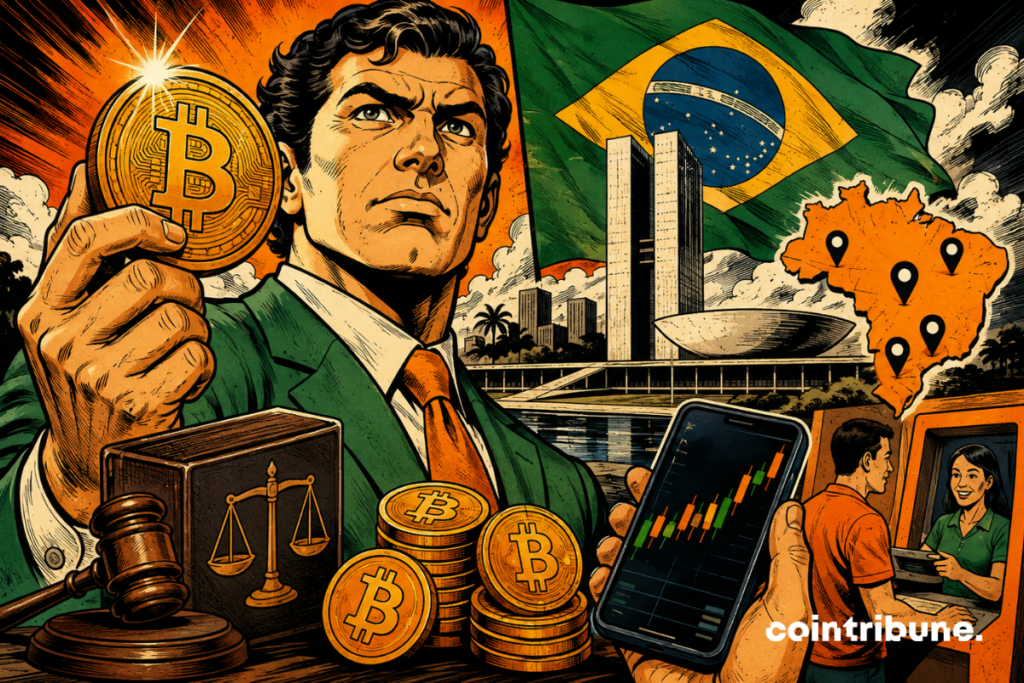
However, if you are planning a trip or relocating, several practical questions usually come up:
- Are cryptocurrencies legal in Brazil?
- What is the easiest way to compare the best ways to get USDT, and how can travelers cash out digital assets for Brazilian Reais (BRL) or exchange currency back and forth?
- Do you have to pay crypto taxes in Brazil?
- Can remote workers or expats get paid in USDT?
In this guide, we will explore the Brazilian regulatory landscape, tax obligations enforced by the Federal Revenue service (Receita Federal), the most traded cryptocurrencies in the country, popular local payment methods and the most effective ways to locate reliable exchange services.
Is cryptocurrency legal in Brazil? Understanding the regulatory framework
The short answer is yes: using, holding, and trading cryptocurrencies is completely legal in Brazil.
The country took a major regulatory leap forward with the enactment of Law No. 14,478/2022, commonly referred to as the Cryptoassets Legal Framework (Marco Legal das Criptomoedas). This law established clear guidelines for Virtual Asset Service Providers (VASPs).
Supervisory bodies
Regulatory supervision of digital assets in Brazil is divided between two primary governmental authorities:
- Central Bank of Brazil (Bacen): Primary regulator responsible for authorizing, supervising, and setting operational rules for Virtual Asset Service Providers (VASPs), including crypto exchanges and digital brokerages.
- Securities and Exchange Commission of Brazil (CVM): Regulates digital assets when they qualify as securities under financial law, protecting investors in capital markets.
Legal tender vs. voluntary acceptance
Although cryptoassets are legal and protected as private property, cryptocurrencies do not hold legal tender status in Brazil. Under national monetary law, the Brazilian Real (BRL) is the sole official currency with mandatory legal tender power.
Consequently, no vendor or individual is legally obligated to accept Bitcoin or Tether as payment for goods or services, unless both parties voluntarily agree to do so in a private contract.
What is strictly forbidden by law?
To protect financial system integrity, Brazilian law imposes strict criminal penalties for the illicit use of virtual assets:
- Money laundering, asset concealment, and terrorism financing;
- Currency evasion and unauthorized capital flight;
- Fraudulent financial schemes and illegal pyramid operations;
- Operating an unlicensed VASP or soliciting public funds without authorization.
Can you receive income or salary in crypto in Brazil?
For expats and remote workers in Brazil, receiving income in crypto depends heavily on the legal nature of the employment contract.
Formal CLT employees
For employees hired under the formal Brazilian Labor Code (Consolidação das Leis do Trabalho, or CLT), the law strictly dictates that salary payments must be made in the official national currency (BRL).
Therefore, a company registered in Brazil cannot legally pay a formal CLT employee’s base salary in digital assets.
Independent contractors, freelancers, and PJs
The rules are far more flexible for independent contractors, freelancers, and individuals operating as sole proprietors or legal entities (Pessoa Jurídica, or PJ). Under Brazilian civil law, freedom of contract applies.
If a contractor agreement specifies that payment for services rendered will be delivered in digital assets, the transaction is fully valid.
This setup is widely popular among remote workers and expats residing in Brazil who work for international companies and prefer to receive payments in Tether or even buy USDT with BRL directly for global liquidity.
Practical everyday uses for crypto in Brazil
Beyond contractor payments, visitors and residents use digital currencies for various daily financial activities:
- Direct purchases: Paying businesses that accept crypto payments by direct private agreement;
- Investment: Portfolio diversification and long-term store of value;
- Arbitrage and trading: Speculative and market-making transactions across currency trading markets;
- International remittances: Moving funds directly across borders between individuals with lower banking costs;
- Currency hedging: Holding dollar-pegged stablecoins to protect purchasing power, easily looking up options for USDT to BRL exchanges when local funds are needed.
How crypto taxes work in Brazil
Taxation of digital assets in Brazil is governed by the Federal Revenue Service (Receita Federal do Brasil, or RFB), primarily under Normative Instruction RFB No. 1,888/2019 and general capital gains tax laws.
The system is relatively straightforward for individual tax residents.
Summary of Brazilian Tax Rules for Crypto
| Fiscal rule | Description & thresholds |
| Capital gains exemption | Monthly sales up to R$ 35,000.00 (total across all cryptocurrencies) are completely tax-exempt from capital gains. |
| Capital gains tax rates | Progressive rates starting at 15% apply to monthly net profits when total sales exceed R$ 35,000.00 in a calendar month. |
| Monthly reporting (IN 1888) | Mandatory reporting for transactions on foreign exchanges or P2P trades exceeding R$ 30,000.00 per month. |
| Annual tax return (IRPF) | Mandatory annual declaration under “Assets and Rights” for any asset category with an acquisition cost equal to or exceeding R$ 5,000.00. |
Popular cryptocurrencies traded in Brazil
The Brazilian crypto market displays clear asset preferences. Stablecoins, in particular Tether (USDT), lead daily transaction volumes due to their utility in international trade and dollar-pegged stability.
Key market assets
Investors and traders actively follow top global projects alongside stablecoins:
- Tether (USDT): The most liquid dollar-pegged asset in Brazil, widely used for immediate liquidity and wealth preservation.
- Bitcoin (BTC): The premier digital store of value and the most recognized cryptocurrency among the public. Market participants closely follow the daily Bitcoin price movements, and convert BTC to BRL.
- Ethereum (ETH): The second-largest digital asset by market capitalization, widely held by investors seeking portfolio growth, with high interest in tracking the ETH price.
- Ripple (XRP): Preferred for fast cross-border transfers, with high search volume made by people looking to convert Ripple to USD.
- Cardano (ADA): Highly popular in local trading communities, with frequent checks for ADA to USD metrics.
- Other highlights: Projects such as Solana (SOL), Chainlink (LINK), Avalanche (AVAX), alongside Polygon (POL), Polkadot (DOT), and Shiba Inu (SHIB) complete the list of widely followed assets among local retail investors.
How to buy or sell cryptocurrency for Brazilian Reais (BRL)
Converting between Reais (BRL) and crypto is fast and accessible thanks to Brazil’s advanced digital payments infrastructure.
Summary of payment methods in Brazil
| Payment method | Key features & suitability |
| Pix | The undisputed king of Brazilian payments. Instant transfers, operating 24/7/365 with zero fees for individuals. |
| Bank transfers (TED) | Traditional bank transfers offered by institutions like Itaú, Bradesco, and Santander for larger corporate or individual amounts. |
| Fintechs & digital banks | Modern mobile banking apps such as Nubank, Mercado Pago, and PicPay provide instant BRL balance management. |
| In-person cash / P2P | Direct peer-to-peer or cash exchange options available in major metropolitan centers like São Paulo and Rio de Janeiro. |
How to find a reliable exchanger using BestChange
Searching for a trustworthy service to convert Reais into crypto (or cash out digital assets into BRL) by manually checking dozens of websites can be overwhelming.
As an efficient alternative, you can use BestChange, a free online exchange monitoring platform that has operated globally since 2007. The platform displays real-time rates for crypto and other kinds of digital assets, fiat currencies, and electronic payment systems into a single user-friendly interface.
Before any exchanger is listed on BestChange, it undergoes a thorough compliance check. Following listing, BestChange continuously monitors exchanger performance, operational stability, and user feedback.
Important notice: BestChange operates strictly as an informational monitoring and comparison service; BestChange does not execute currency exchanges nor does it hold or custody user funds.
All exchange transactions and settlements are performed directly on the website of the chosen third-party exchanger.
Step-by-step guide to using BestChange in Brazil
Finding competitive rates and transparent conditions on BestChange takes just a few steps:
- Select asset and network: Choose your currency pair (for instance, converting BRL to Tether (USDT) on TRC20, BEP20, ERC20, TON, or Polygon).
- Choose your payout method: Select how you want to receive your BRL (e.g., via Pix, Mercado Pago, PicPay, or direct bank transfer).
- Use the Calculator: Input your desired exchange amount to instantly filter the list, displaying only exchangers with sufficient reserves and compatible order limits.
- Review special signs & terms: Pay attention to special icons warning about manual processing, additional service fees, floating exchange rates, or identity verification (KYC) requirements.
- In-person cash options: If you require physical cash in major cities such as São Paulo or Rio de Janeiro, you can filter for cash delivery offers and review meeting locations, required documents, and security terms.
Access channels and support
BestChange provides access through its website, official mobile application (available on iOS, Android, and Huawei), Telegram bot and mini app, and browser extensions. If an ideal rate or reserve is unavailable at the moment, you can easily configure a custom notification alert via email or Telegram.
Before creating an order on the selected exchanger’s website, carefully review their Terms of Service, requirements regarding the origin of funds (AML policy), and pay attention to their order processing time. If any delay occurs during order processing on the exchanger’s side, contact their customer support team first.
If the issue remains unresolved, you can submit an official complaint on the exchanger’s profile page within BestChange. Their support team operates 24/7 to assist users and exchangers in mediating disputes and facilitating a fair resolution.
Conclusion
Navigating cryptocurrency in Brazil is straightforward thanks to a clear legal framework and the speed of Pix instant payments. Understanding local regulations, fulfilling tax reporting responsibilities, and choosing reputable exchange channels are essential steps for any expat or traveler.
By leveraging trusted monitoring platforms like BestChange, you can easily compare rates, verify exchanger reputations, and manage your digital assets with confidence while in Brazil.
Maximize your Cointribune experience with our "Read to Earn" program! For every article you read, earn points and access exclusive rewards. Sign up now and start earning benefits.

The Cointribune editorial team unites its voices to address topics related to cryptocurrencies, investment, the metaverse, and NFTs, while striving to answer your questions as best as possible.
The views, thoughts, and opinions expressed in this article belong solely to the author, and should not be taken as investment advice. Do your own research before taking any investment decisions.