Does the Binance Case Mark a Turning Point for the European Financial System?
The refusal of Binance’s MiCA license in Greece shakes the European crypto market. As the world’s largest platform sees its access to the EU restricted, regulatory tensions rapidly intensify. Behind this decision, a larger power struggle pits institutions against crypto players, against the backdrop of European monetary transformation in a context of accelerating the digital euro and European financial control. Does the Binance case mark a turning point for the European financial system?

In Brief
- Greece refuses Binance’s MiCA license, illustrating the tightening of access to the European crypto-asset market.
- Binance confirms the failure of its application, amid growing restrictions on its activities in Europe.
- Suspicions of political pressure arise, although no official involvement of the ECB has been demonstrated.
- Stablecoins and the digital euro emerge as major strategic issues for European authorities.
- The Binance case symbolizes the strengthening of European institutions’ control over digital finance.
Binance Facing MiCA: A License Refusal Marking a Turning Point for Access to the European Market
The refusal of Binance’s MiCA license in Greece stands as one of the most important events under the new European regulatory framework applied to cryptocurrencies. The platform, still the largest in the world with over 300 million users, aimed to obtain a regulatory passport allowing it to operate freely throughout the European Union.
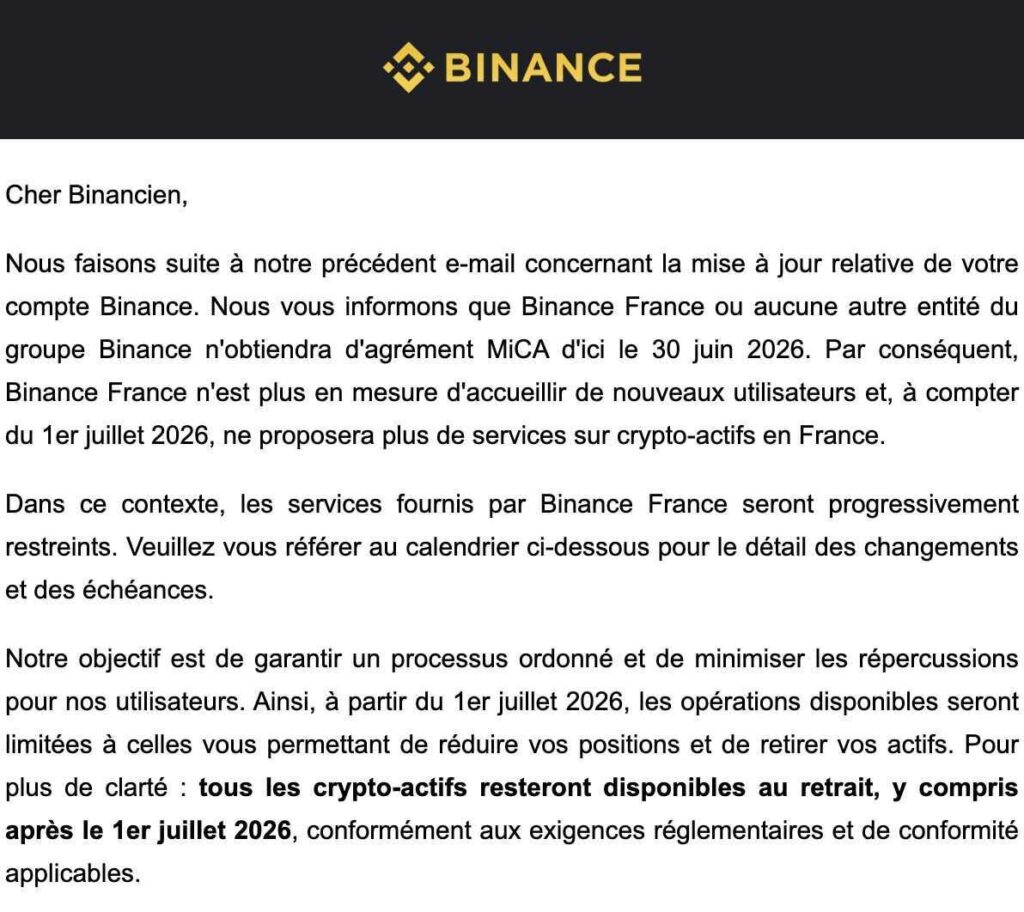
Binance confirmed the failure of this procedure amid already tense circumstances marked by a message to its European users announcing the gradual suspension of certain activities on the continent. This internal communication reinforced the idea of a real regulatory turning point for the platform, forced to review its strategy facing MiCA’s requirements.
With this new framework, Europe intends to uniformly regulate crypto players, but in practice, it also becomes an extremely selective access filter for international platforms.
This refusal is not just about a simple administrative authorization. It highlights a structural evolution of the European market, where entry conditions are becoming increasingly strict for non-bank players and large global crypto platforms.
For Binance, this blockage occurs in a context where demand for crypto services remains high in Europe, but regulatory requirements are strongly tightening. The company thus finds itself in an environment where access to the European market now depends on full compliance with standards imposed by European institutions.
This first regulatory shock lays the foundation for the debate surrounding the Binance case today: an issue that goes far beyond a simple license and touches on the very place of crypto infrastructures in the European financial system.
The ECB Behind Binance’s Refusal? Suspicions Grow Around a Financial Control Strategy
The refusal of Binance’s MiCA license in Greece continues to raise questions about the behind-the-scenes of this decision. According to information published by The Big Whale media, the crypto platform’s file was technically finalized before a turnaround occurred in the last stages of the regulatory process.
According to sources cited by the media, the Greek Capital Market Commission (HCMC) deemed Binance’s application complete and compliant with regulatory requirements. The officer in charge of anti-money laundering within the Greek regulator also maintained a favorable opinion regarding obtaining the license.
The forty-day review period provided by the MiCA regulation also expired on June 4 without any European objection. Binance had even anticipated a positive outcome by filing passporting notifications with the HCMC to prepare its expanded access to the European market.
The file thus seemed close to completion. The president of the DFSC, the coordinating body within the European Securities and Markets Authority (ESMA), reportedly indicated during a phone call on June 2 that it was the “last call” regarding the Binance procedure.
The situation reportedly changed between June 7 and 15. The shift in position came after political pressure attributed to the European Central Bank. Christine Lagarde, ECB president, apparently told Greek Prime Minister Kyriakos Mitsotakis during a meeting held in May that Binance was not considered a desirable player for Europe.
The Greek finance minister, also president of the Eurogroup and favorable to granting the license, ultimately failed to convince the prime minister to continue the process. The national political context, with the possibility of early elections before the end of the year, also reportedly pushed Kyriakos Mitsotakis to avoid a direct confrontation with the ECB.
These revelations now fuel criticism from part of the crypto industry, which believes the Binance file goes beyond the regulatory issue and reveals a broader desire to control the evolution of the European digital financial sector.
Binance and Stablecoins: A Battle for Control of European Financial Infrastructures
At the heart of questions lies the issue of stablecoins. According to sources cited by The Big Whale, the stance attributed to Christine Lagarde, long known for her criticisms of stablecoins and Bitcoin, is mainly related to Binance’s strategic role in this ecosystem.
As the world’s leading exchange platform, Binance also represents one of the main liquidity channels for stablecoins in Europe. A dominant position that could compete with the vision promoted by the ECB around the digital euro.
This situation appears paradoxical to some industry observers. Binance, primarily an exchange platform and distribution infrastructure, could theoretically contribute to the development of new digital financial uses, including around a future European digital currency.
“It’s paradoxical because Binance is an exchange platform, a distribution channel. It could quite support the digital euro project,” a source cited by The Big Whale reportedly explained.
This source also reportedly drew a parallel with the case of Revolut, which faced obstacles in the European Union due to concerns about its internal control mechanisms. According to this analysis, European institutions’ worry concerns less the existence of new financial actors than their ability to reach a sufficiently large size to compete with traditional structures.
“The concern is about the size of new entrants; Christine Lagarde would prefer traditional banks to manage the flows,” this source added.
This vision is also legally contested. An expert cited by The Big Whale believes that any political interference in a MiCA process would be a major problem, recalling that the ECB officially has no direct competence over crypto license granting.
“This is political interference in a process under the exclusive competence of an independent regulator,” this expert reportedly said. “The ECB has no authority over MiCA licenses.”
Although no direct intervention by the ECB has been officially demonstrated, the Binance case fuels a broader debate about Europe’s financial future. For its critics, the regulatory tightening against large crypto platforms occurs at the very moment the ECB is developing a public digital alternative with the digital euro.
“And It is adopted, digital euro is adopted, this is a historic day for Europe”
These are the words with which Aurore Lalucq, chair of the European Parliament’s Committee on Economic and Monetary Affairs, announced the official adoption of the digital euro project.
This timing does not go unnoticed. At a time when this declaration marks a major political acceleration around European digital currency, Binance, the world’s largest crypto platform with over 300 million users, finds itself blocked in Europe with the refusal of its MiCA license in Greece.
It is hard to see here a simple coincidence of timing. On one side, Europe pushes a digital monetary infrastructure entirely controlled by public institutions. On the other, it slows the expansion of a global private actor that has structured a large part of global crypto liquidity.
The digital euro is not a neutral evolution of payments. It is a profound transformation of the European financial architecture, harboring an unprecedented extreme control mechanism aimed at preserving a completely dysfunctional economic system rejected by citizens.
Binance, conversely, represents a parallel finance already functional on a global scale. An infrastructure independent of traditional banks, organizing crypto exchanges on a very large scale, largely escaping classical financial circuits.
It is precisely here that the case becomes strategic. The refusal of the MiCA license no longer looks like a simple regulatory decision. It fits into a larger dynamic where access to the European market is increasingly conditioned on integration into the institutional framework.
And What Next?
We are clearly changing worlds.
The ECB and European institutions are very aware of what is happening: the European population is progressively turning away from the traditional financial system. Bitcoin is no longer a marginal asset. Cryptos are no longer a “speculative bet.” They have become a parallel infrastructure used by millions of users to store, transfer, and protect value outside the classical banking system.
And these figures are already known internally. Central banks and financial institutions closely monitor crypto-asset adoption, the explosion of Bitcoin wallets, and the rise of stablecoins as an alternative payment method. They know exactly that usage is not slowing down — it is accelerating.
It is in this context that everything aligns.
On one side, Binance — the world’s largest crypto platform, with over 300 million users — finds itself blocked in Europe with the refusal of its MiCA license. On the other, the ECB is pushing its digital euro at full speed, a programmable, centralized currency fully controlled by the institution.
This is not a simple coincidence of timing. It is a reaction.
A reaction to a simple reality: decentralized finance is gaining ground. Bitcoin becomes a global store of value. Stablecoins already dominate part of on-chain flows. Platforms like Binance have become critical infrastructures of global finance, outside the traditional banking system.
And facing this, the European response is clear: take back control.
MiCA is not only for “regulating.” It also serves to filter who can access the European financial system. And in practice, actors that are too big, too global, or too independent become potential systemic problems for institutions.
The result is brutal: while crypto adoption explodes among individuals and investors, institutions tighten access, harden rules, and accelerate their own centralized alternatives.
This is exactly where the clash becomes obvious. On one side, an open, global, borderless finance, driven by Bitcoin, cryptos, and platforms like Binance. On the other hand, European institutional finance is progressively closing in around the ECB and the digital euro. And the more crypto adoption continues to rise, the more regulatory pressure increases. What we observe today is not a simple regulatory adjustment. It is a control shift over the very architecture of European finance.
Maximize your Cointribune experience with our "Read to Earn" program! For every article you read, earn points and access exclusive rewards. Sign up now and start earning benefits.

Journaliste et rédacteur web passionné par l’univers des cryptomonnaies et des technologies Web3. J’y traite les dernières tendances et actualités afin de proposer un contenu de haute qualité à un large public du secteur.
The views, thoughts, and opinions expressed in this article belong solely to the author, and should not be taken as investment advice. Do your own research before taking any investment decisions.