ECB Answers Surveillance Fears Over the Digital Euro
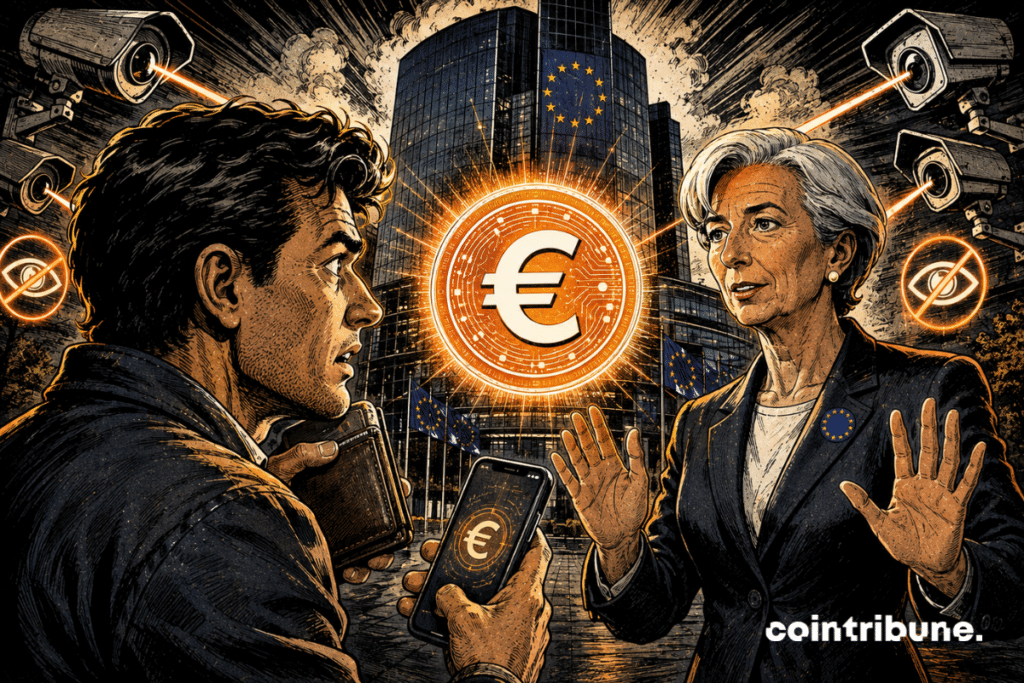
The digital euro would offer more privacy than a traditional bank transfer. At least, that’s what the European Central Bank claims, through Piero Cipollone, a member of its executive board, who states that the Eurosystem will remain unable to link a citizen to their payments. A promise that digital rights advocates receive with suspicion.
In Brief
- According to Piero Cipollone, the Eurosystem will not be able to identify any user of the digital euro, whether online or offline.
- Offline payments would be visible only to the sender and the recipient, similar to a cash transaction.
- Liberty defense organizations believe these guarantees rely too much on trust in institutions, and not enough on verifiable technical mechanisms.
The Eurosystem Will Not Be Able to Link Citizens to Their Payments
The digital euro is the central bank digital currency (CBDC) of the eurozone, an electronic form of public money issued by the ECB to complement banknotes and coins. The project, which we have detailed the operation of, is based on an architecture that, according to Frankfurt, prevents the Eurosystem from linking an individual to a transaction.
In a interview published by the ECB on August 10 with the Italian media ilsussidiario.net, Piero Cipollone compared the digital euro to a traditional bank transfer.
Currently, in the case of a bank transfer, all the transaction data is known to the parties involved. The digital euro would guarantee better protection of privacy. The digital euro guarantees the highest level of confidentiality that current technology can offer.
Two regimes coexist. Offline, payments go directly from one device to another, without passing through a central infrastructure: only the sender and recipient know the details of the exchange.
Online, commercial banks remain intermediaries and can identify their clients to comply with anti-money laundering rules, but the Eurosystem would only receive pseudonymized data, with no direct link to a person.
CoinDesk, which reported these statements on Tuesday, presents them as the strongest response from the ECB to surveillance accusations. Christine Lagarde continues to repeat that the digital euro and cash will coexist.
Civil Society Wants Technical Guarantees, Not Promises
Frankfurt’s assurances, however, are not enough to convince everyone. In June, the Austrian organization Epicenter.works and several civil society actors had already called on European lawmakers to strengthen the project’s privacy guarantees. Their concern notably focuses on the risk of relying on institutional guarantees that could evolve over time.
This distrust goes far beyond European borders. In the United States, Congress has banned the Federal Reserve from issuing a digital dollar until the end of 2030, a law passed in the Senate by 85 votes to 5 and enacted on July 11.
This context pushes the ECB to multiply clarifications: it has already detailed the role of banks and fintechs, and Cipollone warned in July that the growth of stablecoins threatens European bank deposits.
A Tight Schedule Between Negotiations and Pilot Project
The text has not yet been adopted. European deputies validated their negotiation position on July 9, opening discussions with the Council, with an agreement hoped for by the end of 2026. Each step can still change the balance between privacy and fraud prevention.
Deutsche Bank, UniCredit, and Revolut are among the 36 providers selected by the ECB for a twelve-month pilot scheduled for the second half of 2027, which will test online and offline payments as well as the user experience. A first issuance is still targeted for 2029, subject to legislation, pilot results, and a decision by the Governing Council.
The green light given by European deputies changed nothing: it is the autumn negotiations and then the 2027 pilot phase that will determine if the digital euro really offers more privacy than a bank transfer, or if in the end the difference is just a simple communication argument.
Maximize your Cointribune experience with our "Read to Earn" program! For every article you read, earn points and access exclusive rewards. Sign up now and start earning benefits.

Passionné par le Bitcoin, j'aime explorer les méandres de la blockchain et des cryptos et je partage mes découvertes avec la communauté. Mon rêve est de vivre dans un monde où la vie privée et la liberté financière sont garanties pour tous, et je crois fermement que Bitcoin est l'outil qui peut rendre cela possible.
The views, thoughts, and opinions expressed in this article belong solely to the author, and should not be taken as investment advice. Do your own research before taking any investment decisions.