Elon Musk Wants To Move AI Data Centers Into Space
The authorization granted to SpaceX to deploy up to one million satellites dedicated to artificial intelligence computing marks a turning point in the race for digital infrastructure. However, behind this regulatory victory of Elon Musk lies a less spectacular reality. Obtaining the right to occupy orbit does not mean having all the necessary permits to operate data centers there. The real challenge for SpaceX could therefore be as much legal and industrial as technological.
In brief
- SpaceX receives FCC green light for its Starmind project, which plans up to one million satellites dedicated to artificial intelligence.
- The U.S. authorization imposes a precise schedule and does not yet cover all planned operations.
- Orbit becomes a new battleground between SpaceX, Google, and Blue Origin to develop AI infrastructures.
- Space debris management, congestion risks and regulatory constraints could slow Elon Musk’s project.
Starmind, one million satellites and an authorization that doesn’t solve everything for SpaceX
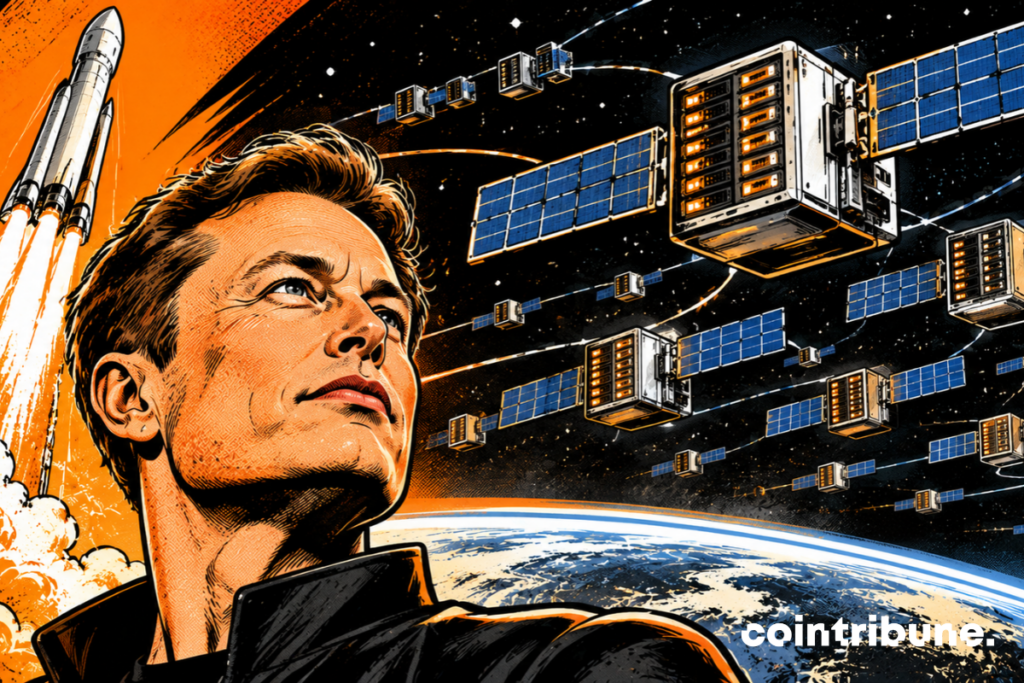
On November 25, 2026, the Federal Communications Commission (FCC) gave the green light to SpaceX’s Starmind project. This constellation could include up to one million low orbit satellites designed to perform artificial intelligence computations and transmit their results to Earth.
This decision is a major breakthrough for Elon Musk, but its scope needs to be clarified. The FCC has not given a blank check for all the operations planned by SpaceX. Its authorization notably concerns radio backup communications and telemetry, tracking, and command functions of the satellites.
Several elements remain decisive :
- Deployment schedule : SpaceX must place its first operational satellite in orbit before November 2033 ;
- Scaling up : half of the constellation must be deployed before November 2038, and all before November 2040 ;
- Communications : exchanges must mainly rely on laser links, with authorized radio frequencies serving as a backup solution ;
- Debris management : some end-of-life conditions for satellites, particularly beyond 600 kilometers altitude, remain subject to additional permits.
The nuance is essential. SpaceX has obtained a strategic authorization but still needs to demonstrate its ability to meet the technical and regulatory requirements associated with an unprecedented orbital infrastructure.
Orbit becomes a new territory of industrial competition
Until now, the artificial intelligence battle was mainly around processors, models, and access to electricity. With Starmind, SpaceX intends to shift part of this competition to space. The goal is to circumvent some physical limits of terrestrial infrastructures, notably energy availability and electrical grid constraints.
The satellites must operate using solar power and communicate with each other via optical links. Elon Musk’s company notably bets on its ability to reduce launch costs thanks to Starship, its reusable heavy launcher. The company plans to start initial deployments in 2027, before progressively accelerating production.
However, this strategy raises a new industrial question: who will control the orbital infrastructures essential to the artificial intelligence of tomorrow?
SpaceX is not alone on this front. Google is developing Project Suncatcher, while Blue Origin is also working on orbital computing infrastructures. The American authorization could thus accelerate competition in which launch capabilities, access to electronic components, and mastery of space communications will become decisive advantages.
The real risk is building an infrastructure without legal precedent
The ambition of Starmind far exceeds the usual difficulties of a satellite project. A constellation of one million devices would deeply change the orbital environment and raise unprecedented liability questions.
Amazon Leo, Viasat, and the American Astronomical Society have notably expressed concerns about space congestion risks, interference, and consequences for astronomical observations. The FCC has rejected appeals against the project, notably judging that some environmental and scientific concerns did not directly fall within the scope of its radio authorization.
The end-of-life issue for satellites particularly illustrates this difficulty. SpaceX notably wishes to send some devices to heliocentric orbits rather than systematically deorbiting them into the atmosphere. However, the FCC has postponed its decision on this possibility due to insufficient information.
This point could become a significant obstacle to Starmind’s expansion. Unlike terrestrial data centers, an orbital computing infrastructure cannot be dismantled or repaired as easily. Each failure, collision, or replacement operation involves additional constraints.
Ultimately, the FCC green light does not yet herald the birth of a new generation of data centers. It rather opens a decisive phase: one where SpaceX, which targets a valuation of 1,000,000 billion $, will have to prove that a computing infrastructure of such scale can operate sustainably without compromising other space activities. For Elon Musk, the next frontier of AI will therefore not only be technological. It will also be regulatory.
Maximize your Cointribune experience with our "Read to Earn" program! For every article you read, earn points and access exclusive rewards. Sign up now and start earning benefits.

Diplômé de Sciences Po Toulouse et titulaire d'une certification consultant blockchain délivrée par Alyra, j'ai rejoint l'aventure Cointribune en 2019. Convaincu du potentiel de la blockchain pour transformer de nombreux secteurs de l'économie, j'ai pris l'engagement de sensibiliser et d'informer le grand public sur cet écosystème en constante évolution. Mon objectif est de permettre à chacun de mieux comprendre la blockchain et de saisir les opportunités qu'elle offre. Je m'efforce chaque jour de fournir une analyse objective de l'actualité, de décrypter les tendances du marché, de relayer les dernières innovations technologiques et de mettre en perspective les enjeux économiques et sociétaux de cette révolution en marche.
The views, thoughts, and opinions expressed in this article belong solely to the author, and should not be taken as investment advice. Do your own research before taking any investment decisions.