Elon Musk Shares His Boldest SpaceX Valuation Scenario
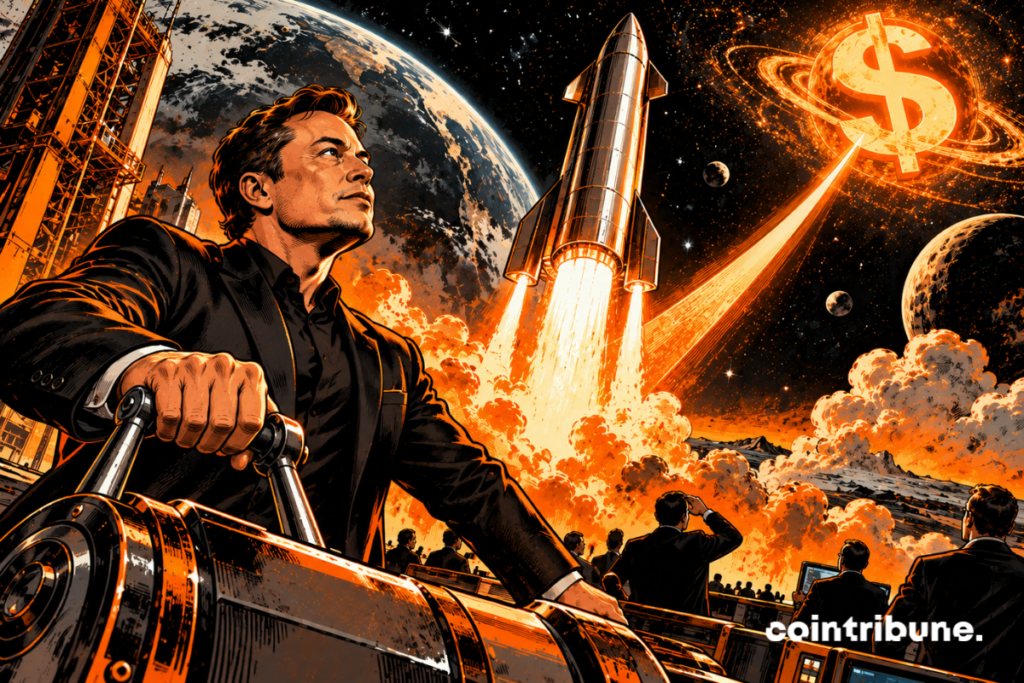
Elon Musk claims to see a trajectory that would allow SpaceX to be worth several times the current global economy. The entrepreneur himself acknowledges the highly speculative nature of this hypothesis, greeted with optimism by Michael Saylor.
In brief
- Elon Musk envisions a valuation of SpaceX exceeding several times the global economy, while acknowledging the speculative nature of this scenario.
- This ambition is based on the development of orbital artificial intelligence, space solar power, and lunar industries.
- Many technical and financial obstacles still make this vision difficult to achieve.
- Michael Saylor welcomes this projection with optimism and gives a nod to bitcoin, without announcing a new investment.
Elon Musk imagines SpaceX beyond the global economy
Elon Musk wrote on October 8 on X:
This is going to sound completely crazy, but I see a path for SpaceX to be worth several orders of magnitude more than the current terrestrial economy.
The expression “several orders of magnitude” implies at least a hundredfold increase. The International Monetary Fund estimates the global gross domestic product at about $126,300 trillion in 2026. A literal interpretation of Musk’s remarks would thus place SpaceX’s potential value beyond 12 million trillion dollars.
The leader then provided a lower, yet still dizzying benchmark. A valuation exceeding 1000 trillion dollars, or 1000 quadrillion in English, now seems to be among the possible outcomes.
“A value above 1000 quadrillion dollars now seems to me to be among the set of possible outcomes, whereas I previously thought it was not the case,” he clarified.
Musk does, however, not present this amount as a financial target or prediction. “Seeing a path is not a statement of extreme confidence in our ability to achieve that outcome,” he added. He only considers that this probability is no longer zero.
Comparing SpaceX’s value to global GDP remains misleading
The comparison strikes the mind, but it brings together two indicators of different nature. A company’s capitalization represents the value investors assign to all its shares at a given moment. GDP measures the production of goods and services during one year.
A company can theoretically be worth more than a country’s annual GDP without possessing wealth equivalent to its entire economy. Apple, Microsoft or Nvidia have already reached capitalizations exceeding the annual production of many states.
The gap, however, remains colossal. SpaceX is currently worth about $2200 billion on the stock market, after its Nasdaq listing in June. The company thus represents less than 2% of the global GDP estimated for 2026.
To exceed 1000 quadrillion dollars, its capitalization would have to be multiplied by more than 450. It would have to increase even more to match the strict interpretation of the “several orders of magnitude” mentioned by Musk.
No conventional financial model today justifies such a value based on SpaceX’s current revenues, profits, or activities.
Orbital AI and solar energy support this scenario
Musk’s vision is not based solely on rocket launches or Starlink subscriptions. It implies creating an industrial economy outside Earth, with data centers powered by solar energy in space.
Satellites could host chips dedicated to artificial intelligence. In space, solar panels benefit from more consistent sunlight and avoid some constraints of terrestrial data centers, notably land availability and access to the power grid.
The realization of this project would first depend on a sharp drop in launch costs. Starship should rapidly become fully reusable to transport massive quantities of equipment into orbit.
Musk then imagines production on the Moon of solar panels, radiators, and satellites. The low lunar gravity would reduce energy needs to send this equipment into space.
However, this scenario accumulates technical, financial, and regulatory obstacles. Maintenance of orbital infrastructure, data transmission, component cooling, and space debris remain major issues. The lunar industries described by Musk do not yet exist at a commercial scale.
Michael Saylor establishes a symbolic link with bitcoin
Michael Saylor responded to Musk’s message with a single word: “₿ullish”. The Executive Chairman of Strategy replaced the first letter of “bullish” with the bitcoin symbol, without explaining how SpaceX’s expansion would directly benefit crypto.
This nod reminds that SpaceX itself holds bitcoin. As of June 30, the company reported owning 18,712 BTC, acquired for $661 million and valued at nearly $1.1 billion at that date.
Saylor has long advocated the idea that spectacular growth of the digital economy will increase demand for a rare asset independent of national currencies. His reaction is, however, symbolic approval, not a SpaceX investment announcement.
Elon Musk’s projection ultimately describes a still hypothetical multi-planetary future. It reveals more about the scale of his industrial ambitions than the financial value SpaceX can reasonably achieve today.
Maximize your Cointribune experience with our "Read to Earn" program! For every article you read, earn points and access exclusive rewards. Sign up now and start earning benefits.

Diplômé de Sciences Po Toulouse et titulaire d'une certification consultant blockchain délivrée par Alyra, j'ai rejoint l'aventure Cointribune en 2019. Convaincu du potentiel de la blockchain pour transformer de nombreux secteurs de l'économie, j'ai pris l'engagement de sensibiliser et d'informer le grand public sur cet écosystème en constante évolution. Mon objectif est de permettre à chacun de mieux comprendre la blockchain et de saisir les opportunités qu'elle offre. Je m'efforce chaque jour de fournir une analyse objective de l'actualité, de décrypter les tendances du marché, de relayer les dernières innovations technologiques et de mettre en perspective les enjeux économiques et sociétaux de cette révolution en marche.
The views, thoughts, and opinions expressed in this article belong solely to the author, and should not be taken as investment advice. Do your own research before taking any investment decisions.