MiCA: The EU plans to extend ESMA's powers
The European Union is preparing a major reform to extend ESMA’s powers over cryptos. This proposal, still under debate, aims to centralize supervision and correct the flaws of the current regime. Between innovation and control, MiCA redraws the rules of the game, but its adoption remains uncertain.
In brief
- The EU proposes to extend ESMA’s powers to directly supervise cryptos.
- MiCA aims to fix regulatory gaps, especially after criticisms of the Maltese regime.
- The exclusion of USDT and new rules could benefit bitcoin or the digital euro.
MiCA: toward an extension of ESMA’s powers in Europe?
The European Union adopted MiCA, an ambitious regulatory framework to oversee crypto assets. And for more rigor, the European Commission proposed on December 4, 2025, to significantly extend ESMA’s powers over cryptocurrencies and financial markets. This proposal, still being negotiated at the European Parliament and Council, aims to catch up with the United States by centralizing supervision of key infrastructures.
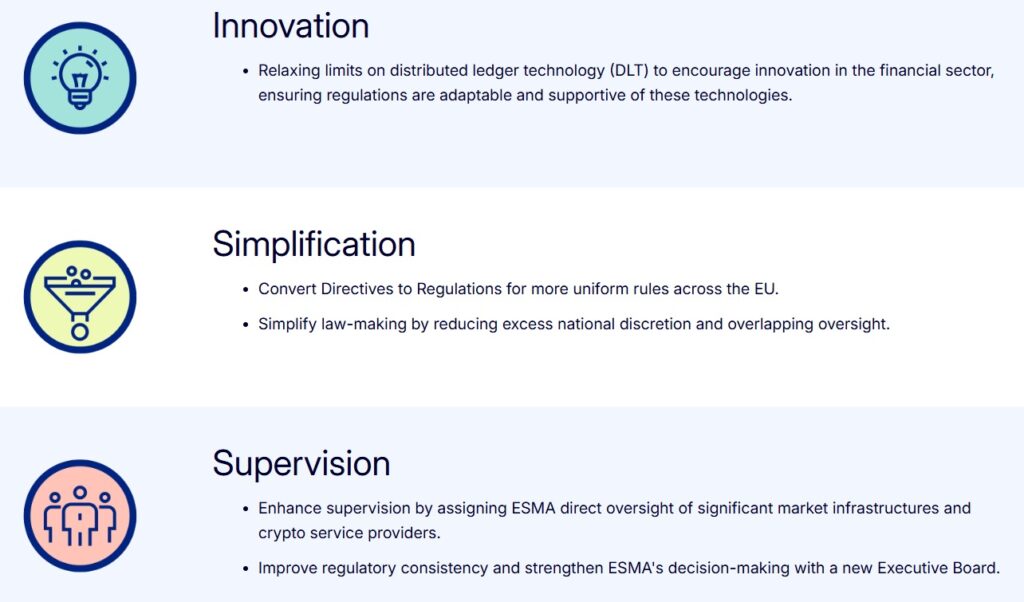
If the EU proposal is adopted, ESMA would have direct powers over crypto asset service providers (CASPs), trading platforms, and central counterparties, inspired by the centralized model of the American SEC. Additionally, the proposal includes measures to encourage innovation, such as relaxing rules on distributed ledger technology (DLT), while strengthening cybersecurity and supervision of new token offerings. The stated objective is:
- To simplify the rules;
- To reduce national overlaps;
- To improve regulatory consistency with the creation of a new executive committee within ESMA.
MiCA’s flaws – fertile ground for malicious actors?
Despite its ambitions, MiCA presents flaws exploited by some malicious actors. Jurisdictions like Malta have been criticized for their laxity, allowing unscrupulous entities to circumvent rules. ESMA has also pointed out the Maltese regime, considering that it only partially meets transparency and security requirements.
These gaps have allowed dubious practices, reinforcing the need for centralized supervision. In response, the EU is tightening controls, but this rigidity could also stifle legitimate initiatives. Small companies and crypto startups fear prohibitive compliance costs, while investors question the balance between security and financial freedom. The question arises: have these flaws accelerated the decision to extend ESMA’s powers?
USDT banned in Europe because of MiCA – a boon for bitcoin?
Since March 31, 2025, USDT has disappeared from major European platforms. Tether, its issuer, refused to comply with MiCA, accusing the ECB of favoring its own digital euro project. This exclusion creates a gap that bitcoin could fill, as a decentralized and censorship-resistant asset.
However, MiCA also imposes strict constraints on platforms, limiting BTC’s appeal to individuals. Meanwhile, the ECB and several European banks are preparing to launch euro stablecoins as early as 2026, aiming to reduce dollar dependency and strengthen monetary sovereignty. This showdown between Tether and European regulators illustrates tensions between innovation and control.
MiCA and the extension of ESMA’s powers could redefine the crypto landscape in Europe. Between strict regulation and monetary sovereignty, the EU is charting an ambitious but risky course. Will bitcoin emerge stronger, or will the digital euro become the new standard? And you, which solution do you favor for the future of cryptocurrencies in Europe?
Maximize your Cointribune experience with our "Read to Earn" program! For every article you read, earn points and access exclusive rewards. Sign up now and start earning benefits.

The world is evolving and adaptation is the best weapon to survive in this undulating universe. Originally a crypto community manager, I am interested in anything that is directly or indirectly related to blockchain and its derivatives. To share my experience and promote a field that I am passionate about, nothing is better than writing informative and relaxed articles.
The views, thoughts, and opinions expressed in this article belong solely to the author, and should not be taken as investment advice. Do your own research before taking any investment decisions.