Over 80 Nations Adopt Alternatives To The US Dollar
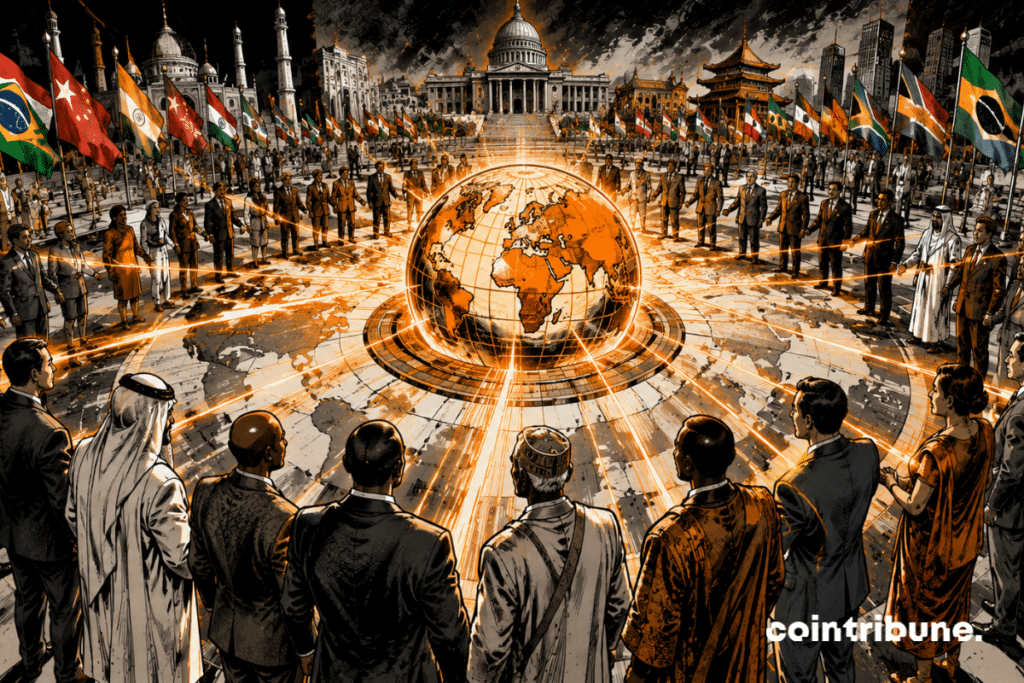
More than 80 countries are now seeking to reduce their dependence on the US dollar, a movement gaining unprecedented momentum under the impetus of the BRICS. Between trade settlements in yuan, rupee, or ruble and the multiplication of bilateral monetary agreements, several major economies are accelerating their transition towards alternatives to the greenback. As the expanded BRICS bloc gains influence on global trade, this dynamic is gradually reshaping international financial balances and fueling questions about the future of dollar dominance.
In Brief
- More than 80 countries are gradually reducing their dependence on the dollar in their trade exchanges.
- The BRICS strengthen their global economic weight and accelerate the use of national currencies.
- China and Russia now settle most of their exchanges in yuan and ruble.
- This dynamic could contribute to the emergence of a more multipolar international financial system.
More than 80 countries join the dedollarization movement
The dedollarization movement reaches a new stage. Thus, more than 80 countries now participate in initiatives aimed at reducing their dependence on the US dollar in international trade. This dynamic is largely associated with the growing influence of the BRICS, whose membership has expanded with the arrival of new members such as Saudi Arabia, the United Arab Emirates, Egypt, Iran, and Ethiopia.
Such an evolution is part of a broad strategy aimed at promoting the use of national currencies in trade exchanges. The Chinese yuan, Indian rupee, and Russian ruble gradually appear as alternatives to the greenback in several bilateral agreements. For the countries involved, the objective is to reduce their exposure to financial mechanisms dominated by the United States while strengthening their autonomy in settling their international transactions.
The figures presented help measure the scale of this transformation :
- More than 80 countries participate in dedollarization initiatives ;
- The BRICS now account for 20.4 % of global trade ;
- The bloc represents about 36.8 % of global GDP at purchasing power parity ;
- The yuan, rupee, and ruble are among the main currencies used in these new settlement mechanisms.
These indicators reflect the growing economic weight of the grouping and explain why dedollarization initiatives are attracting increasing attention on international markets.
Local currencies gain ground in trade and energy
The most significant development concerns economic cooperation between China and Russia, two influential members of the BRICS alliance. According to Yuri Ushakov, diplomatic advisor to the Kremlin, “practically all payments related to the $240 billion trade between the two countries are now made in yuan and ruble, protecting them from Western sanctions”. This statement reveals a change already widely operational: trade exchanges between the two powers, valued at about $240 billion, are now settled almost entirely in local currencies.
Moreover, this transformation is accompanied by increased energy exchanges. Russia exported more than 31 million tons of oil to China during the first quarter of the year, a rise of over one-third. At the same time, Beijing is pursuing its international strategy by multiplying currency swap agreements. China is said to have signed this type of agreement with more than 50 countries, including notably Russia, Saudi Arabia, and the United Arab Emirates. India, for its part, is also developing its own settlement mechanisms in rupees with over 20 partner countries.
The potential consequences of this evolution are multiple. The dollar remains today the main global reserve currency and retains a dominant position in international financial markets.
However, the multiplication of trade agreements in local currencies shows that several economies seek to diversify their payment instruments and reduce their reliance on a single currency. The interest shown by Saudi Arabia in a possible partial invoicing of its oil exports in yuan is a signal particularly observed by the markets. If this trend continues, it could contribute to strengthening a more multipolar international monetary system, in which several currencies would coexist within global trade exchanges.
Maximize your Cointribune experience with our "Read to Earn" program! For every article you read, earn points and access exclusive rewards. Sign up now and start earning benefits.

Diplômé de Sciences Po Toulouse et titulaire d'une certification consultant blockchain délivrée par Alyra, j'ai rejoint l'aventure Cointribune en 2019. Convaincu du potentiel de la blockchain pour transformer de nombreux secteurs de l'économie, j'ai pris l'engagement de sensibiliser et d'informer le grand public sur cet écosystème en constante évolution. Mon objectif est de permettre à chacun de mieux comprendre la blockchain et de saisir les opportunités qu'elle offre. Je m'efforce chaque jour de fournir une analyse objective de l'actualité, de décrypter les tendances du marché, de relayer les dernières innovations technologiques et de mettre en perspective les enjeux économiques et sociétaux de cette révolution en marche.
The views, thoughts, and opinions expressed in this article belong solely to the author, and should not be taken as investment advice. Do your own research before taking any investment decisions.