Switzerland pulls ahead of Germany in crypto adoption
A statue of Satoshi Nakamoto stands in Lugano, and Swiss merchants readily accept bitcoin. In the Helvetic Confederation, paying with cryptocurrency is nothing out of the ordinary. The BearingPoint study confirms this deep-rooted reality: Switzerland has pulled ahead of its German-speaking neighbours. While Germany is still deliberating, Switzerland is taking action and widening the gap.
In brief
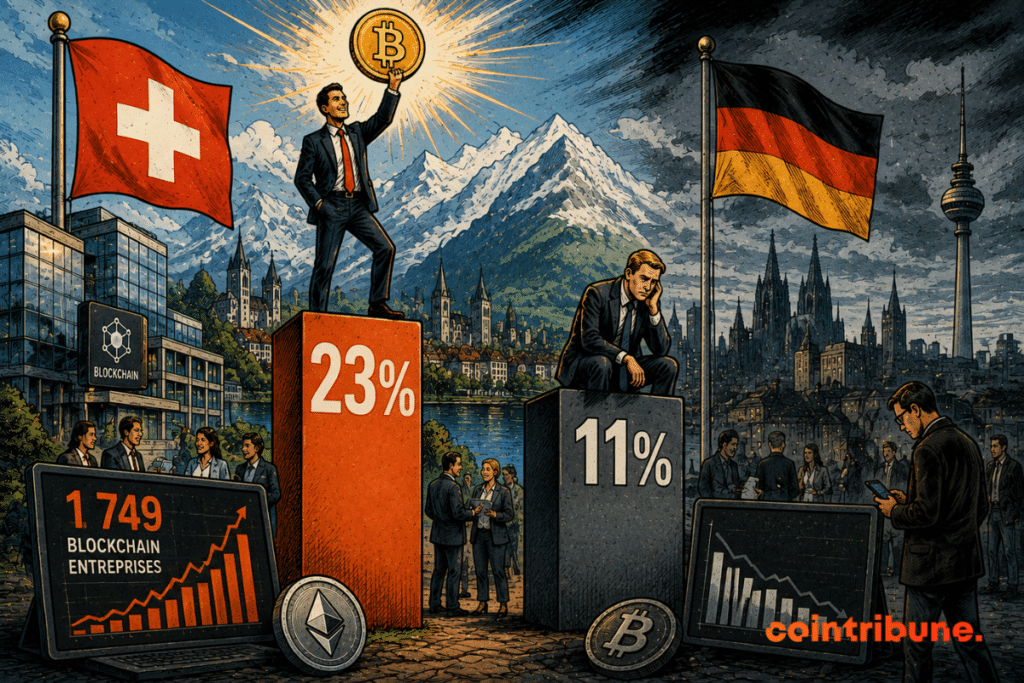
- Switzerland has 23% of cryptocurrency users, compared to 11% in Germany, widening the gap considerably.
- Thirty-seven percent of Swiss people consider cryptocurrencies a worthwhile investment, compared to 23% of Germans.
- The 2021 DLT Act has enabled Switzerland to build an ecosystem of 1,749 companies in Crypto Valley.
- German banks DZ Bank and Dekabank are aiming for 80 million customers to catch up.
23% vs 11%: just how wide is the gap between these two neighbours?
The YouGov survey conducted in June 2026 among 4,000 people paints a stark picture. Switzerland boasts 23% cryptocurrency users, compared with just 11% in Germany and 18% in Austria. The gap is not limited to usage alone. 37% of Swiss respondents view crypto as a sound investment, versus 23% of Germans.
Germany discusses risks while its neighbours are already using and investing more.
Dr Robert Bosch, head of financial services at BearingPoint
The Swiss are also 45% likely to imagine cryptocurrencies as a reserve currency, against 32% in Germany. Interest in CBDCs reaches 44% in Switzerland, far ahead of the 29% across the Rhine.
A chasm is opening, and the Germans are struggling to cross it.
Germany debates, Switzerland acts: two approaches to crypto go head-to-head
The gap between the two countries is no accident. It stems from diametrically opposed political choices. On one side, a pragmatic Switzerland that adopted the DLT Act back in 2020, integrating digital assets into its existing legal framework.
On the other, a Germany that has locked itself into endless debates about risks. “Germany debates, Switzerland acts,” Bosch sums up.
German banks like DZ Bank and Dekabank are only just beginning their crypto journey, while Switzerland already boasts an ecosystem of 1,749 companies. The contrast is striking: Germany piles up analyses, Switzerland piles up users.
This antithesis raises a question: is German prudence wisdom or weakness?
Switzerland’s DLT Act: a slow-burning bomb that hit its target dead centre
The Distributed Ledger Technology Act, which came into force on 1 August 2021, changed the game. Rather than creating a new framework, the Swiss legislator integrated digital assets into existing legal structures. A decision that has had spectacular effects.
Crypto Valley now counts 1,749 companies, growing at 14% per year. Zug hosts 719 companies, Zurich 15%, and clusters are emerging in Geneva, Ticino and Lucerne. Ethereum, Cardano, Solana, Polkadot, Tezos, Sygnum Bank and Amina Bank are all present.
The ecosystem attracts lawyers, bankers, developers and investors, creating a virtuous circle. This 2020 gamble is paying off.
Key figures of Switzerland’s lead:
- BTC price at time of writing: $62,806
- Crypto usage: 🇨🇭 23% / 🇩🇪 11%
- Investment: 🇨🇭 37% / 🇩🇪 23%
- Strategic role: 🇨🇭 45% / 🇩🇪 32%
- Crypto Valley companies: 1,749 (+14% / year)
Can Germany turn the tide with 80 million banking customers in its corner?
Faced with Switzerland’s lead, Germany has a major asset: its banks. DZ Bank launched “meinkrypto” at the end of 2025, integrated into the VR Banking app, with custody provided by Börse Stuttgart Digital. Dekabank is preparing a similar platform for the savings banks network, targeting 50 million customers.
These networks could reach 80 million people. Yet activation by individual banks remains uncertain, creating a risk of fragmentation. Switzerland’s lead rests on years of ecosystem and expertise.
German banking distribution is an asset, but can it convince banks to activate the features?
Switzerland has turned regulation into an advantage, while Germany remains trapped in its debates. But the Swiss National Bank, for its part, excludes Bitcoin from its reserves. Irony of fate: the people adopt, the institution refuses. The ethics of innovation play out at multiple levels.
Maximize your Cointribune experience with our "Read to Earn" program! For every article you read, earn points and access exclusive rewards. Sign up now and start earning benefits.

La révolution blockchain et crypto est en marche ! Et le jour où les impacts se feront ressentir sur l’économie la plus vulnérable de ce Monde, contre toute espérance, je dirai que j’y étais pour quelque chose
The views, thoughts, and opinions expressed in this article belong solely to the author, and should not be taken as investment advice. Do your own research before taking any investment decisions.