In a crazy quest to save the American economy, VanEck sees bitcoin as a miracle cure. Could a strategic reserve of cryptocurrency really wipe out 21 trillion in debt by 2049?
The American economy is facing a dynamic that could disrupt the existing balances: demand for long-term Treasury bonds is weakening, calling into question the strength of the dollar and fueling new economic uncertainties. As the Federal Reserve remains committed to a delicate monetary policy and inflation struggles to slow down, Bitcoin finds itself at a strategic crossroads. Historically viewed as a speculative asset, it is now seeing its status evolve as some U.S. states consider incorporating it into their reserves. The central question is thus: will Bitcoin suffer the effects of this uncertainty or will it seize the opportunity to assert itself as an alternative safe haven?
While the Fed hesitates between caution and action, inflation runs rampant, and crypto wavers, poised for a week of financial roller coasters.
The impact of the latest U.S. inflation data was immediately felt on the crypto market this Wednesday, February 12, 2025. Bitcoin fell below the $95,000 mark following the announcement of higher-than-expected inflation, while Donald Trump continues to push for a reduction in interest rates.
Traders fear the impact of the US employment report on bitcoin. In this article, we explain why.
Every decision made by the American Federal Reserve shapes the global economy and influences the cost of credit, the direction of investments, and the stability of financial markets. At its first meeting of 2025, the Federal Open Market Committee (FOMC) chose to keep interest rates unchanged, despite Donald Trump's persistent calls for monetary easing. This status quo caused a contrasting shock wave: stock indices, from Nasdaq to Dow Jones, closed lower, while Bitcoin surged by 2.5%. Thus, this movement underscores once again the unique trajectory of cryptocurrencies, which seem to diverge from traditional economic logics.
Bitcoin (BTC) started the last week of January with a significant drop below $100,000, reaching its lowest point in 10 days. Even though the queen of crypto slightly rebounded to $100,000, investors are navigating an environment of increasing tension! Between market volatility and uncertainties from the Federal Reserve... Here are 5 things to know about Bitcoin this week.
The relationships between political leaders and financial institutions are going through a phase of great tension. Donald Trump, the President of the United States, has strongly criticized the Federal Reserve (Fed) and is calling for an immediate reduction in interest rates. This appeal, made during the World Economic Forum in Davos, comes at a time when the Fed, led by Jerome Powell, is maintaining a cautious approach in the face of persistent inflation and a strong labor market. Such a showdown highlights critical stakes for the American economy, raising questions about the independence of central banks on a global scale.
President Donald Trump signed an executive order that upends the American approach to crypto. This text marks a break by excluding two key players, the Federal Reserve (Fed) and the Federal Deposit Insurance Corporation (FDIC), from regulatory discussions.
The correlation of Bitcoin with the Nasdaq has reached its highest level in two years, exceeding 0.70 according to Bloomberg data. This synchronization occurs at a critical moment as markets hold their breath ahead of the release of the next American Consumer Price Index (CPI) report.
The American Federal Reserve (FED) may slow down its interest rate cut cycle in 2025, according to recent statements from its officials. An announcement that sparked panic on Wall Street, where stock indices fell sharply on Friday, shaken by robust economic data! This reinforces the idea that the FED could curb its monetary easing sooner than expected.
Below $92,000, Bitcoin wavers, and the Fear & Greed index, like a nervous barometer, shifts from vertigo to apathy.
The American Federal Reserve is divided over the potential inflationary consequences of the tariff increases promised by Donald Trump. While some officials downplay the risks, others fear a resurgence of inflation in an already strained economic context.
The year 2025 could very well start with a bang for Bitcoin, thanks to a massive injection of liquidity from the FED, which could propel BTC to a new ATH in March 2025.
The year 2025 begins under the sign of instability for the crypto market. After briefly exceeding the symbolic threshold of 100,000 dollars on January 7, Bitcoin experienced a dramatic reversal, falling to 92,500 dollars in just a few hours. This sudden decline cannot be explained by a technical factor but rather by major macroeconomic elements. Investors are closely monitoring the monetary policy of the U.S. Federal Reserve (Fed), whose decisions directly influence financial markets. So far, many had anticipated a drop in interest rates as early as the first quarter of 2025. However, the latest economic data in the United States indicate stronger-than-expected growth, which challenges this assumption. As a result, markets are reassessing their expectations and adjusting their positions. This uncertainty has triggered a wave of liquidations that has contributed to Bitcoin's decline.
Between Trumpian euphoria and the cold mechanics of the Fed, bitcoin swings, a fragile king of a kingdom of uncertainties.
Bitcoin could reach between $150,000 and $400,000 by 2025, according to a report by Blockware Solutions. The projections depend on several key factors: the policy of the U.S. Federal Reserve, corporate adoption, and the potential strategic reserve of bitcoins under Trump.
A renowned financial analyst, Dr. Jim Willie, recently sounded the alarm about a massive debt crisis that could hit the U.S. economy in 2025. According to him, the United States is heading toward a critical point with $7 trillion in debt maturing, which could trigger a major economic crisis.
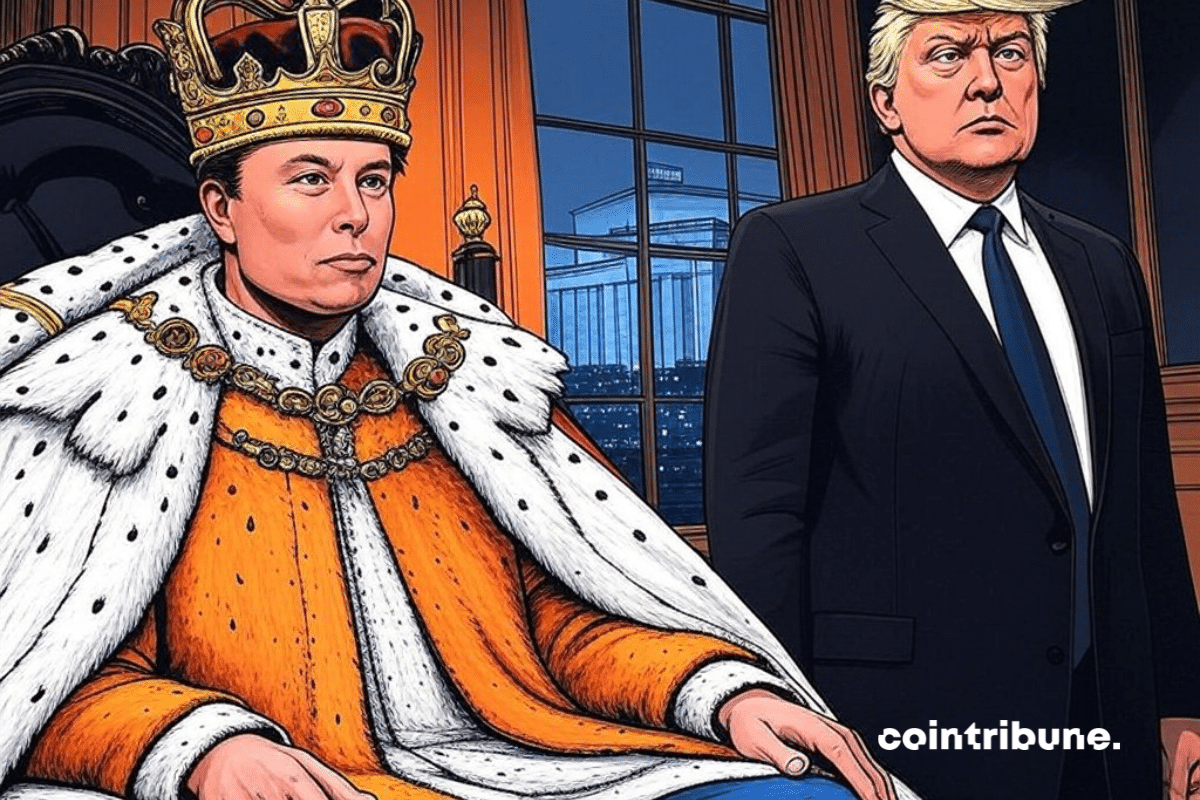
Elon Musk is shaking Washington. Between his influence on social media and his hundreds of millions of dollars in donations, Elon Musk is increasingly establishing himself as the true master of the White House.
The United States surprises with economic performance well beyond expectations for the third quarter. According to data from the Department of Commerce, the gross domestic product (GDP) grew by 3.1%, compared to an initial estimate of 2.8%. This result exceeds observers' forecasts and reflects a dynamic economy, driven by strong consumer spending and an improvement in exports. While many regions of the world struggle to maintain their economic momentum, as evidenced by the limited growth forecast of 0.7% for the Eurozone in 2024, this progress indicates the resilience of the American economy in the face of global uncertainties. These figures also highlight the impact of recent monetary decisions by the Federal Reserve, which has fostered a conducive environment for growth through adjustments to interest rates.
The crypto market is going through a period of high volatility, marked by a drop in the price of Bitcoin, now valued at $100,300. This unexpected plunge for many investors comes in the wake of the recent announcements from the U.S. Federal Reserve. While the 0.25% reduction in the federal funds rate appeared to align with expectations, the upward revision of inflation forecasts for 2025, now set at 2.5% from 2.1% previously, took the markets by surprise. In his speech, Jerome Powell, the Fed chair, emphasized that these adjustments reflect a cautious approach in the face of current economic challenges. These decisions have triggered shockwaves in the financial markets, increasing uncertainties and sparking a debate on the potential implications for crypto investors.
The global economic landscape is at a critical phase. Every decision by the Federal Reserve (Fed) becomes a key signal, closely monitored by investors and financial analysts. In this context, the imminent announcement of a new interest rate cut sparks keen interest. As inflation, once rampant, begins to return to more controlled levels, the Fed is considering reducing its benchmark rate once again, this time to a range of 4.25% to 4.5%. This measure, which is part of an economic stabilization strategy, leaves no market indifferent. For cryptocurrencies, this announcement fuels both hope for a more favorable monetary environment and fear of increased instability. As Bitcoin and Ethereum already face significant declines, investors question the prospects ahead.
Under the Christmas tree of the global economy, Bitcoin sparkles. But behind the digital gold, the shadow of a storm is gently forming.
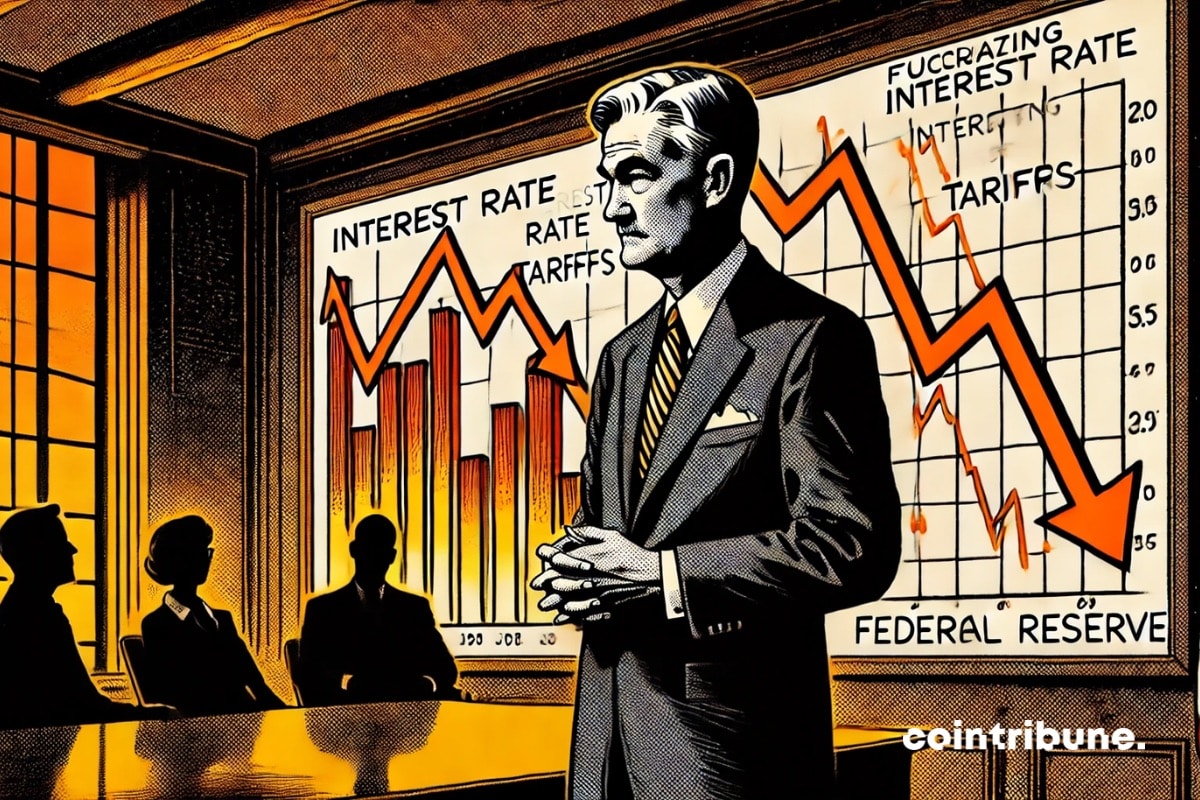
Amid whispers of inflation and hopes for growth, the Fed is reshaping its horizons. Powell, with caution in hand, challenges a nascent economic storm.
Recent employment data in the United States suggests a likely reduction in interest rates in December, according to Grayscale. This outlook could influence financial markets, particularly bitcoin, which may benefit from this more accommodative monetary policy. Here’s what the figures reveal.
After the governor of the Bank of France, it is now the turn of the Fed's governor to temper his stance regarding Bitcoin.
Investors are ramping up their bets on a decrease in the U.S. Federal Reserve's benchmark interest rates in December, according to the CME FedWatch tool. The probability of a 25 basis point reduction has surged to 74.5%, compared to 66% last week.
With XRP soaring, Ethereum galloping, and the Fed squawking, the week promises to be as unpredictable as a night market. Watch out for the jolts!
In a context of booming financial markets, where every macroeconomic event can redefine the balance, the upcoming week is set to be crucial for cryptocurrencies. Investors' attention is focused on key indicators such as the PCE price index, the minutes of the U.S. Federal Reserve (FOMC), and the revision of U.S. GDP. Meanwhile, the imminent expiration of over 10 billion dollars in Bitcoin and Ethereum options is expected to add to the prevailing volatility. These dynamics, which intertwine economic uncertainty and crypto issues, could significantly shape the financial landscape.
Trump wants to lead the Fed, but Powell, stoic as a Swiss banker, refuses to relinquish the reins. Guaranteed economic duel!