The House Prohibits Lawmakers From Buying Stocks but Allows Them to Sell
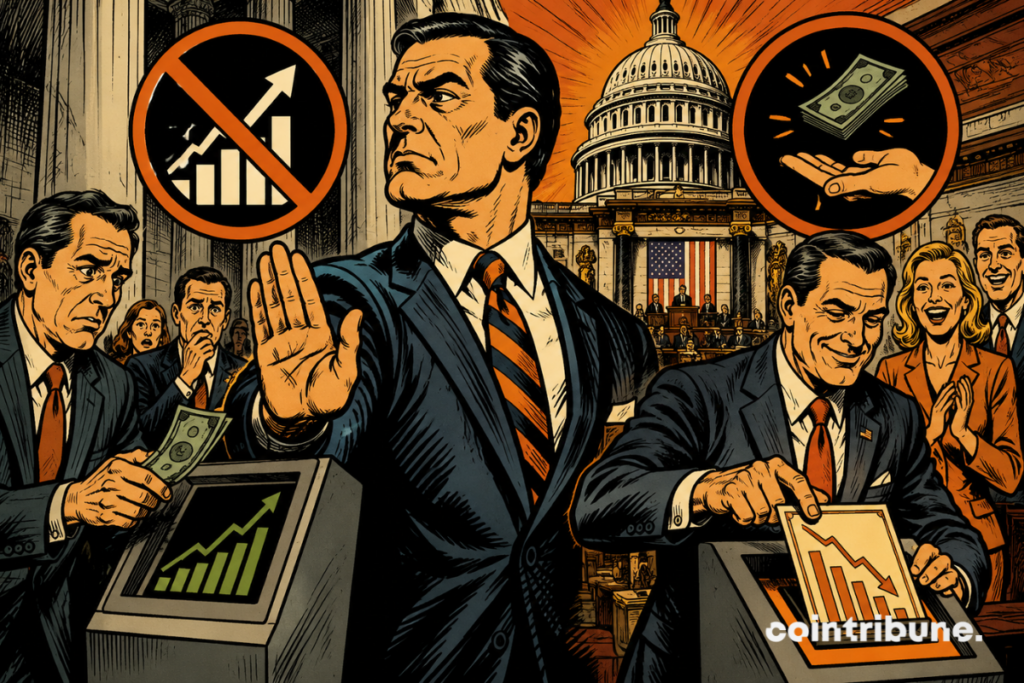
The U.S. House of Representatives has taken a new step in regulating investments made by lawmakers. Representatives passed a bill that now prohibits members of Congress, their spouses, and dependent children from buying publicly traded stocks, while allowing them to keep and then sell stocks they already own. This decision opens a new debate on conflict of interest prevention before the Senate examines the bill.
In Brief
- The House adopts a ban on stock purchases for lawmakers.
- Parliamentarians will still be able to keep and sell their stocks.
- The bill provides fines and restitution of illegal gains.
- The bill is now sent to the Senate for review.
The House Adopts a Reform Against Insider Trading
The United States House of Representatives passed the bill by 232 votes to 198 before sending it to the Senate. This text, introduced by Wisconsin Representative Bryan Steil, aims to prevent members of Congress from benefiting from insider information when making investments. The stated objective is to strengthen trust in institutions while limiting the risks of insider trading.
Bryan Steil, an elected official from Wisconsin, claims this reform includes significant financial penalties in case of violation. Offenders would face a fine of $2,000 or 10% of the transaction amount involved.
A fine of $2,000 or 10% of the transaction amount, as well as restitution of profits, will be provided. Offenders will lose all profits made if they do not comply with this legislation.
Bryan Steil, Wisconsin Representative.
Additionally, they should return all profits made from transactions deemed illegal. This measure aims to discourage any stock purchase made based on non-public information according to his statements.
The bill, however, only concerns a portion of public officials. The proposal targets only members of Congress, their spouses, and dependent children. The president, vice president, and their families are not included within this legislative framework, unlike other projects currently being studied in Washington.
Stock Sales Remain Allowed Despite Criticism
While the House now bans new purchases, it still allows lawmakers to keep and sell stocks they already hold. This provision is the main point of disagreement regarding the bill. Several political officials believe that this exception greatly limits the reform’s scope.
Bryan Steil nevertheless defends this approach, explaining that it introduces an additional transparency mechanism. Members of Congress will have to notify seven days before any sale of already owned stocks. According to him, this obligation reduces the possibility of profiting from confidential information before a transaction.
Senator Elizabeth Warren, however, disputes this analysis. The senator believes that lawmakers will still be able to own and sell stocks, which does not fully address the risks of conflicts of interest. She wrote in a post on Bluesky:
I have long fought to ban members of Congress from trading stocks, but the bill passed by House Republicans has major loopholes. Lawmakers can continue to own and sell stocks; this text will therefore not solve the problem. It will not pass the Senate. Members of Congress should neither own, buy, nor sell stocks.
Elizabeth Warren, Democratic Senator.
She believes lawmakers should neither buy, own, nor sell financial securities. For this reason, she thinks the text should not be adopted by the Senate in its current form.
A Reform Distinct from Crypto and Predictive Market Projects
After its passage by the House of Representatives, the bill now follows its legislative course before the U.S. Senate. This proposal, however, remains different from the Digital Asset Market CLARITY Act, which is also under Senate review. While the latter concerns the structure of the cryptocurrency market, the bill pushed by Bryan Steil focuses solely on investments made by lawmakers.
The CLARITY Act project, which currently stands between investor protection and conflicts of interest, notably includes restrictions on the issuance or sponsorship of digital tokens by U.S. public officials until 2029. In contrast, the text adopted by the House does not address digital assets. It exclusively regulates transactions involving stocks held by members of Congress and their family circle.
Meanwhile, Bryan Steil supports another proposal dedicated to prediction markets. This bill targets political officials using platforms such as Kalshi or Polymarket to bet on public decisions or political events such as the incident involving the soldier who reportedly won more than $400,000 betting on the arrest of Venezuelan President Nicolás Maduro. The proposed penalties follow the same principle as that applied to stocks, with a fine of $2,000 or 10% of the value of the prohibited operations.
Interest in prediction markets has intensified after several highly publicized cases involving significant gains made on political events. These episodes have fueled discussions about better regulation of investments and bets involving public officials. Now, the Senate will have to decide whether the bill passed by the House maintains its current balance or if it should be amended before possible final adoption.
Maximize your Cointribune experience with our "Read to Earn" program! For every article you read, earn points and access exclusive rewards. Sign up now and start earning benefits.

Journaliste et rédacteur web passionné par l’univers des cryptomonnaies et des technologies Web3. J’y traite les dernières tendances et actualités afin de proposer un contenu de haute qualité à un large public du secteur.
The views, thoughts, and opinions expressed in this article belong solely to the author, and should not be taken as investment advice. Do your own research before taking any investment decisions.