Trump Asserts Dominance Over Hormuz Triggering Iranian Response
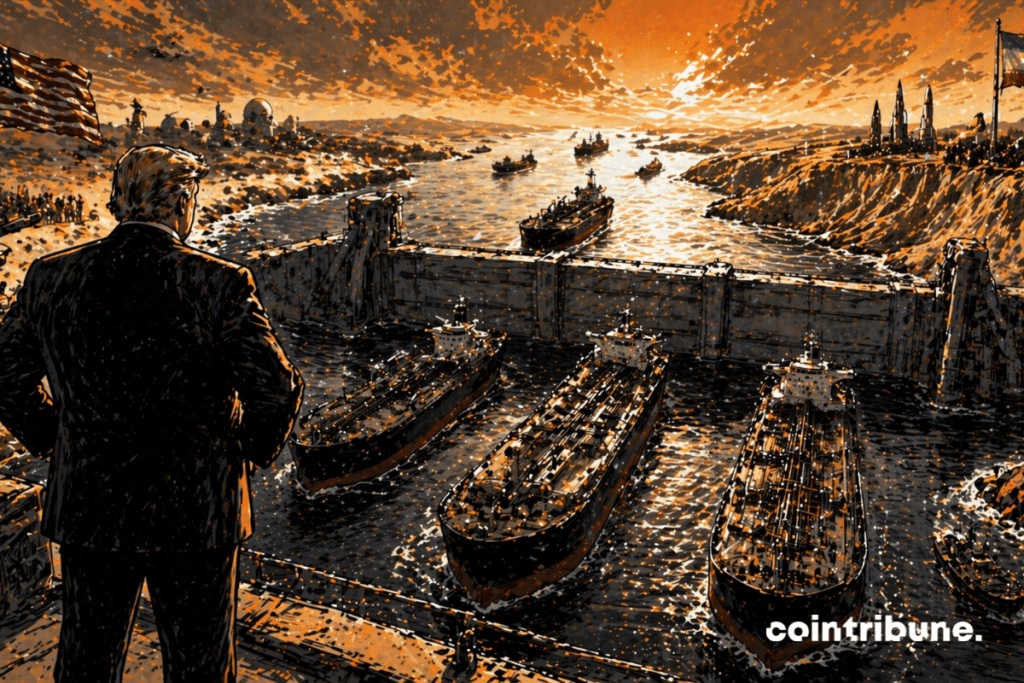
The Strait of Hormuz, a key passage through which nearly one-fifth of the world’s oil transits, is tipping into a zone of extreme tension. Donald Trump now claims to have total control over access, stating that no ship can pass without the approval of the United States Navy. This stance comes after several military incidents between Washington and Tehran, escalating an already explosive crisis. Between shows of force and direct responses, this standoff is redrawing energy and strategic balances on a global scale.
In brief
- Donald Trump announces total control of the Strait of Hormuz, stating that no ship can pass without US Navy approval.
- The United States establishes a strategic naval blockade to pressure Iran and limit its oil revenues.
- A series of military incidents increase tensions, with interceptions, ship seizures, and Iranian responses.
- This escalation poses major risks to global energy and geopolitical stability.
A military show of force at the heart of the Gulf
Donald Trump stated on April 23 that the United States exercises absolute control over the Strait of Hormuz. He declared : “we have total control over the Strait of Hormuz. No ship can enter or leave without the authorization of the US Navy. It is completely locked, and will remain so until Iran reaches an agreement.”
This announcement fits into a military sequence that began on April 13, when Washington officially established a blockade aimed at pressuring Iran.
Here are some key elements :
- On April 19, the destroyer USS Spruance intercepted the Iranian cargo MV Touska in the Gulf of Oman, fired upon the engine room to immobilize it, then had it boarded by the Marines ;
- On April 22, Iran responded by seizing two container ships and attacking a third vessel in the strait ;
- The US forces then seized an oil tanker linked to Iranian smuggling operations ;
- Donald Trump ordered to shoot without hesitation at any boat laying mines and announced a tripling of demining operations.
These actions illustrate a rapid escalation of the US military presence in the area, with a clear objective: to reduce Iran’s economic capabilities by directly targeting its oil and maritime flows.
Markets under tension and a persistent diplomatic deadlock
On the economic and diplomatic front, the situation reveals a more complex dynamic. The Strait of Hormuz accounts for about 20 % of global oil trade, and any disruption immediately impacts markets.
On April 23, Brent prices rose sharply while maritime traffic showed signs of slowing. However, Tehran disputes the American version, claiming the strait is not completely locked. Independent data indeed indicates that some ships continue to transit, although several have turned back in the face of growing risks.
Politically, the deadlock remains total. The Iranian Foreign Minister accuses the United States and Israel of being responsible for the escalation, while Iran refuses any negotiation as long as the blockade is in place, calling it an act of war. Despite active mediation by Pakistan and the maintenance of an expanded ceasefire in the region, no concrete progress is emerging.
Boosted by news of the truce in the region, bitcoin rebounded, reflecting a renewed appetite for risk despite a still-tense geopolitical context.
The coexistence of increased military pressure, economic tensions, and fragile diplomatic channels reveals a durably unstable situation. The evolution of this standoff could heavily impact global energy markets and revive systemic risks, far beyond the Gulf.
Maximize your Cointribune experience with our "Read to Earn" program! For every article you read, earn points and access exclusive rewards. Sign up now and start earning benefits.

Diplômé de Sciences Po Toulouse et titulaire d'une certification consultant blockchain délivrée par Alyra, j'ai rejoint l'aventure Cointribune en 2019. Convaincu du potentiel de la blockchain pour transformer de nombreux secteurs de l'économie, j'ai pris l'engagement de sensibiliser et d'informer le grand public sur cet écosystème en constante évolution. Mon objectif est de permettre à chacun de mieux comprendre la blockchain et de saisir les opportunités qu'elle offre. Je m'efforce chaque jour de fournir une analyse objective de l'actualité, de décrypter les tendances du marché, de relayer les dernières innovations technologiques et de mettre en perspective les enjeux économiques et sociétaux de cette révolution en marche.
The views, thoughts, and opinions expressed in this article belong solely to the author, and should not be taken as investment advice. Do your own research before taking any investment decisions.