Anthropic Unveils Claude Fable 5, Its Most Powerful AI Model Yet
Competition is intensifying across the artificial intelligence sector, as companies seek to improve reasoning, programming, and complex data-processing capabilities. In this environment, new models are increasingly judged not only by their performance but also by their operating costs. It is within this context that Anthropic has introduced Claude Fable 5, a new-generation model designed to meet the needs of developers, researchers, and businesses.

In Brief
- Anthropic presents Claude Fable 5 as its most powerful publicly available AI model.
- The model is designed for complex applications in programming, finance, vision, and long-context tasks.
- Fable 5 is offered at a lower cost than Claude Mythos Preview.
- Anthropic enhances security through automatic redirection to Claude Opus 4.8.
- The model is available across multiple plans before transitioning to a credit-based usage system.
Anthropic Introduces Claude Fable 5 Following Opus 4.8
After launching its new Opus 4.8 model, Anthropic announced Claude Fable 5 on Tuesday, a Mythos-class AI model designed for general-purpose use. The company describes it as its most powerful publicly available model to date, delivering strong results in programming, finance, vision, and long-context tasks.
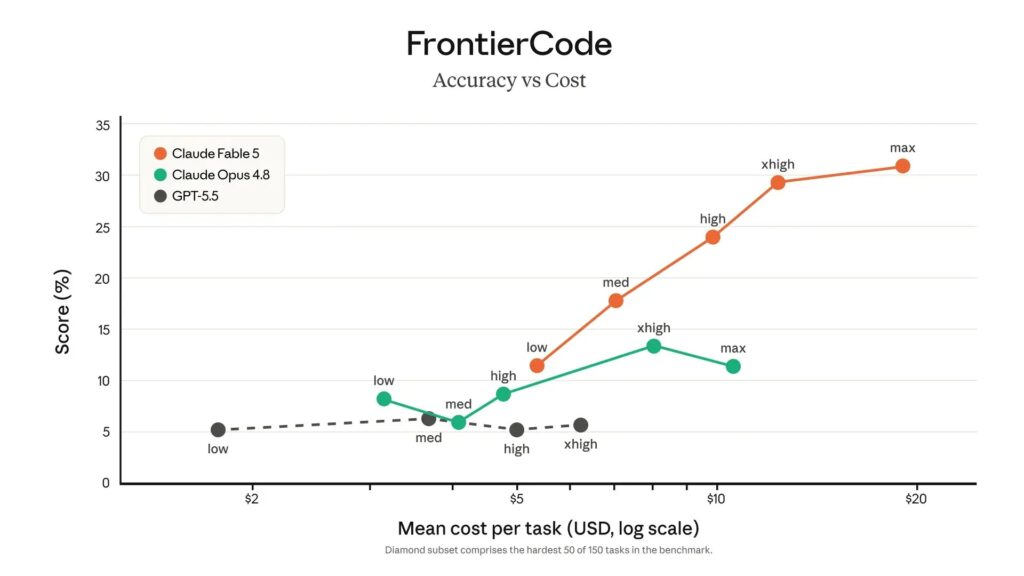
According to Anthropic’s statement, Claude Fable 5 ranks at the top of most evaluated benchmarks. The model stands out in software engineering, scientific research, intellectual work, and extended-context processing. The company also notes that its advantage becomes more significant as tasks grow longer and more complex.
The new model is priced at $10 per million input tokens and $50 per million output tokens. This pricing is less than half the cost of Claude Mythos Preview. Developers can access it directly through the Claude API using the claude-fable-5 endpoint.
Strong Results in Programming and Finance
Early feedback highlights substantial productivity gains. Stripe reported that Fable 5 completed the migration of a Ruby codebase containing 50 million lines in a single day. A similar project would reportedly have required more than two months of manual work from a full engineering team.
In the financial sector, IMC stated that the model successfully passed evaluations involving reasoning, root-cause analysis, and factual research. On Hebbia’s financial reasoning benchmark, Fable 5 achieved the highest score among all tested models.
An AI Built for Vision and Long Contexts
This new AI extends beyond text-based tasks. It also introduces improvements in visual understanding and complex context management.
Among the examples provided, Claude Fable 5 completed the Pokémon FireRed video game using only raw screenshots. No maps, navigation systems, or additional tools were used. Previous Claude models required more extensive assistance to accomplish the same task.
In advanced scientific research, a partner reported that the model achieved a result nearly identical to GPT-5.5 after 36 hours of work. To reach that outcome, Fable 5 reportedly used about one-third of the reasoning tokens consumed by its competitor.
The improvements also extend to memory and long-context tasks. Anthropic stated that file-based memory improved Fable 5’s performance in the deck-building game Slay the Spire three times more than it improved Opus 4.8 under similar conditions.
These results reflect the ongoing evolution of AI models toward systems capable of retaining more information while maintaining response consistency across extended sequences.
Cybersecurity, Availability, and New Protection Measures
Alongside Fable 5, Anthropic also launched Claude Mythos 5. The model is built on the same underlying architecture as Fable 5 but operates with certain cybersecurity restrictions relaxed.
Deployed through the Glasswing project in collaboration with the U.S. government, Mythos 5 is described by Anthropic as having the most advanced cybersecurity capabilities among currently available AI systems.
For Claude Fable 5, Anthropic has implemented several safety mechanisms. Requests related to cybersecurity, biology, chemistry, or model distillation can be automatically redirected to Claude Opus 4.8 rather than being rejected outright. The company states that more than 95% of sessions do not trigger any redirection.
A new data-retention policy also applies to Mythos-class models. Data will be retained for a maximum of 30 days, will not be used for model training, and will then be deleted in nearly all cases.
Claude Fable 5 is available in Pro, Max, Team, and Enterprise plans at no additional cost until June 22. Starting June 23, usage credits will be required. Anthropic says it intends to reintegrate the model into standard subscription plans once capacity allows.
In addition, the company recently filed a confidential application for an initial public offering. This move comes shortly after a similar filing by OpenAI, at a time when artificial intelligence, semiconductor, and major technology stocks continue to attract significant attention from financial markets.
Maximize your Cointribune experience with our "Read to Earn" program! For every article you read, earn points and access exclusive rewards. Sign up now and start earning benefits.

Journaliste et rédacteur web passionné par l’univers des cryptomonnaies et des technologies Web3. J’y traite les dernières tendances et actualités afin de proposer un contenu de haute qualité à un large public du secteur.
The views, thoughts, and opinions expressed in this article belong solely to the author, and should not be taken as investment advice. Do your own research before taking any investment decisions.