Digital Euro: ECB Prepares to Test Payments Powered by AI Agents
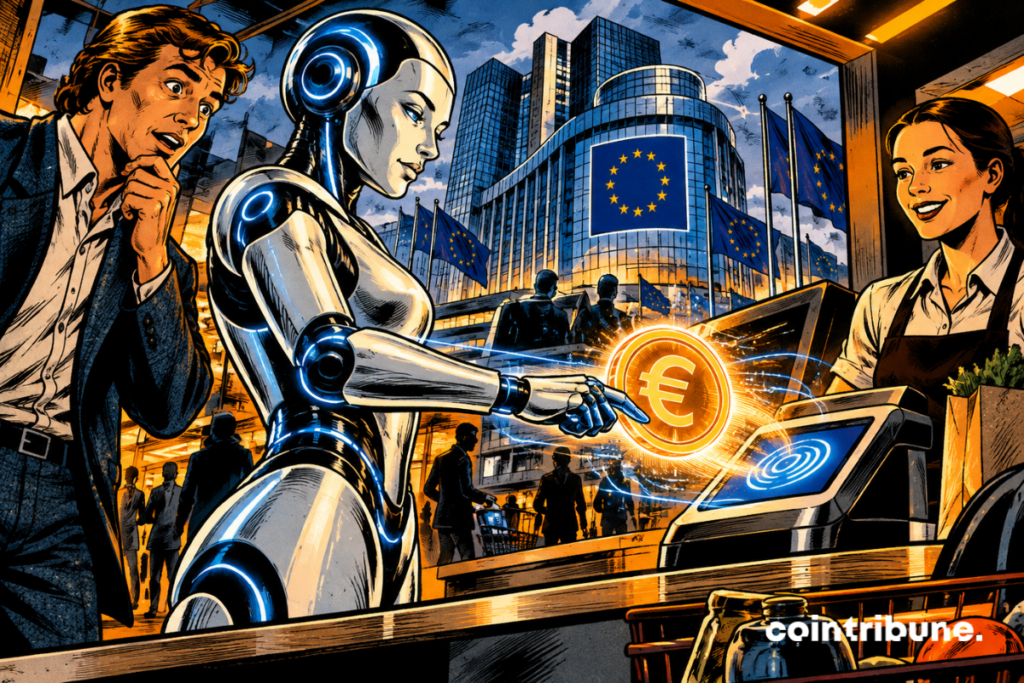
The ECB wants to prepare the digital euro for an economy where humans will not necessarily be behind every payment. The institution is now looking for companies capable of exploring payments using AI agents, micropayments, and machine-to-machine interactions. The first work will begin in 2027. The digital euro project itself is still not officially launched.
In brief
- The ECB opens the digital euro to experiments with AI agents.
- Companies can apply until November 9, 2026.
- Tests and workshops will begin in the first half of 2027.
The digital euro is preparing for AI agents
On September 28, the ECB opened a new call for applications aimed at fintechs, merchants, payment service providers, technology companies, public institutions, and research centers. This new step complements the digital euro pilot already planned for 2027.
This time, artificial intelligence enters the program directly. The ECB wants to explore several uses: AI-assisted payment experiences, AI agents, interactions between these agents, and micropayments. It also plans to study the use of the digital euro in transport, the payment of public services, smart cities, or the automation of certain public sector operations.
Applications are open until November 9, 2026, at 5 pm Central European Time. The work dedicated to these uses will notably take the form of workshops organized at the ECB premises in Frankfurt during the first two quarters of 2027.
For AI agents, everything remains experimental. The ECB does not yet promise a digital wallet capable of spending its owner’s money autonomously. It wants to see what works.
Two different programs to test payments
The new program includes two parts. The first concerns experimentation. Between January and June 2027, selected companies will have to build prototypes using the infrastructure planned for the digital euro.
The list includes electronic receipts integrated into payment applications, transactions involving multiple payers or multiple beneficiaries, conditional payments, and new functions directly accessible from apps.
Participants will have to produce proof of concept as well as a final report. The second part is more prospective. This is where AI agents and micropayments come in. The ECB wants to bring together various sectors to imagine uses that do not necessarily correspond to classic payments made today by card or banking app.
This new phase comes while the project has already significantly expanded. In July, the ECB had selected 36 providers to participate in the digital euro pilot. More than 50 companies had applied.
This pilot will begin in the second half of 2027 and last twelve months. The goal is different: to test a beta version of the digital euro in conditions close to daily use, notably for payments between individuals or at merchants.
The ECB wants a currency ready for new uses
The choice of AI agents is no coincidence. Artificial intelligence systems are becoming capable of executing tasks, using external services, and carrying out several steps without constant human intervention.
Payment could become one of these steps. For example, a machine could automatically trigger a small transaction when a specific condition is met. Micropayments thus become particularly interesting, especially when amounts are too low to justify the costs and procedures of traditional systems.
The ECB already imposes some limits on this reflection. Solutions presented must respect the principle of privacy by design, leave control to the user, and remain compatible with European data protection rules.
The subject is sensitive. The institution recently had to respond to concerns regarding surveillance with the digital euro. Most importantly, the 2027 experiments do not mean that the digital euro will be automatically launched. The ECB reminds that a final issuance decision can only come after the adoption of the European legislative framework. For now, it is building. And it already foresees that machines could one day be among the users.
Maximize your Cointribune experience with our "Read to Earn" program! For every article you read, earn points and access exclusive rewards. Sign up now and start earning benefits.

Fascinated by Bitcoin since 2017, Evariste has continuously researched the subject. While his initial interest was in trading, he now actively seeks to understand all advances centered on cryptocurrencies. As an editor, he strives to consistently deliver high-quality work that reflects the state of the sector as a whole.
The views, thoughts, and opinions expressed in this article belong solely to the author, and should not be taken as investment advice. Do your own research before taking any investment decisions.