Major Defeat for Trump Against the US Justice System
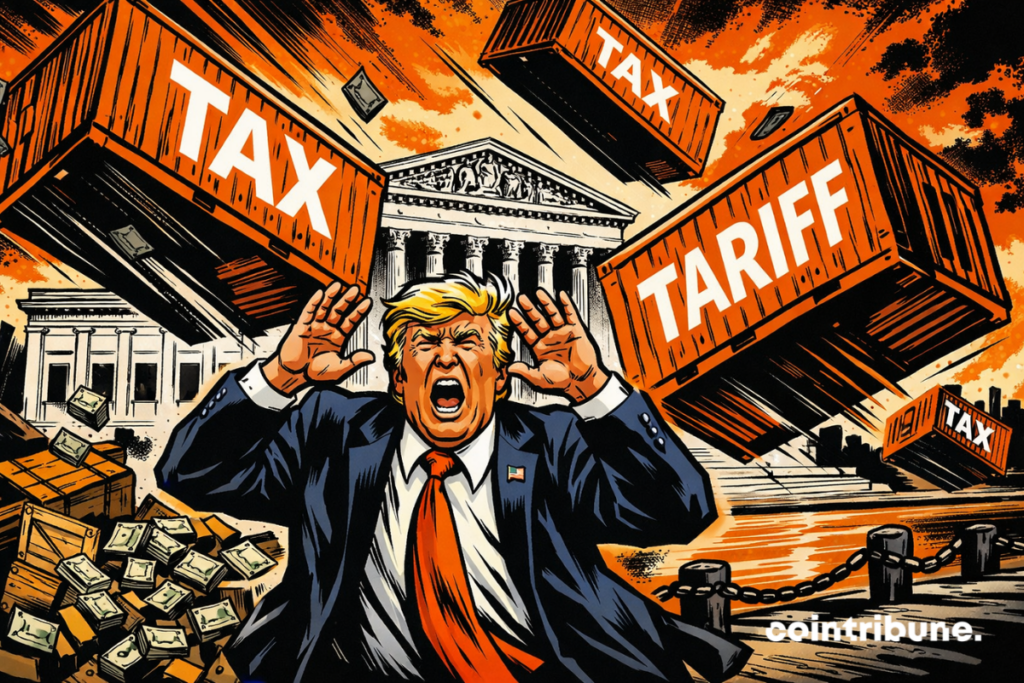
The United States Supreme Court has just struck hard. In a rare decision, it declared illegal the international tariffs imposed by Donald Trump, removing a trade tool he wielded as a geopolitical weapon. A judicial slap that could reshuffle the cards of his economic policy. But how far will this confrontation between the White House and the judiciary go?
In Brief
- The Supreme Court invalidated Trump’s global tariffs by 6 votes to 3.
- The IEEPA law does not authorize the president to impose tariffs, according to the majority.
- Chief Justice John Roberts wrote the majority opinion.
- The blocked tariffs targeted Canada, Mexico, China and dozens of other trade partners.
The Supreme Court Restricts Trump’s Tariff Power
On Friday, February 20, 2026, the United States Supreme Court issued a stinging verdict against Donald Trump, invalidating by 6 votes to 3 a central part of his tariff policy.
Chief Justice John Roberts wrote the majority opinion, supported by liberal judges Elena Kagan, Sonia Sotomayor, and Ketanji Brown Jackson, as well as two conservative judges. Only Thomas, Alito, and Kavanaugh defended the executive’s position.
At the heart of the dispute: the International Emergency Economic Powers Act, known by the acronym IEEPA. After his inauguration, Trump invoked this law to declare a national emergency. Initially against drug trafficking from Canada and Mexico, then due to “persistent trade deficits” with his partners.
On this basis, he imposed massive tariffs: 25% on Canadian and Mexican imports, 10% on Chinese products, and a floor tariff of 10% on nearly all global imports.
The Court ruled unambiguously: the IEEPA did not grant him that right. The term “regulate imports,” included in the law, cannot be equated to an unlimited taxing power.
As Roberts recalls, tariffs are not a softened version of a ban or obligation; they fall under the fiscal power, which constitutionally belongs to Congress.
A Doctrine Applied with Surgical Precision
To justify its decision, the majority of judges relied on a well-established legal principle: the “major questions” doctrine. The idea is simple, when a political decision is of considerable importance, Congress must explicitly authorize it. It cannot, through vague wording, leave the president free to act as he wishes.
However, in fifty years of existence, the IEEPA had never been used to impose tariffs of this magnitude. A non-existent precedent which, in the eyes of the Court, says it all.
The majority also dismissed, point by point, the arguments put forward by the Trump administration. The comparison with the Trading with the Enemy Act? Considered too fragile. Precedents from wartime contexts? Unusable in peacetime.
As for the Federal Energy Administration v. Algonquin SNG ruling, it simply did not apply: it was based on Section 232, a law which explicitly mentioned tariffs. Which IEEPA does not.
On the judicial side, the battle was fought on two fronts simultaneously. Small businesses sued in the Washington D.C. district court, while twelve states and other companies filed a separate action in the Court of International Trade.
In both cases, the White House suffered defeats. The federal court of appeals subsequently confirmed these decisions. The Supreme Court then combined both cases to rule once and for all.
A Turning Point for American Trade Policy
This decision is not limited to a legal disagreement: it redraws the contours of executive power in international trade. Trump can no longer use the IEEPA as a blank check to impose tariffs at will.
To regain leeway, he will have to either obtain explicit authorization from Congress or resort to other legal bases, such as Section 232 or Section 301, with their own procedural constraints.
For markets, the news is reassuring: a more predictable playing field, potentially stabilized trade relations. However, for Trump, this is a rare humiliation and perhaps the beginning of a forced redefinition of his economic strategy.
Maximize your Cointribune experience with our "Read to Earn" program! For every article you read, earn points and access exclusive rewards. Sign up now and start earning benefits.

Passionné par le Bitcoin, j'aime explorer les méandres de la blockchain et des cryptos et je partage mes découvertes avec la communauté. Mon rêve est de vivre dans un monde où la vie privée et la liberté financière sont garanties pour tous, et je crois fermement que Bitcoin est l'outil qui peut rendre cela possible.
The views, thoughts, and opinions expressed in this article belong solely to the author, and should not be taken as investment advice. Do your own research before taking any investment decisions.