While Wall Street stutters, Metaplanet, the crypto-yen samurai, stacks bitcoins like others stack Treasury bonds. Michael Saylor applauds. The Fed coughs in its corner.
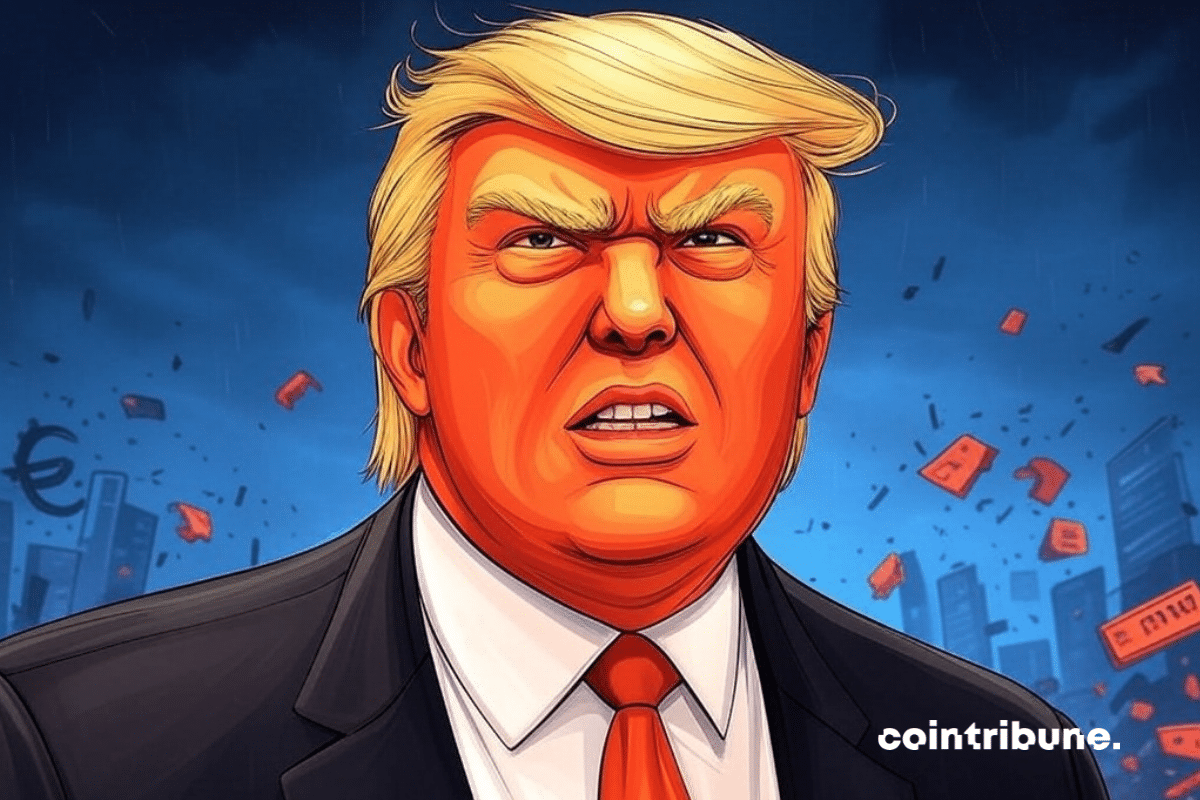
While Trump plays the customs officer, Tesla wavers, Alphabet holds firm, and Wall Street takes on water. The markets, on the other hand, brace for the next presidential tweet.
As the bank failures of 2023 continue to shake the markets, economist Peter Schiff is fueling fears of a total collapse of the American financial system. Known for his attachment to gold, he warns that a recession of historic proportions is underway and that all banks are destined to fall. Thus, this radical diagnosis, issued in an already tense context, reignites the debate over the strength of financial institutions and the viability of economic policies pursued since the 2008 crisis.
Peter Brandt's explosive prediction about Ethereum (ETH) has electrified the crypto community. This veteran trader, whose career spans five decades, anticipates a collapse in the price to around $800, a level unseen since 2022. While ETH struggles to stabilize above $1,600, this warning reignites debates about the uncertain future of the second-largest cryptocurrency. Between relentless technical analysis and the unwavering optimism of certain industry figures, the market is divided. But who is really right?
While the United States tightens its tariff arsenal, the rest of the world is organizing itself. Thus, the BRICS bloc attracts economies seeking strategic independence. Breaking away from the established monetary order, this alliance is reshaping trade routes and weakening the dollar's dominance. A silent but structural shift is underway.
The Bank for International Settlements (BIS) has just issued an unprecedented warning: cryptocurrencies and decentralized finance (DeFi) may have crossed a critical threshold, threatening global financial stability. Behind this observation lies a paradox. While the crypto ecosystem prides itself on democratizing finance, according to the BIS, it could amplify inequalities and create unexpected systemic risks. Between massive adoption, shaky regulation, and contagion effects, here is an analysis of a warning that is shaking the markets.
Stock tokenization, still a modest segment, could experience spectacular expansion in the coming years. According to several industry leaders, this market is expected to surpass $1 trillion in market capitalization in the medium term, driven by growing institutional interest.
While Bitcoin struts on the stock market like a peacock in rut, Ethereum broods in silence. Zero inflows, zero outflows: investors have clearly put Ether on a dry diet.
In 2025, record US debt issuance is worrying the markets. Is crypto becoming the last refuge? Analysis.
In a recent explosive statement, Donald Trump did not mince his words regarding Jerome Powell. The American president stated that the "resignation of the Fed chief couldn't come soon enough" and that he would not hesitate to fire him if he wanted to.
Donald Trump has renewed his attacks against Jerome Powell, the chairman of the Federal Reserve. He accuses him of not acting quickly enough to lower interest rates. Amid political tension, this criticism reignites the debate over the FED's independence and its growing influence on financial markets.
Cointribune is happy to invite you to participate in its new Read to Earn (R2E) quest on Credefi. This unique initiative not only allows you to earn crypto rewards but also to deepen your knowledge about this DeFi platform and the tools to succeed in this crypto field.
Jerome Powell's words have rarely sounded so heavy. Faced with a weakened economy and renewed trade tensions, the Fed chairman warns: new tariffs could plunge the United States into a zone of turbulence. Growth under pressure, inflation lurking, political uncertainties: the Federal Reserve must now contend with increasingly contradictory variables, risking losing control over the country's economic balance.
While Beijing maintains a strict ban on cryptocurrencies, a paradoxical reality is emerging: local governments are quietly selling off seized digital assets, filling their public coffers. Between opacity and financial urgency, this practice reveals the cracks in a system torn between repression and economic pragmatism. A tangle that reignites the debate on the legal framework for these assets, in a geopolitical context where China watches with suspicion the crypto-American advances.
France is struggling with a massive deficit, Bayrou calls for more work, but amid social cuts and political tensions, the reform risks triggering a governance crisis.
Out of 181 bitcoin companies, only 20 are active. With an 89% failure rate, Bukele's bitcoin project is a fiasco. The ambitions of digital revolution crash against reality.
How many bitcoins will the United States buy and how? White House advisor Bo Hines advocates using customs tax revenues.
Storms can erupt in the blink of an eye in the crypto sphere. Mantra (OM), once hailed by its supporters, has just experienced a dizzying 95% drop. As accusations of manipulation and opacity fly, John Mullin, CEO of the project, steps up. Between firm denial and promises of recovery, the scenario mixes a crisis of confidence with survival strategies.
Billionaire Ray Dalio warns that the international order is about to change at the expense of U.S. monetary hegemony. Bitcoin is lurking.
Crypto ETFs are in free fall: $795 million withdrawn last week. Discover more details in this article!
China does not intend to yield to the new American protectionist measures. In response to the tariff surge imposed by Donald Trump, Beijing retaliates directly by demanding the immediate removal of tariffs, fearing the effects of a major global economic shock.
The recent imposition of massive tariffs by Donald Trump, followed by an unexpected pause on certain Chinese products, has thrown financial markets into turmoil. While some see this as a deliberate strategy to reorganize the global economic landscape, others interpret this turnaround as a capitulation to market pressures and Chinese intransigence.
April's volatility in the U.S. financial markets is worrying global investors. Since the surprise announcement of new tariffs by Donald Trump on April 2, the S&P 500 has lost 5.4%. However, it is mainly the signals from the bond market and the dollar that raise fears of a deeper movement: an exodus of assets out of the United States.
While economists count illusions, Bitcoiners sense the truth. False data, weakening dollar: a new monetary dogma is being born before our eyes, far from official reports.
As geopolitical tensions reshape global balances, the BRICS are accelerating the establishment of their own payment network. Led by Russia, this infrastructure aims to free itself from SWIFT and open a financial pathway outside of Western control. The announcement of its accessibility to non-member countries marks a strategic rupture. Beyond being a regional tool, BRICS Pay becomes a lever of global influence and a strong signal in favor of a multipolar monetary order.
As macroeconomic tensions intensify, gold continues to break records and reaches a new high of $3245. Driven by the fall of the dollar and rising bond yields, the precious metal confirms its role as a safe haven. An analysis of a bullish trend that seems far from over.
Larry Fink, head of the world's largest asset manager, BlackRock, believes that the American economy may have already entered into recession, mainly due to the impact of Donald Trump's tariff policies.
Crypto in France is moving out of its phase of euphoria towards a more mature structuring. This 2025 study by Adan (Association for the Development of Digital Assets), conducted with Deloitte and Ipsos, presents a clear assessment: stabilized adoption, asserted industrial ambitions, but persistent challenges. Amid the rise of Web3, institutional openness, and regulatory barriers, the French ecosystem is carving its path towards sustainable integration. This survey sheds light on the springs of a dynamic in full redefinition, where the strategic future of cryptocurrencies in Europe is at stake.
Born from a meme, Dogecoin has established itself as a paradox of cryptocurrencies: both a joke and a serious asset. This Saturday, the price of DOGE surprised with a 6% rebound, reaching $0.166. Behind this surge, a rare technical signal on the hourly chart rekindles speculation. But amid contradictory indicators and recent news, the trajectory of the crypto dog remains enigmatic.
JPMorgan crushes forecasts but tempers euphoria. Through the publication of historical results for the first quarter of 2025, the leading American bank asserts its power amid ongoing volatility. However, Jamie Dimon is not celebrating victory. He warns of an accumulation of systemic risks, from inflation to geopolitical tensions. This dual signal, between accounting triumph and strategic warning, summarizes the paradoxes of a banking sector facing an uncertain world.