The crypto industry is going through its worst semester against hackers. Ethereum and Solana account for record losses. Full analysis.
While activity records are being broken by Ethereum, Solana, and Avalanche, their prices are plummeting. A concerning divergence that begs the question of whether adoption is sufficient to reduce costs. Examine this crypto paradox that is causing controversy.
Lido starts consolidating over 8 million ETH, valued at 16.5 billion dollars, into a much smaller number of validators. This migration could reduce the total number of active validators on Ethereum by one third. The network should thus process fewer technical messages, without directly changing gas fees or speeding up user transactions.
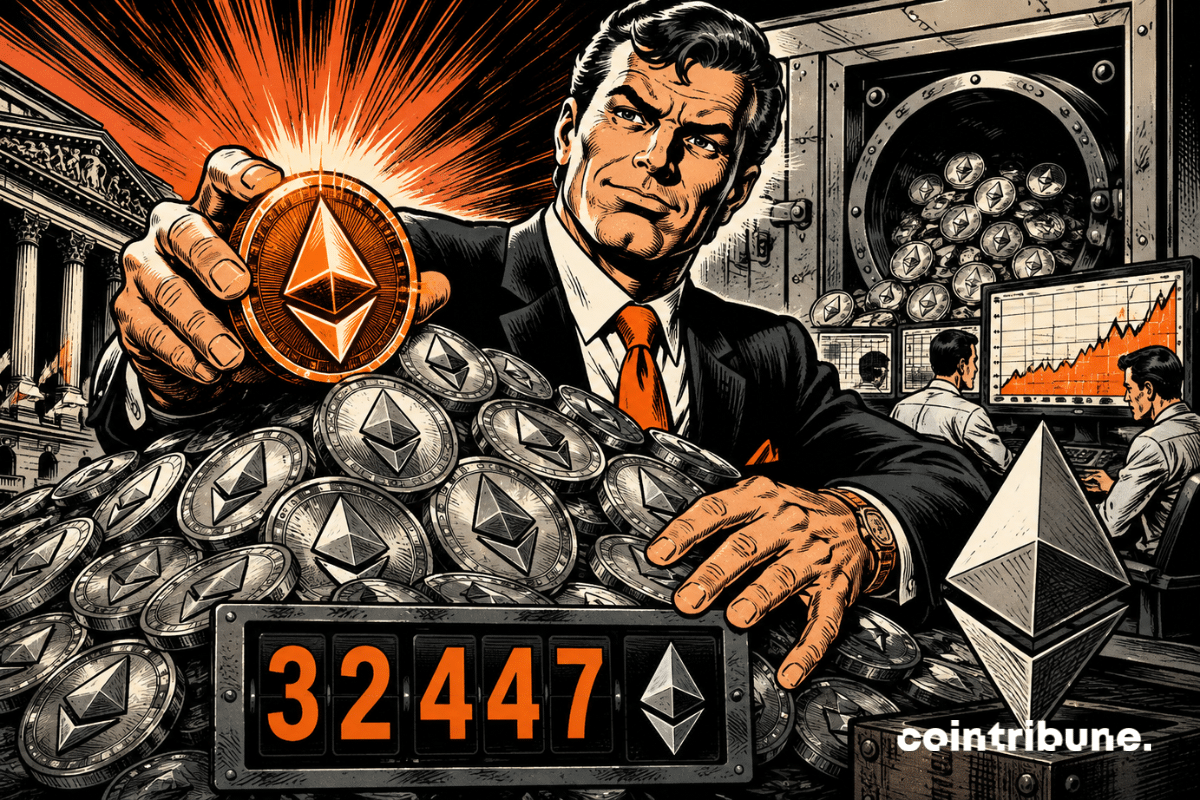
BitMine continues its accumulation strategy and hits a new milestone on Ethereum. The company announced holding 5.79 million ETH, about 4.8% of the total cryptocurrency supply. This increase follows a new purchase completed during the past week. At the same time, a large part of its assets already participates in staking, while the group strengthens its position among the largest institutional holders of publicly traded digital assets.
Is Ethereum just going through a simple consolidation phase or have investors already turned the page? While the crypto market watches for the slightest sign of a rebound, prediction platforms like Polymarket display a pessimism rarely seen towards the sector's second largest capitalization. Having returned around 1,880 dollars after a brief passage above 1,950 dollars, ETH remains above its late June low at 1,510 dollars, without convincing. This gap between a still solid network and a degraded market sentiment raises the question: how far can distrust go?
After weeks of continuous inflows, capital is beginning to leave American spot ETFs dedicated to cryptos. This reversal, observed at the end of July, marks a break in the momentum that had been supporting the market for several weeks. Far more than a simple flow indicator, these funds have become the main barometer of institutional demand. Their move into the red could reveal a change of mood on Wall Street regarding Bitcoin, Ethereum, and more broadly, the entire crypto market.
The US spot Bitcoin and Ethereum ETFs recorded a combined net outflow of $310.62 million on July 24, 2026, according to data compiled by SoSoValue. This slowdown marks the end of a relatively calm period for crypto-listed products. The reversal mainly affects Ethereum funds, which had seen five consecutive days of inflows.
Ethereum reserves on exchange platforms continue to shrink, while an increasing portion of the supply remains locked in staking. This dual dynamic progressively tightens the liquidity available in the market and strengthens the scenario of a supply squeeze, a supply shock likely to impact price formation. While ETH tries to maintain around $1,900, on-chain data reveals a fundamental evolution that could redefine the balance between buyers and sellers in the coming weeks.
Tom Lee, the head of research at Fundstrat, believes that AI-related capital is shifting towards Ethereum rather than memory chip manufacturers. Over one month, ETH gained 24% while the Roundhill Memory ETF, or DRAM, fell by 38%.
Ethereum has just regained a level of dominance it had not reached for months. By crossing the 10% threshold of the total market capitalization again, the second largest global crypto records a surge that exceeds that of the ten largest assets over a week. This comeback reignites speculations about a new bullish phase, especially since no major event seems, at first glance, to explain such a movement.
Russia is about to adopt a major crypto law. The reform includes licenses, investment caps, and an unprecedented framework.
Are retail investors shunning crypto? Key data reveal a critical drop in activity on social networks. All details here!
BlackRock approaches 3 billion dollars of tokenized blockchain assets. The financial giant now manages 2.93 billion dollars onchain, with Ethereum leading at 1.1 billion. This milestone confirms that institutional crypto is no longer limited to bitcoin ETFs: it is also settling into money market funds, Treasury bonds, and liquidity management.
Bitcoin sees its dominance challenged by Ethereum on a closely watched indicator: the ETH/BTC ratio. Rising to 0.02858 BTC, Ethereum breaks a resistance of several weeks. For Tom Lee, this movement may signal a return of altcoins. But the signal remains fragile, as bitcoin still holds the psychological advantage in the market.
A Cambridge study reveals that Ethereum consumes less energy per dollar of market capitalization than Solana. Data 2026 decryption.
By 2040, will AI save us or destroy us? The alarm is set off by Vitalik Buterin. Could Ethereum be our last line of defense against an uncontrollable superintelligence in the midst of apocalyptic scenarios and decentralized hopes?
The cryptocurrency market has experienced mixed developments in recent days, but Ether stood out with a 3% increase between Thursday and Friday. This rise occurs in a context marked by the growth of tokenization, the successful launch of Robinhood Chain, and continued purchases by several companies. Despite this favorable dynamic, surpassing the 1,800-dollar threshold remains out of reach. On-chain data and indicators from derivative markets still show signs of weakness, limiting short-term growth potential.
The Ethereum network continues to evolve, but its geographical distribution remains a subject of monitoring for researchers. A new study from the Cambridge Center for Alternative Finance shows that a significant share of nodes operates in North America and Europe. This snapshot of the network highlights several technical and legal issues. It also reminds us that the location of infrastructures can influence the protocol's resilience. The updated data finally sheds new light on the network's energy consumption after the merge.
Spot Bitcoin ETFs garnered nearly 200 million dollars of net inflows last week, ending eight consecutive weeks of withdrawals. Bitcoin crosses the 64,000-dollar mark, driven by this renewed institutional appetite. Is the negative streak finally coming to an end?
The market for investment products related to cryptocurrencies continues to evolve as issuers adjust their strategies. This time, VanEck has modified the registration documents of its spot Ethereum ETF, a change that occurs as competition intensifies among asset managers. While this update does not call into question the launch of the funds, it brings a new element into a competition where costs, capital flows, and investor choices become determining factors. This development thus deserves careful reading in the current context.
The Ethereum Foundation is shifting paradigms and automating its cyber defense. Its « Protocol Security » unit now deploys swarms of autonomous AI agents to continuously attack its own network. The goal is to track, exploit, and fix vulnerabilities before hackers do. This initiative, revealed by the protocol's security team, marks a major technological breakthrough at a time when the slightest flaw in a smart contract can lead to losses of hundreds of millions of dollars.
After several weeks marked by high volatility, Ethereum shows signs of recovery that revive investors' expectations. The second most important cryptocurrency has rebounded from its low recorded in June and again attracts analysts' attention. Several technical indicators and the growing interest of institutional players support a favorable short-term scenario. However, some signals still call for caution, as the market remains divided between the prospect of a new rise and the risk of a temporary pullback.
The stablecoin market is split into two distinct uses of USDT and USDC according to Dune Analytics. Complete breakdown here!
While capital is fleeing Bitcoin and Ethereum ETFs at an unprecedented rate, another player is attracting attention. Hyperliquid's HYPE token continues to evolve at the top of its valuation, contrary to a crypto market under pressure. This divergence reveals a deeper shift. In an environment where speculative liquidity fades, protocols capable of generating real economic activity begin to break free from traditional cycles. Hyperliquid today stands as the most significant embodiment of this mutation.
With a new purchase of $74M, BitMine strengthens its Ethereum treasury. Comprehensive analysis of a major institutional strategy.
Ethereum changes course: Vitalik Buterin unveils a roadmap focused on quantum resistance. Read our full analysis.
Solana has lost 68% of its validators in three years, dropping from around 2,500 to about 800 after a purge launched in 2025. Joseph Chalom, co-CEO of Sharplink and former BlackRock executive, contrasts this decline with Ethereum's over 900,000 validators. This battle of figures reignites the debate on the true decentralization of major blockchains. Will institutional investors decide in favor of robustness over speed?
The historic volatility of cryptos once again reminded market operators that short-term certainties do not exist in this universe. This Thursday, July 2, the ecosystem recorded a technical reversal, inflicting dry financial losses on investors positioned short. Indeed, this sudden surge, occurring after several days of bearish pressure, redefines the short-term price dynamics for the main market assets. Understanding the mechanisms of such a purge is essential today, as it illustrates the extreme sensitivity of the crypto market to leverage effects and global macroeconomic indicators.
The crypto ecosystem is trying to regain momentum as the second largest market asset goes through a zone of strong structural and narrative turbulence that calls into question the very foundations of its valuation. There is indeed a blatant gap between the record technical use of the Ethereum blockchain and the prolonged stagnation of its price, still unable to sustainably settle above past historical highs. This situation, exacerbated by internal strategic moves and major restructurings, places the network at the center of all attention.
The digital asset market is attracting new attention following the publication of a US financial disclosure linked to Donald Trump's interests. The document reveals the scale of revenues from crypto, with a significant focus on cryptocurrencies, token sales, and blockchain-related projects. Among the declared assets are Bitcoin and Ethereum, two major sector references. This publication comes as the links between politics, regulation, and the crypto industry are gaining increasing importance in the United States.