Vitalik Buterin Challenges Ethereum's Ultrasound Money Idea
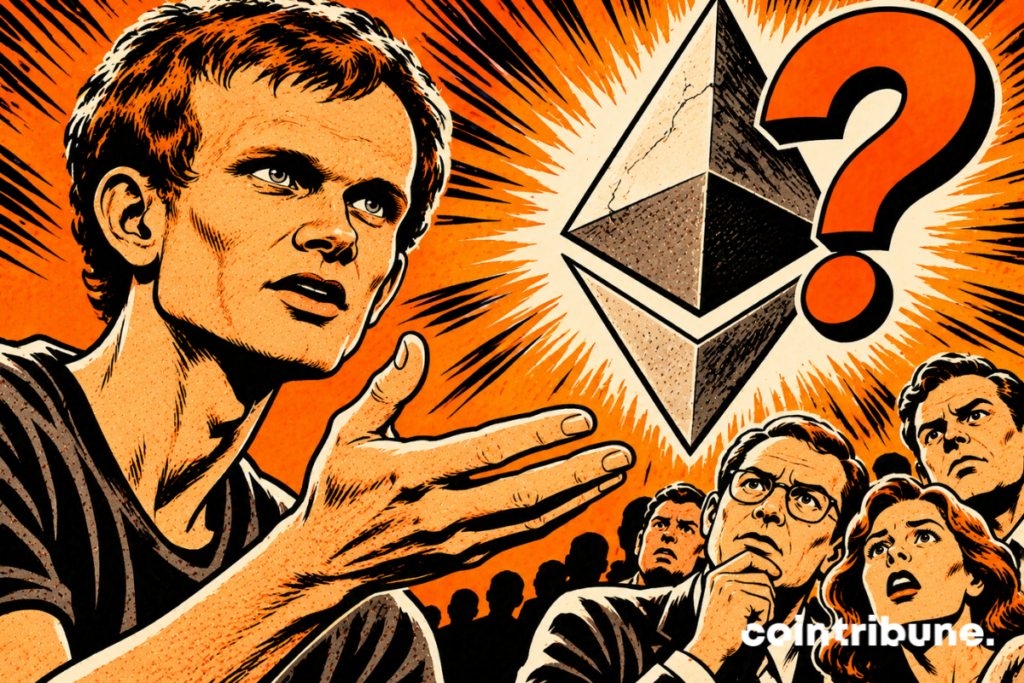
Vitalik Buterin no longer wants the value of ETH to depend mainly on the fees burned by Ethereum. His reasoning resolves a contradiction that has become central : the network cannot simultaneously make its transactions cheaper and rely on high fees to support the token’s scarcity.
In brief
- Vitalik Buterin believes that the value of ETH should no longer depend mainly on the fees burned on Ethereum.
- He favors a vision of ETH as a store of value, based on the security and resilience of the network.
- The decrease in transaction fees and the rise of layer 2 solutions significantly reduce ETH burn.
- According to Buterin, maintaining high fees to make ETH rarer would penalize users and slow Ethereum adoption.
- The long-term value of ETH should rely more on trust, decentralization, and the network’s ability to withstand crises.
Ethereum abandons making fees its main argument
Since the introduction of EIP-1559 in 2021, a portion of the fees paid on Ethereum is permanently burned. This mechanism fueled the thesis of “the ultrasound money”. When burns exceed the emissions paid to validators, the supply of ETH decreases.
Vitalik Buterin now believes this mechanism should no longer be the core of the token’s valuation. He summarizes his position as follows: “ETH as a store of value makes much more sense than ETH considered as an asset whose value depends on burned fees.”
His argument is based on several observations :
- The burn peaks mainly came from speculative activities internal to crypto ;
- These revenues would have decreased alongside the price of ETH during a crisis ;
- Layer 2 networks sustainably reduce the fees paid on the main chain ;
- Maximizing burn would incentivize Ethereum to maintain costly transactions.
Buterin does not propose removing EIP-1559. “We should keep it,” he specifies, adding that holders should not worry if burns remain sustainably below 10% of the level necessary to offset new emissions.
The evolution is already visible. Ethereum burned about 1.48 million ETH in 2022, compared to only 19,200 ETH since the beginning of 2026 at the time of the source article’s publication. This drop notably reflects the shift of some activity to less costly layer 2 solutions.
High fees would eventually penalize Ethereum
The new doctrine defended by Buterin breaks the artificial link between the interests of users and those of ETH holders. If the token’s value depends primarily on burned fees, every decrease in transaction costs becomes negative for investors, even when it improves the network experience.
Conversely, seeking more burn would mean encouraging high fees. Such a strategy could exclude individuals as well as users who most need private and censorship-resistant transactions.
Buterin also contests the idea that burns would create a true valuation floor. He cites the theoretical example of a token burning one billion dollars per year: with a 4% discount rate, this income could justify a 25 billion dollar market cap. But this calculation only works if revenues remain stable when the market falls.
However, much of the record fees recorded between 2021 and 2023 came from NFTs and speculation. The sale of Otherdeed virtual lands alone caused approximately 180 million dollars of burns in one day. The NFTs involved now trade far below their initial level, illustrating the unstable nature of this revenue source.
Turning Ethereum into a fee machine would also require more interventionist governance. Buterin estimates a network run like a large company would need to massively fund its development. He mentions about 700,000 ETH in annual protocol-integrated expenses, which could reduce validators’ revenues by two-thirds.
The value of ETH would depend first on its ability to survive
The new narrative proposed by Buterin relies less on mechanical scarcity and more on infrastructure strength. According to him, the first quality of a store of value is its ability to survive technical, political, and economic crises.
Ethereum should therefore prioritize decentralization, security, privacy, code openness, and censorship resistance. Buterin groups these properties under the acronym CROPS. “In the era of AI-driven upheavals, stability will be highly valued,” he asserts.
This orientation justifies research on quantum resistance, multisignature wallets, privacy tools, and mechanisms preventing arbitrary exclusion of transactions. It also encourages a more cautious protocol evolution, with fewer changes likely to increase its complexity.
Tokenized assets may strengthen this thesis without causing a fee explosion. Their presence on Ethereum expands the use of ETH as collateral and settlement asset, while bringing activity more stable than speculative waves related to NFTs.
However, Buterin does not guarantee that ETH will become a store of value comparable to bitcoin. He rather redefines the criterion to watch: less the volume of tokens burned than Ethereum’s capacity to remain neutral, secure, and usable over several decades. The price of ETH would then no longer be the result of the cost imposed on users but that of the trust granted to the network.
Maximize your Cointribune experience with our "Read to Earn" program! For every article you read, earn points and access exclusive rewards. Sign up now and start earning benefits.

Diplômé de Sciences Po Toulouse et titulaire d'une certification consultant blockchain délivrée par Alyra, j'ai rejoint l'aventure Cointribune en 2019. Convaincu du potentiel de la blockchain pour transformer de nombreux secteurs de l'économie, j'ai pris l'engagement de sensibiliser et d'informer le grand public sur cet écosystème en constante évolution. Mon objectif est de permettre à chacun de mieux comprendre la blockchain et de saisir les opportunités qu'elle offre. Je m'efforce chaque jour de fournir une analyse objective de l'actualité, de décrypter les tendances du marché, de relayer les dernières innovations technologiques et de mettre en perspective les enjeux économiques et sociétaux de cette révolution en marche.
The views, thoughts, and opinions expressed in this article belong solely to the author, and should not be taken as investment advice. Do your own research before taking any investment decisions.