Gold Drops Below $3,900 After A Historic October
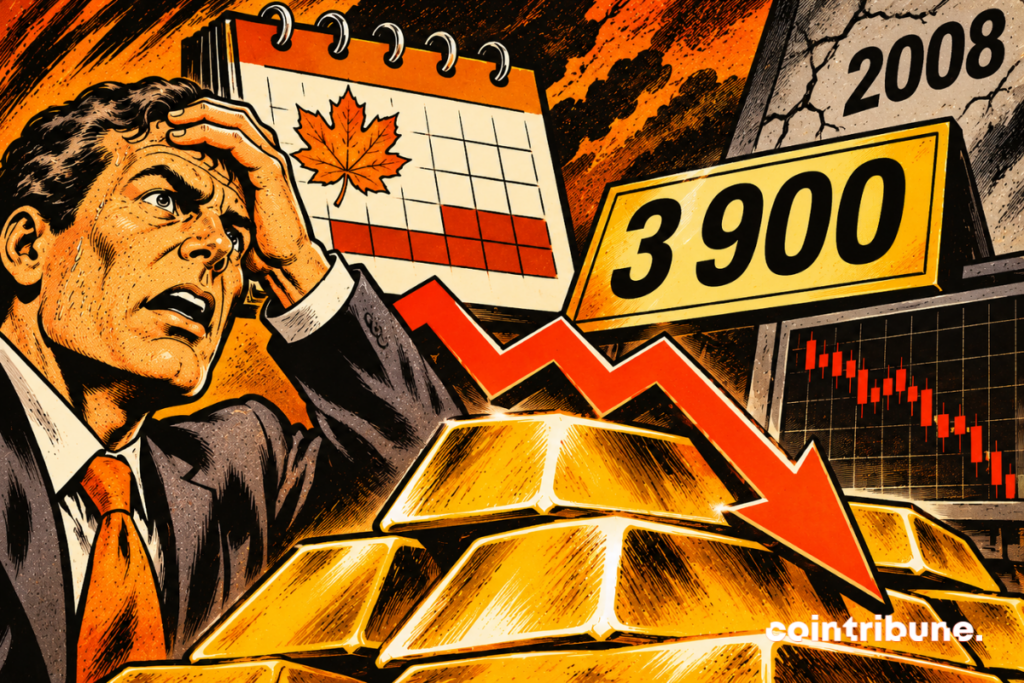
Gold closed October around 3875 dollars an ounce after its worst October since the 2008 financial crisis. This drop does not necessarily mean that the metal has lost its safe-haven status: it mainly shows that long-term protection can sharply decline when investors seek immediate liquidity.
In brief
- Gold lost nearly 7% in October, marking its worst October since 2008.
- The fall of the yellow metal especially weakens investors who bought recently.
- ETF sales, rising interest rates, and the strength of the dollar increase pressure on prices.
- Despite this correction, gold retains its role as a long-term safe haven.
- A return above 4000 dollars could signal market stabilization.
Gold’s fall mainly traps recent buyers
Gold lost nearly 6.9% in October, after a 6.6% drop in September. Futures started the month around 4190 dollars, reached a high near 4259 dollars on October 2, then ended below 3900 dollars. More than 80% of the monthly decline occurred during the last eight sessions.
The session of October 30 particularly weakened the market. The metal dropped about 3.6% and broke several technical thresholds, including 3970 dollars. It also closed below its October 2025 low, around 3886 dollars.
Several factors explain why this correction could still weigh on prices :
- Investors have added about 150 tonnes of gold to ETFs since July ;
- A large portion of these purchases is now at a loss ;
- Hedge funds have reduced their long positions for nine consecutive weeks ;
- Only 10% of gold mining groups trade above their 200-day moving average ;
- The return above 4000 dollars would be a first sign of stabilization.
Ole Hansen, head of commodity strategy at Saxo Bank, estimates:
Short-term selling pressure tests long-term convictions.
Recent buyers now represent the main risk: a further drop could push them to sell to limit their losses.
The correction could thus become self-reinforcing, even without further deterioration of fundamentals. ETF outflows would push prices down, trigger new technical sales, and further increase the number of investors at a loss.
A safe haven does not protect against all shocks
The simultaneous fall of gold, tech stocks, and bitcoin may seem contradictory. In times of stress, the yellow metal is generally sought for its stability and lack of credit risk. But this function does not guarantee an immediate rise in every crisis.
When margin calls increase, investors must quickly find liquidity. They then do not sell only assets they consider fragile, but also those with a still deep market. Commentator Prem Soni sums up this mechanism: “when you are over-leveraged and have no cash, you do not sell what you want to sell. You sell what you can sell”.
The current environment adds a second difficulty. Since the beginning of the Iran conflict, Brent oil has gained about 10%, while gold has lost nearly 4%, according to economist Robin Brooks. Rising energy prices sustain inflation and increase the possibility of further rate hikes in the US.
However, gold pays no interest. Sustained high bond yields thus increase its opportunity cost. The strong dollar exerts additional pressure on buyers using other currencies.
This situation does not, however, eliminate the strategic role of the metal. Central banks continue to buy it to diversify their reserves, while physical demand in India and China remains an important support. A survey of 30 analysts and traders places the median price forecast at 4495 dollars in 2026 and 4650 dollars in 2027.
Gold thus appears less as insurance against every down day than as a hedge against monetary erosion, budget risks, and currency depreciation over several years.
US data will decide the next move
The first week of November could determine whether October’s drop marks a temporary capitulation or the start of a deeper correction. Investors will monitor notably US ISM indices, midterm elections, and the employment report expected on November 6.
Job creations and wages above forecasts would strengthen the high rate scenario. This outlook could support the dollar and keep gold under pressure. Conversely, a clear slowdown in the labor market would reduce expectations of monetary tightening and renew interest in the metal.
Technically, a sustained return above 4000 dollars would ease selling pressure. As long as this threshold is not regained, investors will remain exposed to new sell-offs, especially among ETF holders who recently entered the market.
The October drop does not thus announce the end of gold as a safe haven. It rather reminds us that a wealth insurance can itself become a temporary source of liquidity when all markets fall simultaneously.
Maximize your Cointribune experience with our "Read to Earn" program! For every article you read, earn points and access exclusive rewards. Sign up now and start earning benefits.

Diplômé de Sciences Po Toulouse et titulaire d'une certification consultant blockchain délivrée par Alyra, j'ai rejoint l'aventure Cointribune en 2019. Convaincu du potentiel de la blockchain pour transformer de nombreux secteurs de l'économie, j'ai pris l'engagement de sensibiliser et d'informer le grand public sur cet écosystème en constante évolution. Mon objectif est de permettre à chacun de mieux comprendre la blockchain et de saisir les opportunités qu'elle offre. Je m'efforce chaque jour de fournir une analyse objective de l'actualité, de décrypter les tendances du marché, de relayer les dernières innovations technologiques et de mettre en perspective les enjeux économiques et sociétaux de cette révolution en marche.
The views, thoughts, and opinions expressed in this article belong solely to the author, and should not be taken as investment advice. Do your own research before taking any investment decisions.