Bolivia Abandons the US Dollar, Bitcoin Emerges as an Alternative
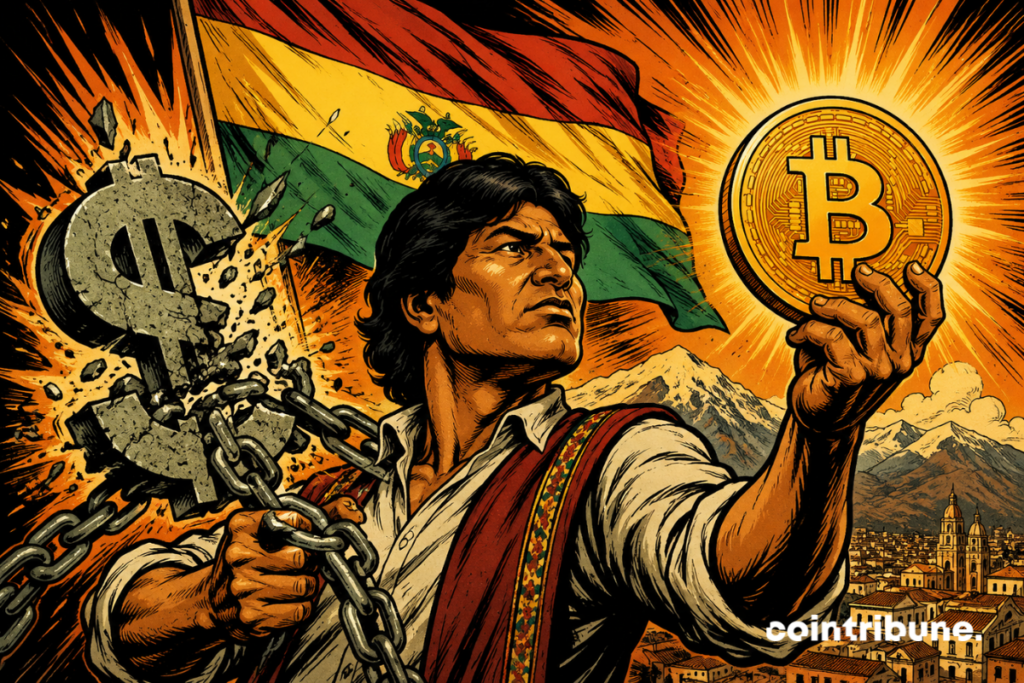
Bolivia changes its monetary strategy after fifteen years of artificial stability. The country abandons its fixed peg to the dollar due to the decline of its reserves and economic pressure. This decision also revives the debate around financial alternatives like Bitcoin, as cryptocurrencies advance in economies facing currency tensions. The new exchange rate regime marks a new stage for the boliviano and transforms the country’s monetary environment.
In Brief
- Bolivia abandons its fixed peg to the Dollar after fifteen years to adopt a flexible exchange rate regime due to the exhaustion of its reserves.
- The end of monetary control occurs as the gap between the official rate and the parallel market Dollar rate has widened significantly.
- The lifting of restrictions on cryptocurrencies in 2024 caused a strong rise in trading volumes and accelerated the adoption of stablecoins in the country.
- Bolivian banks are beginning to integrate services related to digital assets, notably USDT, amid financial transformation.
- Facing currency tensions, Bitcoin appears as a strategic reserve considered by several states and could be a diversification path for Bolivia.
Bolivia Abandons Its Dollar Peg After Fifteen Years of Control
The US dollar just took another hard hit in Bolivia, where it played a central role in the fixed exchange system established since 2011. The country has just ended this system. The Minister of Economy José Gabriel Espinoza announced in a press release the abandonment of the official rate of about 6.96 bolivianos per US dollar. The country now adopts a flexible floating exchange rate regime, with a rate determined by market forces. This decision comes as the old mechanism no longer reflected the economic reality.
Before this announcement, the Central Bank’s reference rate had already exceeded 10 bolivianos per dollar. The gap between the official exchange rate and the parallel market had significantly increased, reaching about 12.9 to 13.1 bolivianos per dollar by late 2025. The old monetary system could no longer maintain sustainable stability. The government chose a new approach to address accumulated imbalances.
The fixed exchange rate regime worked when Bolivia had enough reserves to support its currency. In 2014, foreign exchange reserves exceeded 15 billion dollars, giving the central bank the means to defend the official rate. Since then, reserves have sharply decreased, reducing their intervention capacity. Rising budget deficits also made maintaining this model increasingly difficult.
The shift to a flexible system is part of a broader economic stabilization strategy. This evolution could also accompany new dealings with international financial institutions. For Bolivian authorities, the goal is to restore a balance between the official market and economic reality. This transformation also opens a new chapter for alternative monetary solutions.
The Rise of Cryptocurrencies Accelerates in the Country
For ten years, Bolivia had banned virtual assets on its territory. The situation changed in June 2024, when the central bank lifted restrictions with resolution no. 082/2024 from its board. This opening quickly changed the local financial landscape. Users began exploring cryptocurrencies more as a tool for protection against monetary tensions.
Transaction volumes via official channels rose from 46.5 million dollars in the first half of 2024 to 294 million dollars in the first half of 2025. This increase represents a rise of over 530% in one year. The Bolivian crypto market thus developed a new dynamic after the end of restrictions. Local players gradually adopted new digital uses.
In April 2026, three Bolivian banks already offered services related to USDT. This evolution shows that stablecoins now hold an important place in the national financial ecosystem. Bolivia’s central bank also signed a memorandum of understanding with El Salvador’s National Digital Assets Commission in 2025. The country thus seeks to better understand opportunities related to digital assets.
The disappearance of the fixed rate could, however, change the demand for cryptocurrencies. If citizens can access foreign currencies at market price via official channels, the use of certain stablecoins as protection against dollar shortages could evolve. However, the infrastructure built in recent years remains in place. Users now have digital wallets and master virtual asset transactions.
This situation shows that monetary crises can accelerate stablecoin adoption. Bolivia thus becomes a case observed by crypto market players. Investors now monitor volume evolution after the exchange regime reform. Continued institutional demand around USDT could confirm the lasting establishment of cryptocurrencies in the local financial system.
And Why Not Bitcoin as a New Strategic Reserve?
Beyond stablecoins, Bitcoin appears as a monetary alternative used by several states seeking to diversify their reserves. Unlike traditional currencies, its supply is limited to 21 million units. This characteristic makes it a digital asset considered by some governments as a long-term store of value. Its decentralized operation represents a major difference from currencies controlled by central banks.
The United States has integrated Bitcoin into its strategic thinking around national digital asset reserves. This approach is based on the idea that an asset independent from the classic monetary system can strengthen a country’s financial diversification. El Salvador has also placed Bitcoin at the core of its monetary policy since its official adoption. The country continues accumulating Bitcoin reserves totaling 7,696.37 BTC in a logic of financial sovereignty despite IMF pressures.
Bhutan is also among the countries that have developed significant exposure to Bitcoin. Thanks to its energy resources, the country has participated in the development of Bitcoin mining and holds this digital asset in its reserves. This strategy shows that some states now consider Bitcoin a new financial instrument on the same level as certain traditional reserves. The objective is to have an alternative asset in the face of global economic uncertainty.
In this context, Bolivia could also consider Bitcoin as a complementary tool to strengthen the diversification of its reserves. After abandoning its dollar peg and facing difficulties in maintaining sufficient foreign currency levels, the country has an opportunity to explore new financial mechanisms. A Bitcoin reserve would not replace traditional currencies but could offer additional protection against tensions on international markets.
For Bolivia, progressively integrating Bitcoin into a national strategy could represent a new step in modernizing its financial system. The experience of other countries shows that a digital asset can become a diversification instrument when framed by a clear policy. As the country seeks to restore economic stability, BTC could become an additional component of its strategic reserves alongside traditional assets.
Maximize your Cointribune experience with our "Read to Earn" program! For every article you read, earn points and access exclusive rewards. Sign up now and start earning benefits.

Journaliste et rédacteur web passionné par l’univers des cryptomonnaies et des technologies Web3. J’y traite les dernières tendances et actualités afin de proposer un contenu de haute qualité à un large public du secteur.
The views, thoughts, and opinions expressed in this article belong solely to the author, and should not be taken as investment advice. Do your own research before taking any investment decisions.