The CME finally opens its bitcoin shop without closing on weekends, depriving traders of an old graphical talisman. The gaps become fossils, but Wall Street still keeps its administrative slippers.
The White House opens a new regulatory phase around prediction markets. Donald Trump clearly supports the CFTC, while several American states want to keep their control power over these sensitive contracts.
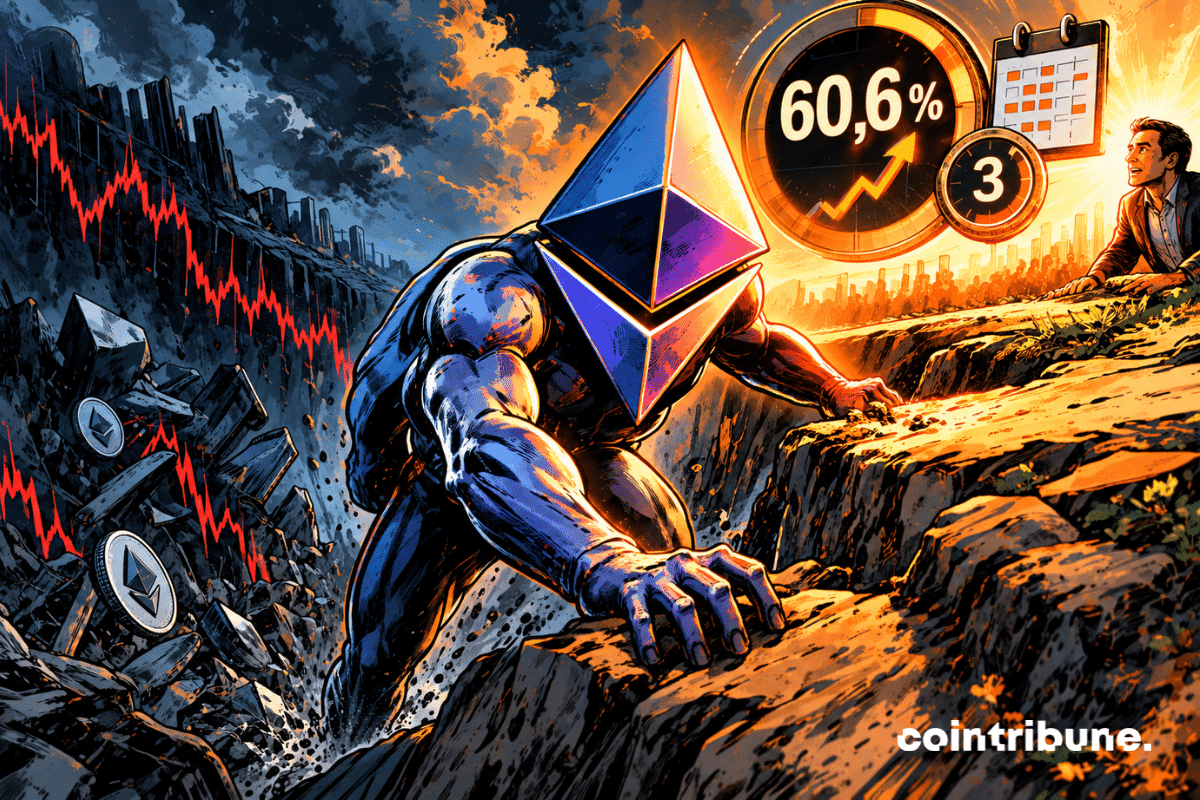
The cryptocurrency market continues to undergo strong turbulence, and Ether is no exception. Since its historic peak reached in August, the second-largest digital asset has dropped nearly 59%. Exchange-traded products linked to Ethereum are also experiencing a series of significant withdrawals, increasing investor concerns and sparking new speculation about the price trajectory in the coming months.
The BIS's Agorá project has reached a decisive stage. After months of simulations, its members are moving to real value transactions to test the tokenization of central bank reserves and commercial bank deposits. Seven central banks and over 40 private financial institutions are participating in the initiative.
Former bitcoin holders are regaining control of the market. While BTC trades below 75,000 dollars, several wallets inactive for years have just moved millions of dollars, some of which to Coinbase. These movements, rare and closely monitored in the crypto ecosystem, rekindle speculation about possible profit-taking by the network's first whales.
XRP is going through a phase of extreme tension. According to Santiment data, active wallets over the last thirty days show an average loss of 47%, a level associated with market capitulation periods. This persistent weakness contrasts with the activity of the XRP Ledger and Ripple’s continuous progress on the institutional front. Such a discrepancy reignites doubts about XRP's ability to regain a sustainable bullish momentum.
Bitcoin just dropped out of the top 10 largest global assets. While AI and semiconductors soar, the crypto market goes through a new turbulence zone. We explain everything!
More than 207 billion SHIB have left the exchange platforms in 24 hours, according to CryptoQuant data. This movement comes as the token price remains stuck below $0.0000054, in a market under strong selling pressure. Does this decoupling between on-chain activity and price evolution signal a reversal?
Bitcoin miners' stocks are rising because the market no longer sees them only as BTC producers. It now values them as holders of electricity, land, data centers, and capacities useful to artificial intelligence. This change explains the recent interest around TeraWulf, Hut 8, IREN, or Riot Platforms, in a context where Wall Street remains driven by AI and semiconductors.
HYPE climbs like a hurried candidate to the upscale neighborhoods of the market, while Hyperliquid cashes in on ETFs and XXL bets. The cautious are already counting possible bumps.
For a long time, accumulating ether was enough to drive up crypto companies' valuations. However, this model now shows its limits. Despite billions of dollars in ETH reserves, several publicly traded companies report massive losses, according to an Everstake study. In a market now dominated by Ethereum spot ETFs, investors expect more than mere price exposure. Staking and revenues generated by blockchain infrastructure become the new key criteria. Ethereum is thus beginning a major transformation, shifting from a speculative asset to a true yield engine.
The crypto market is closely watching Bitmine's new massive purchase. The publicly traded company added nearly $237 million in Ether to its balance sheet as the price of Ethereum remains under pressure. This operation marks its largest ETH purchase in 2026 and brings the company closer to its strategic holding goal.
Intentionally destroying more than 8 million dollars in bitcoin remains a very rare act, even in a market accustomed to excesses. However, an unknown user has just sent 107 BTC to one of the most famous and irrecoverable addresses in the Bitcoin network. Behind this mysterious operation, on-chain analysts and historical figures in the ecosystem are now trying to understand whether it is a simple symbolic burn, an ideological message, or an experiment related to future quantum threats that already worry some industry experts.
It's no longer a project, it's official: Tether is partnering directly with the government of Georgia to launch GELT, a state crypto stablecoin backed by the Lari. Failure or stroke of genius? Details here!
Pi Coin dangerously returns to its lows. Weakened by a continuous decline in investor interest, the Pi Network token now trades near the 0.13 dollar threshold. At the same time, several market indicators signal a deterioration of momentum, including technical weakness, a decline in social activity, and a gradual withdrawal of speculative capital.
BlackRock sold 1.01 billion dollars worth of bitcoin via IBIT in five sessions, but this move does not necessarily mean that the American giant is turning its back on BTC. It mainly reveals a wave of buybacks by investors in its spot ETF, at a time when former remarks by Larry Fink on cryptos are resurfacing and clouding the market reading.
Flows change direction in the crypto market. This week, Bitcoin and Ethereum ETFs recorded significant capital outflows, while funds related to XRP, Solana, and HYPE attracted new investments. Behind these movements is a gradual rotation of institutional investors, who now seem to seek more exposure to altcoins than to the market's dominant assets.
Thunderbolt on Ethereum! A whale just opened a massive $100M short on Hyperliquid with an XXL 23x leverage. While Vitalik Buterin promises to sell less, this trader goes all in. Genius or financial suicide? We analyze this move shaking the crypto market.
Artificial intelligence no longer just responds, writes, or analyzes. It also starts to pay. And in this new economy driven by autonomous agents, crypto establishes itself as an almost natural infrastructure. According to Keyrock, these agents settled over 73 million dollars on 176 million transactions between May 2025 and April 2026. A signal still discreet, but impossible to ignore.
Bitget has opened a new route into the SpaceX IPO narrative with SPCXUSDT, a pre-IPO perpetual contract designed for traders seeking early exposure to one of the most watched private companies in the world. The move does not give users actual SpaceX shares. It gives them a market instrument tied to expectations around a possible public listing, price discovery, and future valuation scenarios.
American spot Bitcoin ETFs are experiencing their largest series of outflows since the beginning of the year. In six sessions, more than $1.55 billion have left these funds, greatly reducing their net flows for 2026. This reversal comes as several major Wall Street players are already reducing their exposure to bitcoin, a signal closely watched by the crypto market.
Memecoins continue to correct, and the signal becomes clearer. Dogecoin, Shiba Inu, and Pepe no longer benefit from the same speculative appetite. The decline remains contained, but it weakens technical supports closely watched by traders.
The price of the crypto SOL collapsed by 33% in the first quarter of 2026. Yet, behind this brutal decline, the Solana network has never been so active. How to explain this paradox?
The market for bitcoin-backed credit could undergo a major scale change in the coming years. According to a report shared by Ledn, this still marginal segment today could reach $1 trillion in the long term. A projection that comes as the crypto industry is still trying to move past the 2022 bankruptcies and the shock caused by Celsius, Voyager, or BlockFi.
Michael Saylor's latest statement revives questions around Strategy's treasury. On May 24, 2026, the executive chairman indicated that the company had bought bonds, not Bitcoin, during the week. This clarification comes after a strong accumulation of BTC and places debt management at the center of market expectations.
Bitcoin takes the lead again in the crypto market, and Adam Back sees it as a clear signal. The CEO of Blockstream believes that altcoins and memecoins are gradually being brought back to their "real value": zero. A statement that revives the maximalist discourse at a time when BTC outperforms a large part of the market. For Adam Back, this divergence mainly reflects one reality: few cryptos would be able to sustainably retain their value in the face of speculative cycles.
Tom Lee’s Ethereum bet is passing through a zone of strong turbulence. BitMine now shows nearly $7.35 billion in unrealized losses on its ETH wallet, while the crypto market increasingly doubts a quick rebound.
The debate about the role of bitcoin is back in full force. After selling a large part of his BTC, billionaire Mark Cuban believes that the cryptocurrency protects neither against geopolitical crises nor against inflation. A conclusion that Adam Back, a historic figure in the sector and CEO of Blockstream, disputes with data to support it.
Ethereum falls below 2,700 dollars, but the market refuses to give in to panic. With each pullback, buyers return to defend technical levels now closely watched by analysts. This unexpected resistance fuels a central question: is the market quietly preparing for the return of altcoins? Between gradual accumulation, technical consolidation, and renewed trader interest, Ethereum enters a phase where the slightest movement could redefine the crypto market balance in the coming weeks.
The crypto market remains under pressure, but XRP continues to attract attention. Despite a 5.43% drop over the week, withdrawals from exchanges continue. Traders therefore seem to favor accumulation while the price remains fragile. This situation creates a contrast between price weakness and still visible demand.